








By William Schomberg and David Milliken
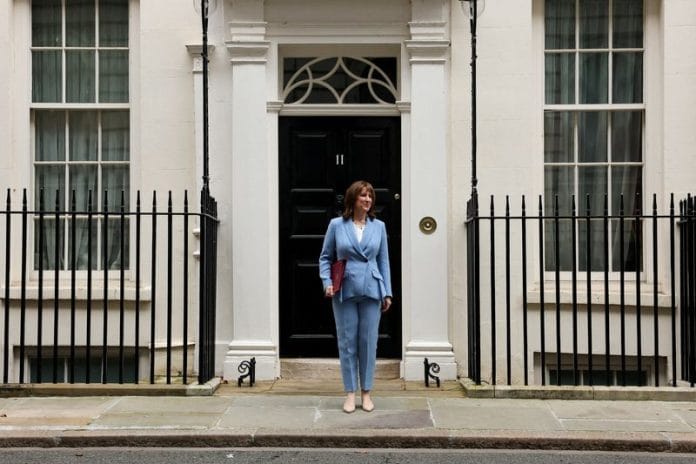
LONDON, March 3 (Reuters) – British finance minister Rachel Reeves said she would provide stability for the economy in a budget update speech on Tuesday that contained no big policy surprises and was overshadowed by alarm among investors over the conflict in the Middle East.
Reeves said fresh forecasts showed inflation and borrowing would be lower than previously thought by Britain’s fiscal watchdog, although its economic growth projection for this year was cut to 1.1% from a previous estimate of 1.4%.
Those forecasts may soon be overtaken by the impact of the U.S.-Israeli war against Iran which has sent British government borrowing costs soaring on worries about the global surge in energy prices.
“This government has the right economic plan for our country, a plan that is even more important in a world that in the last few days has become yet more uncertain,” Reeves said in her speech to parliament.
“It is incumbent on me and on this government to chart a course through that uncertainty, to secure our economy against shocks and protect families from the turbulence that we see beyond our borders.”
PROMISE OF STABILITY IN TURBULENT TIMES
Reeves stressed the need for predictability in government policy as well as investment in infrastructure, accusing the previous Conservative administration of allowing inflation to soar and interest rates to rise to a 15-year high.
“Stability is the single most important precondition for economic growth,” she said.
Reeves is hoping that a period of policymaking stability – after the political turmoil triggered by the Brexit vote 10 years ago – will encourage businesses to invest.
Many employers say higher taxes and other costs imposed on them by Reeves are deterring them from hiring.
In her speech on Tuesday, Reeves said she would set out proposals for closer post-Brexit trade ties with the European Union in the coming weeks and the government would set out reforms for reducing youth unemployment, which has risen sharply.
However, her economic programme could be tested in the coming months if the financial fallout from the conflict in the Middle East is sustained.
Britain still has the highest inflation among the Group of Seven economies, which has prevented the Bank of England from cutting interest rates as quickly as other central banks.
Higher inflation also saddles the government with a bigger bill for its inflation-linked bonds.
Government bond yields surged for a second day in a row earlier on Tuesday as investors worried that a doubling of gas prices, if sustained, might prevent the BoE from cutting borrowing costs this year.
Benchmark wholesale gas prices, which make up the largest single portion of Britain’s domestic energy price cap, have doubled this week, which if sustained could push up the next pricing level for the July-to-September period.
Oil prices have risen 15%, leading to calls from some motoring groups for the government to reverse an end to the fuel duty freeze currently expected in September.
Pressure has grown on Keir Starmer after his Labour Party suffered defeat in an election for a parliamentary seat last week. There are questions about how long Starmer will remain in Downing Street, with local elections in May seen as the next big test of his political future.
But Reeves stuck to her promise not to make major fiscal policy changes outside full budget statements, which take place in the autumn.
The Office for Budget Responsibility’s forecasts showed Reeves had 23.6 billion pounds ($31.4 billion) of so-called headroom for meeting her main fiscal target.
At the time of her last full budget speech in November, that room for manoeuvre was judged to stand at almost 22 billion pounds.
($1 = 0.7510 pounds)
(Additional reporting by Susanna Twidale; Writing by William Schomberg; Editing by Hugh Lawson)
Disclaimer: This report is auto generated from the Reuters news service. ThePrint holds no responsibility for its content.