








By Olena Harmash
KYIV, Feb 4 (Reuters) – Ukrainian and Russian negotiators wrapped up the first day of new U.S.-brokered talks in Abu Dhabi on Wednesday, seeking to advance efforts to end Europe’s biggest conflict since World War Two as fighting raged on.
The two-day trilateral meetings come after Ukraine’s President Volodymyr Zelenskiy said Russia had exploited a U.S.-backed energy truce last week to stockpile munitions, attacking Ukraine with a record number of ballistic missiles on Tuesday.
A source told Reuters on Wednesday evening that talks had ended for the day and would continue on Thursday.
Photographs released earlier in the day by the United Arab Emirates’ foreign ministry showed the three delegations sitting around a U-shaped table, with U.S. officials seated at the centre, including special envoy Steve Witkoff and U.S. President Donald Trump’s son-in-law Jared Kushner.
Before the talks, chief Ukrainian negotiator Rustem Umerov said that teams would meet in separate groups to discuss specific topics and then follow up with a joint meeting to coordinate their positions.
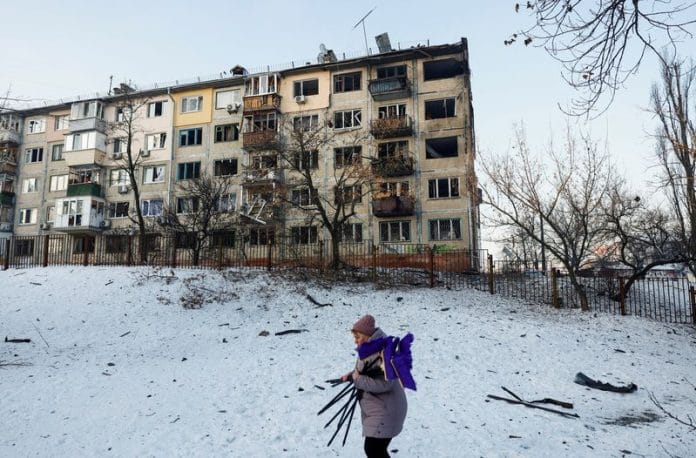
Shortly after talks began, Russian forces struck a crowded market in eastern Ukraine with cluster munitions, killing at least seven people and wounding 15, the Donetsk region’s Governor Vadym Filashkin said.
MAJOR DIFFERENCES REMAIN ON KEY POINTS
Trump’s administration has pushed both Kyiv and Moscow to find a compromise to end the four-year war, but the two sides remain far apart on key points despite several rounds of talks with U.S. officials.
The most sensitive issues are Moscow’s demands that Kyiv give up land it still controls and the fate of the Zaporizhzhia nuclear power plant, Europe’s largest, which sits in a Russian-occupied area.
Moscow wants Kyiv to pull its troops out of all of the Donetsk region, including a belt of heavily fortified cities regarded as one of Ukraine’s strongest defences, as a precondition for any deal.
Ukraine said the conflict should be frozen along the current front line and has rejected any unilateral pullback of its forces.
Kremlin spokesperson Dmitry Peskov said on Wednesday that Russian troops would keep fighting until Kyiv made “decisions” that could bring the war to an end.
Russia currently occupies about 20% of Ukraine’s national territory, including Crimea and parts of the eastern Donbas region seized before the 2022 invasion. Analysts say Russia has gained about 1.5% of Ukrainian territory since early 2024.
“Russia is not winning its war against Ukraine,” Ukraine’s Foreign Minister Andrii Sybiha told online media outlet Liga on Tuesday, arguing that Moscow was paying a heavy price in terms of battlefield casualties and economic harm for small territorial advances.
UKRAINIANS OPPOSE PAINFUL CONCESSIONS
Polls show that the majority of Ukrainians oppose a deal that hands Moscow more land. Kyiv residents told Reuters on Wednesday they were sceptical the new round of talks would bring any major breakthroughs.
“Let’s hope that it will change (something), of course. But I don’t believe it will change anything now,” Serhii, 38, a taxi driver, told Reuters. “We will not give in, and they will not give in either.”
The first round of talks was held in the UAE last month, marking the first direct public negotiations between Moscow and Kyiv.
Chinese President Xi Jinping and Russian President Vladimir Putin hailed their ties during a video call on Wednesday held in the run-up to the fourth anniversary of Moscow’s war in Ukraine.
The Kremlin said Xi – who it said supported this week’s talks – had invited Putin to China in the coming months. Beijing has sought to cast itself as a peacemaker in the war and is a close ally of Moscow, which is increasingly struggling to fund its vast war economy.
A source close to the government told Reuters that Russia’s public deficit could balloon to almost triple the official target by end-2026.
(Reporting by Olena Harmash; Additional reporting by Anna Voitenko and Anna Pruchnicka, Editing by Daniel Flynn and Sharon Singleton)
Disclaimer: This report is auto generated from the Reuters news service. ThePrint holds no responsibility for its content.