








By Trevor Hunnicutt and Xiuhao Chen
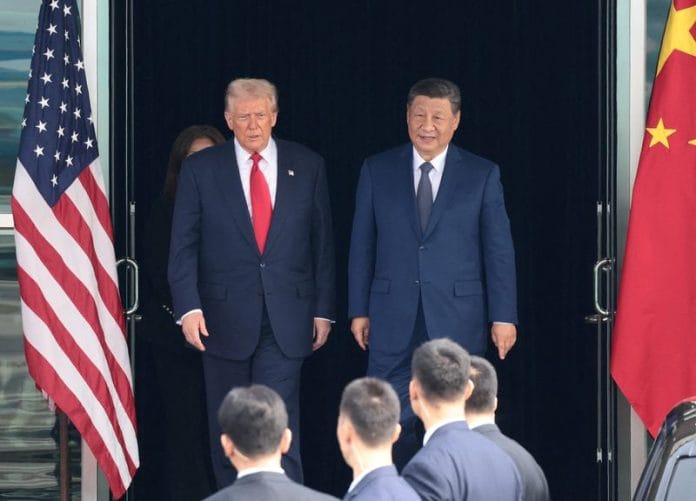
WASHINGTON/BEIJING, Feb 4 (Reuters) – China agreed to buy more U.S.-farmed soybeans in what President Donald Trump called a “very positive” call with President Xi Jinping on Wednesday, even as Beijing warned Washington about arms sales to Taiwan.
In a goodwill gesture two months before Trump’s expected visit to Beijing, Xi agreed to hike soybean purchases from the U.S. to 20 million tons in the current season, up from 12 million tons previously, Trump said. Soybean futures rallied sharply.
Hours after Xi’s virtual meeting with Russian President Vladimir Putin, Xi and Trump discussed Taiwan and a wide range of trade and security issues that remain a source of tension between the world’s biggest economies. Both leaders publicly affirmed their personal stake in strong relations after the call, their first since late November.
“All very positive,” Trump said in a post on his Truth Social platform. “The relationship with China, and my personal relationship with President Xi, is an extremely good one, and we both realize how important it is to keep it that way.”
“I attach great importance to Sino-U.S. relations,” Xi Jinping said, according to an official government account.
“Both sides are signalling that they want to preserve stability in the US-China relationship,” said Bonnie Glaser, head of the Indo-Pacific program at the German Marshall Fund of the United States, a think tank.
Though Trump has tagged China as the reason for several hawkish policy steps from Canada to Greenland and Venezuela, he’s eased policy towards Beijing in the last several months in key areas from tariffs to advanced computer chips and drones.
AREAS OF TENSION AND GOODWILL GESTURES
One key exception is on Taiwan policy. The U.S. announced its largest-ever arms sales deal with Taiwan in December, including $11.1 billion in weapons that could ostensibly be used to defend itself against an attack by Beijing. Taipei expects more such sales.
China views Taiwan as its own territory, a position Taipei rejects. Washington has formal diplomatic ties with Beijing, but maintains unofficial ties with Taiwan and is the island’s most important arms supplier. The U.S. is bound by law to provide Taiwan with the means to defend itself.
“The United States must carefully handle arms sales to Taiwan,” Beijing said in an official summary of the meeting.
The dismissal or investigation into several senior military leaders in China has stirred concern about the implications for Beijing’s foreign policy. But Trump downplayed the investigation into Central Military Commission vice-chairman Zhang Youxia, saying over the weekend that “as far as I’m concerned, there’s one boss in China,” and “that’s President Xi.”
The last nuclear treaty between Russia and the United States is soon to expire, raising the risk of a new arms race in which China will also play a key role with its own growing nuclear stockpile. Trump has said that he wants China to be part of arms control. The Kremlin said it was a topic between Xi and Putin.
SOYBEANS, AIRPLANES AND OIL
Economic issues continue to be a flashpoint between the world’s biggest consumer and its biggest factory. Trump has made tariffs on imports a pillar of his strategy to revive domestic manufacturing jobs. U.S. Vice President JD Vance on Wednesday unveiled plans for a preferential trade bloc of allies for critical minerals, part of an effort to eliminate one key area of leverage that Beijing has over Washington given its control of key metals.
But the two sides are working to find areas of accord heading into an expected April state visit by Trump to Beijing.
Soybeans are a key issue because struggling farmers are a major domestic political constituency for Trump and China is the top consumer. Overseas sales of U.S. soybeans this year slumped to the lowest in 14 years due to trade tensions with China. Benchmark Chicago Board of Trade soybean futures surged more than 3% to a two-month high after Trump’s post.
China’s commerce ministry did not immediately respond to a Reuters request for comment on the soybean purchases Trump announced.
In addition to soybeans, the leaders discussed Iran, Russia’s war in Ukraine, airplane engines and oil and gas, Trump said.
China has been Venezuela’s top oil buyer for years, and the sales helped Caracas repay massive loans to Beijing in debt-for-oil deals.
The Trump administration removed President Nicolas Maduro last month, and it has suggested that China will have to buy Venezuelan oil on the U.S.’s terms.
(Reporting by Trevor Hunnicutt, Xiuhao Chen, Shi Bu, Karl Plume, David Brunnstrom and Ryan Woo, editing by Andrew Heavens, Mark Heinrich, Alex Richardson and Chizu Nomiyama)
Disclaimer: This report is auto generated from the Reuters news service. ThePrint holds no responsibility for its content.