








By Maya Gebeily, Nandita Bose, Parisa Hafezi and Maha El Dahan
BEIRUT/MIAMI/TEL AVIV/DUBAI, March 8 (Reuters) – U.S. President Donald Trump said he is not interested in negotiating with Iran, raising the possibility that the Iran war would only end once Tehran no longer has a functioning military and its leadership is completely wiped out.
Shortly after Trump spoke to reporters aboard Air Force One, U.S. ally Israel announced fresh strikes across Iran early on Sunday, with the war that has brought chaos to the Middle East and roiled global oil markets in its second week.
“At some point, I don’t think there will be anybody left maybe to say, ‘We surrender,'” Trump said.
IRAN PRESIDENT’S APOLOGY CAUSES STIR
Trump has justified the biggest U.S. military operation in the Middle East since the 2003 invasion of Iraq by saying Tehran posed an imminent threat to the United States, without providing evidence.
He has also said Iran was too close to being able to build a nuclear weapon.
The U.S. and Israel have discussed sending special forces into Iran to secure its stockpile of highly enriched uranium at a later stage of the war, Axios reported, citing four people with knowledge of the discussions.
Asked about the possibility of sending ground troops to secure nuclear sites on Saturday, Trump said it was something they could do “later on.”
The governments of Saudi Arabia, Kuwait, the United Arab Emirates and Bahrain reported Iranian drone attacks in their countries on Saturday and early Sunday, with a huge fire engulfing a government office block in Kuwait.
The U.S. embassy in Norway’s capital Oslo was also hit by an explosion early on Sunday, causing minor damage but no injuries, police said. It was not immediately clear what caused the blast or who was involved.
Saudi Arabia has told Tehran that continued Iranian attacks on the kingdom and its energy sector could push Riyadh to respond in kind, people familiar with the matter told Reuters.
In an apparent attempt to cool anger across the Gulf, Iran’s president apologized to neighboring states for its attacks on U.S. facilities in those countries on Saturday.
He dismissed Trump’s earlier demand for the Islamic Republic’s unconditional surrender as “a dream,” but said its temporary leadership council had agreed to suspend attacks on nearby states unless strikes on Iran originated from their territory.
Pezeshkian’s comments caused a political stir in Iran, prompting his office to reiterate Iran’s military would respond firmly to attacks from U.S. bases.
The clerical body charged with choosing Iran’s next supreme leader, to replace Ayatollah Ali Khamenei, slain in an attack last week, could meet as soon as Sunday, Iranian media reported. A majority consensus over a successor has more or less been reached, said Assembly of Experts member Ayatollah Mohammadmehdi Mirbaqeri, according to the Mehr news agency.
ISRAEL WARNS LEBANON TO REIN IN HEZBOLLAH
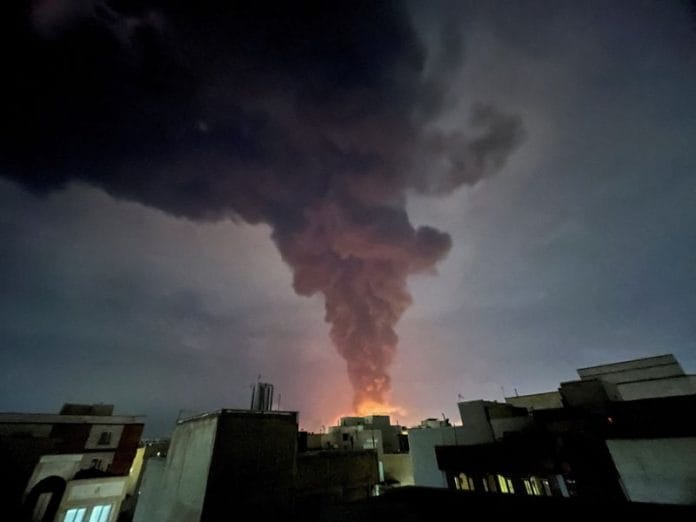
Huge explosions were heard in parts of Tehran, state media reported, while Israel said it had struck Iranian missile sites, command centers and fuel depots on Saturday.
The U.S.-Israeli attacks have killed at least 1,332 Iranian civilians and wounded thousands, according to Iran’s U.N. ambassador, Amir Saeid Iravani.
U.S. forces were likely responsible for an apparent strike on an Iranian girls school that killed scores of children, U.S. officials have told Reuters. But Trump, without citing evidence, told reporters on Saturday that Iran was responsible.
Defense Secretary Pete Hegseth, standing behind Trump aboard Air Force One, said the matter was still under investigation.
Iranian attacks have killed 10 people in Israel. At least six U.S. service members have been killed, with Iran saying on Sunday it had struck U.S. bases in Kuwait.
Israel also launched fresh attacks in Lebanon on Saturday after the Iran-aligned militia Hezbollah fired across the border. Israel warned Lebanon of a “very heavy price” if it did not rein in Hezbollah militants, as the death toll from Israel’s attacks on Lebanon since Monday rose to around 300.
Iran’s apparent strategy of maximum chaos has driven up the costs of the conflict by raising energy prices, hurting global business and logistics links and snarling air travel.
Kuwait’s national oil company began cutting output on Saturday, adding to earlier oil and gas cuts from Iraq and Qatar. Oil prices have hit multi-year highs with the conflict effectively shutting the Strait of Hormuz.
(Reporting by Nandita Bose in Miami, Parisa Hafezi and Maha El Dahan in Dubai, Maya Gebeily in Beirut, Idrees Ali, Mike Stone and Humeyra Pamuk in Washington, Pesha Magid in Jerusalem, Aaron McNicholas and Reuters bureaux; Writing by William Maclean, Matthias Williams, Richard Cowan, Alistair Bell and John Geddie; Editing by Rod Nickel and William Mallard)
Disclaimer: This report is auto generated from the Reuters news service. ThePrint holds no responsibility for its content.