








By Federico Maccioni, Joe Brock and Tim Hepher
DUBAI, March 1 (Reuters) – Global air travel remained heavily disrupted on Sunday as war in Iran kept major Middle Eastern airports including Dubai, the world’s busiest international hub, closed for a second day in one of the sharpest aviation shocks in recent years.
Key transit airports, including Dubai and Abu Dhabi in the UAE and Doha in Qatar, were shut or severely restricted as much of the region’s airspace remained closed after U.S. and Israeli strikes killed Iranian Supreme Leader Ayatollah Ali Khamenei.
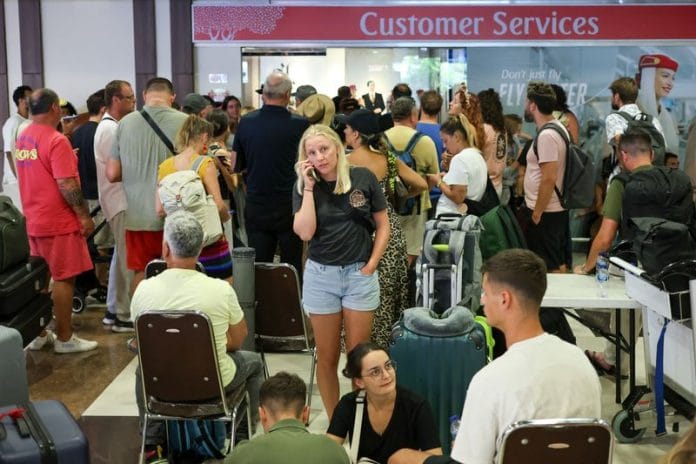
The ripple effects were felt far beyond the Middle East, with tens of thousands of passengers stranded as far as Bali, Kathmandu and Frankfurt.
Israel said it had launched another wave of strikes on Iran on Sunday while loud blasts were heard for a second day near Dubai and over Doha after Iran launched retaliatory air attacks on the neighbouring Gulf states.
Dubai International Airport sustained damage during Iran’s attacks while airports in Abu Dhabi and Kuwait were also hit.
Thousands of flights have been affected across the Middle East, according to data on flight-tracking platform FlightAware.
Emirates, the world’s largest international carrier, said it had suspended all operations to and from its Dubai megahub until Monday.
Qatar Airways, which has suspended all operations, said it would provide a further update on Monday and Germany’s Lufthansa extended its suspension of flights to the region to March 8.
Airspace over Iran, Iraq, Kuwait, Israel, Bahrain, the UAE and Qatar remained virtually empty, maps by Flightradar24 showed on Sunday.
The flight-tracking service said that a new pilot bulletin had extended the closure of Iranian airspace until at least 0830 GMT on March 3, though regional airline sources said there was no certainty how long the conflict-related turmoil would continue.
SHOCKWAVES FAR BEYOND THE MIDDLE EAST
The region and its airlines have become used to travel disruption over the past few years, but such a prolonged closure of the skies – more than 24 hours – and the shutdown of all three major Gulf transit hubs is unprecedented, analysts said.
The Gulf is also a major intersection for air cargo, putting further pressure on trade lanes on top of disruption at sea.
Airline executives have said that crew and pilots are now scattered across the world, complicating the complex process of resuming flights when airspace reopens.
Carriers around the world also face higher oil prices after Brent crude jumped 10% to $80 a barrel over the counter on Sunday, with analysts predicting they could climb as high as $100.
“For everyone the main impact will come through oil prices, which will obviously take a bump upwards,” said aviation adviser Bertrand Grabowski.
Airport closures sent shockwaves around the globe.
At Frankfurt airport on Sunday morning, Australia-bound Lara Haenseler from Bochum, Germany, was trying to rebook after her flight to Dubai was cancelled.
“The phone hotline is completely overloaded. We can’t reach anyone,” she said.
In Bali, Indonesia, long queues snaked through I Gusti Ngurah Rai International Airport as passengers waited to speak to airline staff.
Travellers sat on their luggage as they waited to find out details of their flights at Hazrat Shahjalal International Airport in Dhaka, Bangladesh, while departure boards in Kathmandu’s Tribhuvan International Airport showed a long list of cancelled flights.
About 4,000 flights had been due to land in the region on Sunday, said analytics firm Cirium. The UAE’s civil aviation authority said that it had assisted about 20,200 travellers on Saturday.
Dubai and neighbouring Doha sit at the crossroads of east-west air travel, funnelling long-haul traffic between Europe and Asia through tightly scheduled networks of connecting flights. With those hubs idle, aircraft and crews remained stranded out of position, disrupting airline schedules worldwide.
“It’s the sheer volume of people and the complexity,” said UK-based aviation analyst John Strickland.
“It is not only customers, it is the crews and aircraft all over place.”
Airlines across Europe, Asia and the Middle East cancelled or rerouted flights to avoid closed or restricted airspace, lengthening journeys and driving up fuel costs.
The disruption has been intensified by the loss of Iranian and Iraqi overflight routes, which had grown more important since the Russia-Ukraine war forced airlines to avoid both countries’ airspace.
The Middle East airspace closures were squeezing airlines into narrower corridors, with fighting between Pakistan and Afghanistan adding a further risk, said Ian Petchenik, communications director at Flightradar24.
“The risk of protracted disruption is the main concern from a commercial aviation perspective,” Petchenik said.
“Any escalation in the conflict between Pakistan and Afghanistan that results in the closure of airspace would have drastic consequences for travel between Europe and Asia.”
Highlighting the scale of the disruption, Air India cancelled its flights on Sunday departing from Delhi, Mumbai and Amritsar for major cities in Europe and North America.
(Reporting by Federico Maccioni in Dubai, Joe Brock in Los Angeles, Tim Hepher in Paris, Joanna Plucinska in London and Timm Reichert in FrankfurtEditing by Christopher Cushing, David Goodman, Josephine Mason, Aidan Lewis)
Disclaimer: This report is auto generated from the Reuters news service. ThePrint holds no responsibility for its content.