








By Sakura Murakami and John Geddie
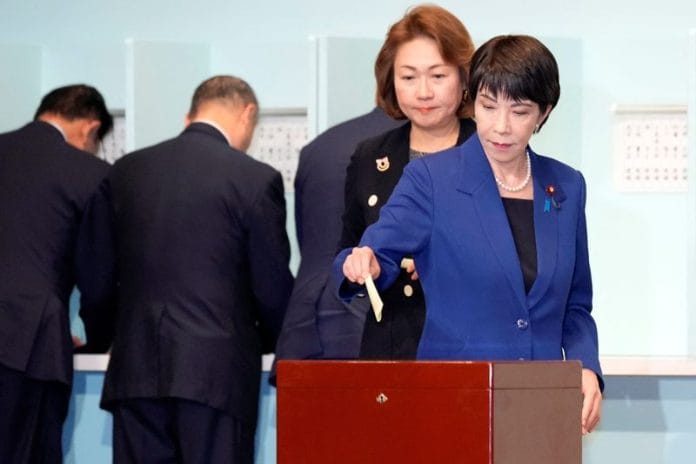
TOKYO (Reuters) -A leadership contest in Japan’s ruling party to determine who will take over as prime minister headed to a run-off on Friday, putting a candidate seeking to become Japan’s first female premier against a veteran making his fifth leadership bid.
The scramble to replace current premier Fumio Kishida was sparked in August when he announced his intention to step down over a series of scandals that plunged the Liberal Democratic Party’s (LDP) ratings to record lows.
Out of a record nine-strong field, right-wing economic security minister Sanae Takaichi, 63, and former defence minister Shigeru Ishiba, amassed the most votes and qualified for the second round expected to conclude at 1530 JST (0630 GMT).
Whoever is chosen must quell anger at home over rising living costs and navigate a volatile security environment in East Asia fuelled by an increasingly assertive China and nuclear-armed North Korea.
The LDP, which has ruled Japan for almost all of the post-war era and has a majority in parliament, must hold a general election by October 2025.
In brief comments made to lawmakers before the run-off, Ishiba called for a fairer and kinder Japan while Takaichi said she wanted to build a country where people could live safely and prosper.
Ishiba has courted controversy with his peers for going against the grain and challenging previous leaders, and has failed in four previous leadership bids. He has said he will not run again after this contest.
He supports some socially progressive policies like changing the law to allow married couples to use separate surnames, a move opposed by Takaichi and other more conservative LDP lawmakers.
Takaichi, an advocate of deceased former premier Shinzo Abe’s “Abenomics” stimulus policies, could be the most consequential pick – not least because she would be the first female prime minister in a male-dominated society.
She has been a vocal critic of the Bank of Japan’s efforts to raise interest rates further away from historic lows, and her election could spur a yen sell-off, market strategists say.
The yen currency weakened against the dollar after the first round of voting was announced, trading around a three-week low.
Her promise to reverse a trend of leaders avoiding the controversial Yasukuni war shrine if elected, could also sour relations with China, South Korea and others that view the site as a symbol of Japan’s wartime aggression.
The last Japanese leader to visit the shrine, which commemorates war dead including those convicted by an Allied tribunal of war crimes after World War II, was Abe in 2013.
(Reporting by Sakura Murakami and John Geddie; Editing by Lincoln Feast)
Disclaimer: This report is auto generated from the Reuters news service. ThePrint holds no responsibilty for its content.