








By Mahmoud Hasano and Khalil Ashawi
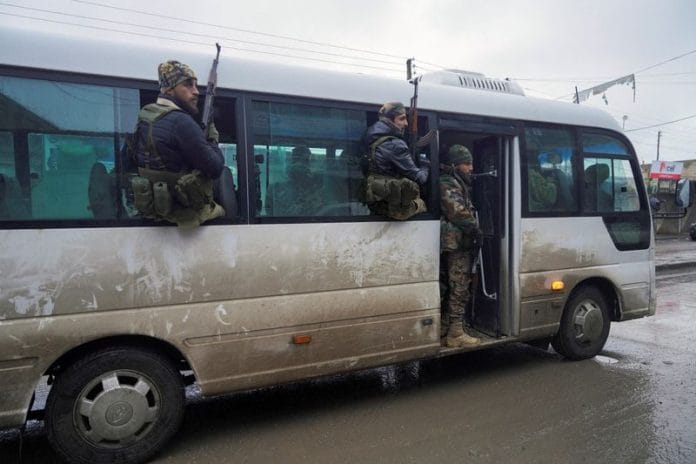
TABQA, Jan 18 (Reuters) – Syrian government troops are pushing towards Raqqa and Hasakah in the northeast of the country, the last strongholds of the U.S.-backed autonomous Kurdish-led administration, government officials and security sources said on Sunday.
They had earlier taken control of the Deir al-Zor’s main oil and gas fields east of the Euphrates River — a key source of revenue for the Kurdish-led forces — dealing a major blow to the group.
Syrian President Ahmed al-Sharaa said last week it was unacceptable for a militia (Syrian Democratic Forces) to control a quarter of the country and hold its main oil and commodities resources.
U.S. envoy Tom Barrack, who had met Kurdish leaders in Erbil in northern Iraq, was holding talks with Sharaa in Damascus over the latest developments, as Washington urged the two sides to de‑escalate, government officials said.
Washington is caught between preventing a collapse of its Kurdish partners’ self-rule enclave — which played a central role in defeating Islamic State in Syria — and supporting Sharaa’s bid to consolidate control over the rest of the country.
Sharaa has vowed to prevent the partition of Syria along sectarian and ethnic lines, while Kurdish leaders say they do not seek separation but want a decentralised state.
France’s President Emmanuel Macron said on Sunday he had spoken to Sharaa to express his concern about the ongoing government offensive against Western-backed Kurdish-led forces.
Macron, whose country has been part of mediation efforts between Damascus and the Kurds, said on Saturday that the offensive needed to stop.
The Syrian army has pressed on into predominantly Arab-populated areas of northeast Syria controlled by the U.S.-backed Syrian Democratic Forces (SDF), despite U.S. calls to halt its advance.
A government source said Kurdish-led forces were overcome after advances led by Arab tribal fighters, allowing the government and its tribal allies to move into territory of more than 150 km along the eastern bank of the Euphrates from Baghouz near the Iraqi border towards key towns, including al-Shuhail and Busayra.
Syrian government officials said the advances effectively brought most of Deir al-Zor province — the country’s main oil- and wheat-producing area along the Euphrates — under their control.
The army is pushing on towards Raqqa, the former Islamic State stronghold that the U.S.-backed Syrian Democratic Forces captured in October 2017, and residents of Raqqa said SDF forces had begun pulling out some of their equipment.
Late on Saturday, the army also took control of the northern city of Tabqa and its adjacent dam, as well as the Freedom Dam, formerly known as the Baath Dam, west of Raqqa.
Syrian Kurdish authorities, who have not acknowledged the loss of those strategic sites, said fighting continued near the dam area, accusing Damascus of breaching an agreement on the withdrawal of forces from areas east of Aleppo to expand its offensive.
Syrian Kurdish officials said factions aligned with the government were attacking their forces despite efforts to reach a peaceful outcome. The civil administration that runs the region said Damascus was intent on sowing divisions between Arabs and Kurds.
“We are at a critical juncture. We either resist or live in dignity and face all types of injustice,” their statement said, urging residents of the majority-Arab areas to stand by the SDF.
“We call on our people, especially the youth, to take up arms and prepare to resist any attack. We are facing a war for our survival,” it added.
The government had called on SDF fighters — most of whom are from Arab tribes — to defect. It says hundreds have already switched sides and joined tribal forces fighting the SDF.
The government’s rapid advances have been helped by thousands of tribal Arab fighters who took up arms against the SDF, reflecting years of resentment over forced conscription and the marginalisation of their oil‑rich areas.
The SDF denies it favours Kurds in the governing bodies, saying its leadership ranks reflect the diversity of Syrian society.
(Reporting by Damascus team; Writing by Suleiman al Khalidi Editing by Elaine Hardcastle and Jane Merriman)
Disclaimer: This report is auto generated from the Reuters news service. ThePrint holds no responsibility for its content.