








By Ece Toksabay and Daren Butler
ISTANBUL, Jan 19 (Reuters) – A deal under which Kurdish forces abandoned long-held territory in Syria to the Syrian government could pave the way for Turkey to advance its stalled effort to end its decades-long conflict with the PKK, Turkish politicians and officials said on Monday.
After days of fighting, the Syrian government and the Kurdish-led Syrian Democratic Forces (SDF) agreed on Sunday to bring Kurdish authorities under the control of Damascus. By Monday, SDF fighters had pulled out of swathes of territory which were now under control of the Syrian military.
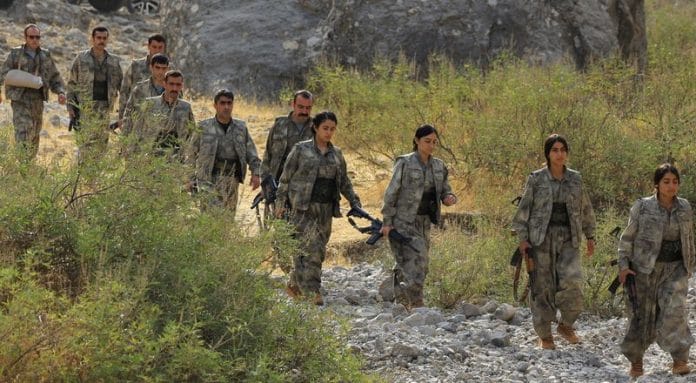
Neighbour Turkey has long considered the SDF in Syria to be an offshoot of the banned PKK, or Kurdistan Workers Party, which decided in May last year to disarm, disband and end its decades-long war against the Turkish state.
Turkish officials have long said that as long as the SDF controlled a swathe of territory across the border, it was difficult to end the war with the PKK. But now, with the SDF pulling out of two Syrian provinces, Turkish leaders see progress resuming.
EFFORTS TO DERAIL PEACE THWARTED, ERDOGAN’S PARTY SAYS
Omer Celik, spokesman for President Tayyip Erdogan’s ruling AK Party, said Syrian government forces’ recent advances had “thwarted” efforts by Kurdish groups to derail Turkey’s peace process.
Feti Yildiz, a deputy leader of the government-allied Turkish nationalist MHP party, said Sunday’s agreement in Syria would have “a favourable impact”.
“Things will become easier,” Yildiz told reporters in the Turkish parliament when asked how the Syrian deal affects the PKK process. “It had been standing like an obstacle, and for now it looks as though that obstacle has been removed.”
The PKK itself had yet to comment on the SDF’s withdrawal as of Monday afternoon. Turkey’s pro-Kurdish DEM Party, which has previously criticised the Syrian offensive against Kurdish forces, has also not yet reacted.
Turkish security sources, speaking to Reuters on condition of anonymity, called the deal a historic turning point and said stability in Syria was vital to Ankara’s goal of eradicating terrorism in Turkey, where the PKK has fought an insurgency since 1984 in which more than 40,000 people have been killed.
Though the PKK symbolically burned weapons in July, the peace process has since shown little sign of progress: a months-long parliamentary commission has so far revealed no details on legal or reform measures.
Joshua Landis, director of the Center for Middle East Studies at the University of Oklahoma, said the deal ended the Kurdish hope of retaining a large measure of autonomy and would benefit Turkey.
“Erdogan is undoubtedly rejoicing at the news, which will greatly weaken the PKK and any lingering Kurdish aspiration for an independent Kurdistan. Syria will become stronger economically and militarily, and Turkey will profit from this,” Landis said on X.
(Reporting by Ece Toksabay and Daren Butler; Editing by Jonathan Spicer)
Disclaimer: This report is auto generated from the Reuters news service. ThePrint holds no responsibility for its content.