








By Jon Nazca and Miguel Pereira
GRAZALEMA, Spain/ALCACER DO SAL, Portugal Feb 6 (Reuters) – One of Spain’s main rivers was close to bursting its banks on Friday and experts warned of landslides from waterlogged ground that could hold no more rain, as Storm Leonardo blew across the Iberian Peninsula with more storms on their way.
Over 7,000 people have been forced to leave their homes in the southern Andalusia region so far in the wake of a “storm train” of consecutive weather fronts pounding Portugal and Spain with torrential rains and strong winds over the past weeks.
A body was found 1,000 metres (yards) from where a woman was swept away by a river in Malaga province as she tried to rescue her dog, military police said on Friday, adding that they still needed to carry out forensic tests to confirm her identity.
State weather agency AEMET warned that another storm, Marta, would hit the peninsula on Saturday, bringing more abundant rainfall.
Several residential areas near the Guadalquivir River in Cordoba province were evacuated overnight due to the dramatic rise in water levels.
Further rain on Saturday could endanger more homes, with the situation around Jaen and the Guadalquivir area of Cordoba particularly worrisome, Andalusia’s regional leader, Juan Manuel Moreno, said during a press conference on Friday.
“We expect 30 mm (of rain). In other circumstances that would be little water but right now it is a lot as the soil is unable to drain and the rivers and reservoirs are full,” he said.
Authorities in Cordoba halted pedestrian traffic on the city’s Roman bridge as the Guadalquivir rose up.
LANDSLIDE RISK IN THE GRAZALEMA MOUNTAINS
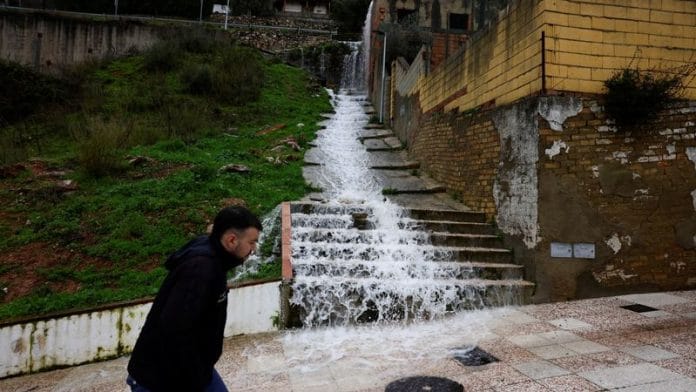
In Grazalema, a mountain village popular with hikers that has been at the centre of the storm, some 1,500 residents were evacuated as water seeped through the walls of houses and cascaded along steep cobbled streets.
The aquifers in the Grazalema mountains were full and could provoke landslides due to pent-up pressure, Moreno said on SER radio.
The Grazalema mountains are made of permeable rock that dissolves when absorbing large volumes of water, potentially leading to structural collapse, Nahum Mendez-Chazarra, a professor of geology at Valencia University, told Reuters.
“It’s possible these cavities will widen and eventually cause the ground to sink, which will obviously affect any house or road on top,” he said.
PORTUGAL EXTENDS CALAMITY STATE
In southern Portugal, large parts of the town of Alcacer do Sal by the River Sado remained semi-submerged for a third day.
“I’m left with nothing, nothing. I only kept the clothes I had on,” Alcacer resident Rita Morgado told Reuters, adding that more than 1,000 people needed help.
Prime Minister Luis Montenegro said late on Thursday his government had extended a state of calamity in 69 municipalities until mid-February, adding “unprecedented” rainfall and flood risks threatened several regions.
The commander of Portugal’s ANEPC civil protection service, Mario Silvestre, said six rivers – including the Tagus – were at risk of significant flooding.
The Tagus river basin was placed on red alert on Thursday due to the abrupt rise in water flow.
($1 = 0.8482 euros)
(Reporting by Paolo Laudani, Emma Pinedo, Sergio Goncalves and Andrei Khalip; Writing by David Latona; Editing by Peter Graff, Toby Chopra and Charlie Devereux)
Disclaimer: This report is auto generated from the Reuters news service. ThePrint holds no responsibility for its content.