








By Tora Agarwala and Saurabh Sharma
Dec 19 (Reuters) – Printing presses at Bangladesh’s two leading newspapers went silent on Friday for the first time in decades after mobs torched their offices in the worst attack on the media ahead of February’s national elections.
The country of nearly 175 million people has been on edge since a student-led uprising in 2024 toppled Sheikh Hasina’s long-standing government. Hasina is now sheltering in New Delhi, straining ties with India.
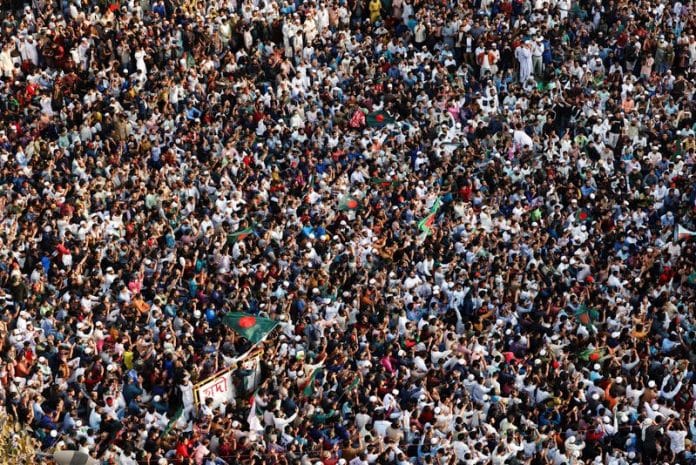
Tensions spiked further after youth leader and election candidate Sharif Osman Hadi – a vocal critic of India – died on Thursday night in a Singapore hospital, days after being shot by masked assailants in Dhaka.
Hundreds of mostly young protesters then flooded Dhaka’s streets, ransacking and setting ablaze the offices of Prothom Alo, the nation’s largest daily, and The Daily Star. By Friday, their charred shells stood as grim evidence, windows shattered and interiors gutted.
STAFF TRAPPED FOR HOURS IN BURNING OFFICES
Journalists and a government source said the newspapers may have been targeted for being seen as pro-Hasina and pro-India, though both say they are independent. The Daily Star said in an online report that the mob had called them “Delhi’s lapdog” and “Sheikh Hasina’s enabler”.
“There have been sporadic attacks on newspaper offices but never at this scale,” Kamal Ahmed, the newspaper’s consulting editor, told Reuters.
“When they set fire to the building, the staff members inside could not escape. They went up to the rooftop, and they were trapped … for about five hours. Our employees were gasping for breath in the dark smoke.”
They were finally able to exit the building after 4 in the morning with the help of military reinforcements, he said.
The paper said in a statement “certain elements and quarters have exploited the public anger (after Hadi’s death) to incite mobs against two newspapers that have always stood for objective journalism”.
YUNUS GOVERNMENT UNDER FIRE
The latest violence has rattled the interim government led by Nobel laureate Muhammad Yunus, who has faced criticism for failing to restore order since taking office in August 2024.
“This is a reflection of the interim government’s failure to control the rise of mobocracy,” said political analyst Asif Shahan, a professor at the University of Dhaka. “The monster has been unleashed and the key challenge for the next government is to tame this leviathan.”
Yunus’ press secretary, Shafiqul Alam, said he was sorry that he could not help the journalists in time despite him receiving “frantic, tear-choked calls for help”.
“I made scores of calls to the right people, trying to mobilise help, but it did not arrive in time,” he said in a social media post. “I wish I could dig up a great piece of earth and bury myself in shame.”
ATTACKS ON JOURNALISTS CONTINUE
Bangladesh ranks 149 out of 180 countries in the World Press Freedom Index, two places ahead of neighbour India. Anti-corruption watchdog Transparency International says harassment of journalists, writers and activists persists under the interim government.
At least 1,073 journalists have faced physical assaults, lawsuits, killings, threats, imprisonment, and property seizures in the past year, its latest report says.
Yunus’ government promised “full justice”, calling attacks on journalists “attacks on truth itself”.
But for those trapped Thursday night, the ordeal lingers. “The smoke was so thick we couldn’t see our hands,” said one journalist, declining to be named.
The Daily Star missed its first edition in 35 years but plans to resume Saturday, Ahmed said.
“Whatever progress the interim government … had achieved in respect of freedom of press and expression, this failure to prevent attacks on two top newspapers has undone that,” he said.
Prothom Alo could not publish on Friday for the first time in its 27-year-history, said its Executive Editor, Sajjad Sharif.
“It’s the darkest day for freedom of press,” he said.
(Reporting by Tora Agarwala and Saurabh Sharma in New Delhi; Writing by Krishna N. Das; Editing by Ros Russell)
Disclaimer: This report is auto generated from the Reuters news service. ThePrint holds no responsibility for its content.