





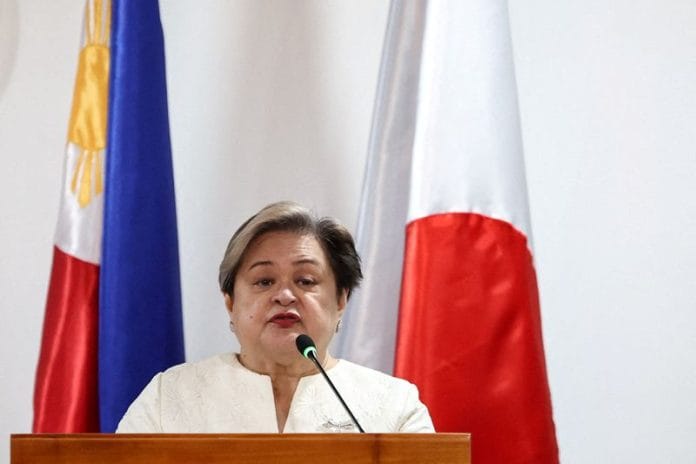



MANILA, Jan 22 (Reuters) – The Philippines, as ASEAN chair, will insist that a long-delayed Code of Conduct with China on the South China Sea explicitly references the U.N. Convention on the Law of the Sea (UNCLOS) as it works to complete the document by this year, its foreign minister said on Thursday.
“The UNCLOS issue is something that we insist on, not only the Philippines, but other ASEAN member states,” Ma. Theresa Lazaro told Reuters in an interview.
The idea of a formal code of conduct to ease tensions in the South China Sea was first raised more than two decades ago, but only in 2017 did the parties commit to start the drafting process. However, little substantive progress has been made since then.
The issue remains highly sensitive. China’s Southeast Asian neighbours want the code to be grounded in international law, which Beijing has repeatedly been accused of disregarding as it asserts its sovereignty over nearly all of the South China Sea.
Lazaro reiterated Manila’s position that the code must be legally binding, although she acknowledged this issue will require “further and deeper discussion” among ASEAN member states and China.
With the Philippines determined to use its position as ASEAN chair to complete the code of conduct this year, it plans to propose a set of strategies to fellow ASEAN members, Lazaro said, including increasing the frequency of negotiations.
Manila and Beijing have been locked in a series of maritime confrontations in recent years, with the Philippines accusing China of repeated aggressive actions inside its exclusive economic zone, including dangerous manoeuvres, water‑cannoning, and disrupting resupply missions.
China, for its part, has accused the Philippines of intruding into what it claims as its territory.
The diplomatic row comes as the Philippines has expanded defence cooperation with the United States. It has also strengthened security ties with other like-minded partners, including Australia, Japan, and Canada, all of which have publicly backed the 2016 Permanent Court of Arbitration ruling that invalidated China’s sweeping South China Sea claims.
Recent weeks have seen sharper exchanges between the Chinese Embassy and Philippine officials, including criticism of the coast guard spokesperson and lawmakers, prompting a response from Manila that Lazaro reiterated, that differences between states are best handled through diplomacy, not public exchanges.
Beijing continues to assert sovereignty over most of the South China Sea, including areas that fall within the EEZs of the Philippines, Brunei, Malaysia, Taiwan and Vietnam.
(Reporting by Karen Lema; Editing by David Stanway)
Disclaimer: This report is auto generated from the Reuters news service. ThePrint holds no responsibility for its content.