





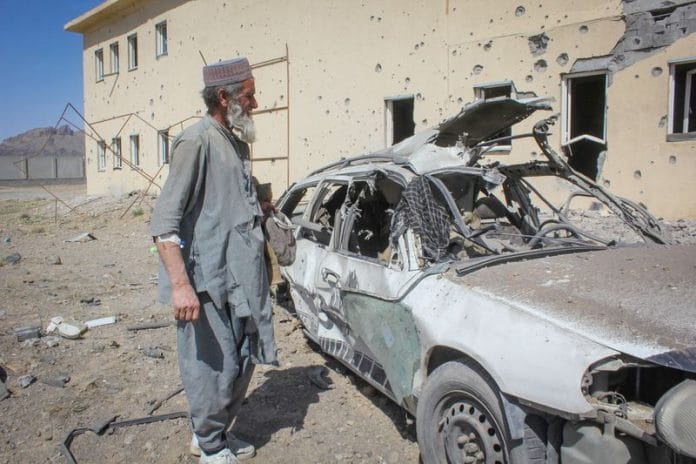



KABUL, Feb 28 (Reuters) – Fighting between Pakistan and Afghanistan’s Taliban military entered its third day on Saturday as foreign governments expressed increasing concern and called for urgent talks.
Pakistan’s strikes on Friday hit Taliban military installations and posts, some of them in Kabul and Kandahar, in one of the deepest Pakistani incursions into its western neighbour in years, officials said.
Islamabad accuses the Taliban of harbouring Tehreek-e-Taliban Pakistan (TTP) militants, who it says are waging an insurgency inside Pakistan, a charge the Taliban denies.
Pakistan said it was responding to cross-border assaults, while Kabul complained of a breach of its sovereignty, saying it remained open to dialogue but warning that any wider conflict would have serious consequences.
PAKISTAN-AFGHANISTAN FIGHTING RAISES FEAR OF LONG WAR
The fighting has raised the risk of a protracted conflict along the rugged 2,600-km (1,600-mile) frontier.
Diplomatic efforts gathered pace late on Friday as Afghanistan said its foreign minister, Amir Khan Muttaqi, had spoken with Saudi Arabia’s Prince Faisal bin Farhan about reducing tensions and keeping diplomatic channels open.
The European Union urged both sides to de-escalate and engage in dialogue, while the United Nations urged an immediate end to hostilities.
Russia urged a return to talks, while China said it was deeply concerned and ready to help ease tensions.
The U.S. State Department said the U.S. supported Pakistan’s right to defend itself against attacks by the Taliban.
A U.S. official, speaking on condition of anonymity, said Washington did not view Pakistan as the aggressor and that Islamabad was under pressure to address security challenges.Exchanges of fire continued along the border overnight.
Pakistani security sources said an operation dubbed “Ghazab Lil Haq” was ongoing and that Pakistani forces had destroyed numerous Taliban posts and camps. Reuters could not independently verify the claims.
Both sides have reported heavy losses. Pakistan said 12 of its soldiers and 274 Taliban had been killed while the Taliban said 13 of its fighters and 110 Pakistani soldiers had died.
Taliban deputy spokesman Hamdullah Fitrat said 52 civilians had been killed and 66 wounded in the Khost and Paktika provinces. Reuters could not verify the figures.
Pakistani Defence Minister Khawaja Muhammad Asif said Islamabad’s patience had run out and described the fighting as “open war”.
Taliban Interior Minister Sirajuddin Haqqani said in a speech that the conflict would be “very costly”, and that Afghan forces had not deployed broadly beyond those already engaged.
He said the Taliban had defeated “the world” through “unity and solidarity” and through “great patience and perseverance” rather than superior military power.
Pakistan’s military capabilities far exceed those of Afghanistan, with a standing army of hundreds of thousands and a modern air force.
The Taliban lacks any conventional air force and relies largely on light weaponry and ground forces.
However, the Islamist group is battle-hardened after two decades of insurgency against U.S.-led forces before returning to power in 2021.
(Reporting by Mohammad Yunus Yawar in Kabul and Ariba Shahid in Karachi; Additional reporting by Trevor Hunnicutt in Washington; Editing by Sam Holmes)
Disclaimer: This report is auto generated from the Reuters news service. ThePrint holds no responsibility for its content.