





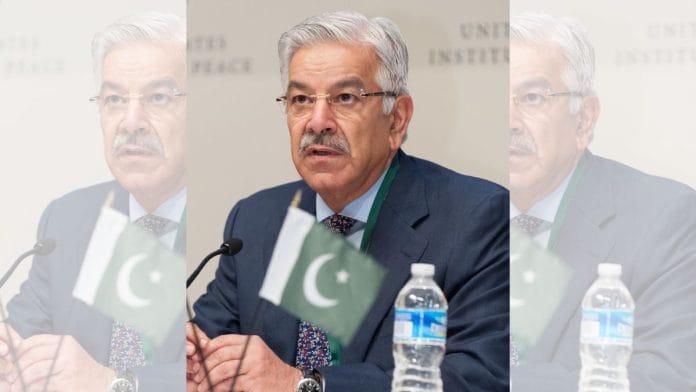



New Delhi: Reflecting on ties with the US, Pakistan Defence Minister Khawaja Asif said Tuesday that Washington DC used Pakistan for strategic gains and then tossed it like “toilet paper”. He even went a step further, describing Islamabad’s post-1999 realignment with the US, when it became the nation’s ally in its war against terror, as a “historic error”.
In a speech in Pakistan’s National Assembly, Asif also lamented that subsequent governments “failed to create our own national heroes”.
Elaborating on his argument about the US using Pakistan and then tossing it like “toilet paper”, Asif blamed Zia-ul-Haq and Pervez Musharraf for dragging Pakistan into the fray as an opponent of the Taliban, first during the Soviet invasion of Afghanistan and then during the ‘war on terror’.
“In a landmark speech of Hillary Clinton at the UN, she described how they left Pakistan like a piece of toilet paper. But we didn’t learn our lesson, we again started celebrating when (former US president) Bill Clinton visited us for just two hours (in 2000),” he said. “Pakistan was treated worse than a piece of toilet paper and was used for a purpose and then thrown away.”
Khawaja Asif termed Pakistan’s involvement in the ‘war on terror’ an “expensive gamble” that sowed seeds of instability and radicalisation still plaguing the country today.
Asif also junked the long-held narrative in Pakistan that its role in the 1980s’ Soviet-Afghan war was driven by religious duty. “People were rallied to battle in the name of jihad, but the term was misapplied and detrimental.” He also said Pakistan’s education system was overhauled to justify its involvement, embedding ideological changes that persist.
The anti-Soviet fight, he argued, was shaped by US geopolitical interests, and not by genuine religious imperatives, planting “long-term instability and radicalisation”.
Pakistan’s alignment with US interests has long been contentious domestically. Islamabad has been seen to prioritise foreign agendas over national stability, fuelling militancy and economic strain.
Also Read: Shehbaz Sharif’s adviser says Balochis have no human rights. ‘Military-elite coordination’
Post-9/11 fallout
Referring to the post-9/11 US-led ‘war on terror’, Asif blamed military Musharraf for pitting Pakistan against the Taliban. Islamabad had previously, in the anti-Soviet war in Afghanistan, supported the mujahideen that eventually became the Taliban.
Musharraf, who seized power in a 1999 coup, had assured then US president George W. Bush in 2001 of full cooperation against the Taliban and Al-Qaeda. Islamabad provided support by offering airspace, logistics, all military facilities, intelligence, and manpower.
Since 2002, Pakistan reportedly received over $33 billion in aid from the US, but public backlash grew. During this time, Tehrik-i-Taliban Pakistan (TTP), which primarily operates along the Afghanistan-Pakistan border, also entered the picture.
“We can never make up for the losses as these were irreversible blunders turning Pakistan into a chessboard for others’ squabbles,” Asif said in his speech Tuesday. In the wake of Asif’s address, Zalmay Khalilzad, former US ambassador to Afghanistan and special envoy for Taliban talks, posted on X Wednesday: “It is well known that Pakistan received military and financial support for assisting America in our operations in Afghanistan.”
Minister Khawaja Asif told #Pakistan's parliament that the country "had rented itself to the United States’ after 9/11 in the war against terror. It is well known that Pakistan received military and financial support for assisting America in our operations in #Afghanistan.
It…
— Zalmay Khalilzad (@realZalmayMK) February 11, 2026
Loss of identity
In his speech, Asif also invoked K.K. Aziz’s book The Murder of History.
Referring to it, he said: “We have failed to create our own national heroes. We have made invaders our heroes. We have even named our missiles and landmarks after them.”
He underscored the nation’s collective amnesia about freedom fighters who battled British colonial rule and sacrificed their lives.
“We don’t recall those freedom fighters who fought against Britain and laid down their lives,” Asif said, urging a reclamation of national pride. “Now more than half of our population has been looking to the west to trace their origins, but we are the people of this land.”
(Edited by Nida Fatima Siddiqui)
Lost golden chance by supporting Taliban and back stabbing US. Choose extremism and now blame US. Shameless.