








March 3 (Reuters) – Israeli Prime Minister Benjamin Netanyahu said the war against Iran was “not going to take years”, as the conflict widened with Israel again attacking the Iranian-backed Hezbollah militia in Lebanon and Iran striking Gulf states that host U.S. bases.
U.S. President Donald Trump, who launched strikes on Iran together with Israel on Saturday, initially projected the war to last four to five weeks, but has since sought to justify a broad, open-ended war.
In the meantime, Iran has launched missile and drone strikes against not only Israel and U.S. forces but also a host of countries across the region that are allied to the U.S., paralysing globally vital energy shipments from the Gulf along with hundreds of busy short- and long-haul flight routes.
ISRAEL SPEAKS OF WAR LASTING ‘WEEKS’
Netanyahu rejected the idea of the conflict lasting years, like previous wars in the region.
“I said it could be quick and decisive. It may take some time, but it’s not going to take years. It’s not an endless war,” Netanyahu said on Fox News’ “Hannity” program on Monday.
Israeli Lieutenant Colonel Nadav Shoshani told an online briefing that the duration of the military campaign could change, depending on developments, adding: “We have prepared a general scope of weeks.”
Asked if Israel could deploy ground forces to Iran, Shoshani said that was unlikely.
Explosions shook buildings across Tel Aviv as air defences intercepted incoming Iranian missiles.
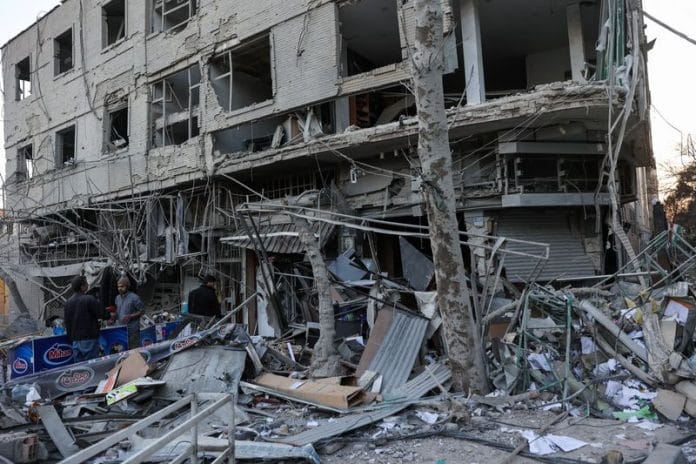
Israel attacked the Tehran complex of Iran’s state broadcaster IRIB in Tehran and Hezbollah militants in towns across Lebanon.
The Israeli military said it had sent more troops into southern Lebanon and positioned them at points near the border as part of “forward defence”. After its November 2024 ceasefire with Hezbollah, a Shi’ite militia that serves as an Iranian proxy force, Israel kept ground troops in Lebanon at five vantage points.
Early on Tuesday, two drones, apparently from Iran, struck the U.S. embassy in Riyadh, causing minor damage and starting a fire, and at least eight more drones were intercepted before reaching the city, Saudi Arabia’s Defence Ministry said.
Hundreds of civilians have been killed in Iran, Israel, Lebanon and other nations since the U.S. and Israel launched the war by killing Iranian Supreme Leader Ali Khamenei from the air on Saturday.
Iran’s Islamic Revolutionary Guard Corps, which reports to the Supreme Leader, said its navy had destroyed the main command building and headquarters of a U.S. air base in Bahrain in what it described as “Operation Promise of the Truth 4”.
It said 20 drones and three missiles had struck their intended targets at the base in the Sheikh Isa area.
The U.S. State Department and the White House did not immediately respond to requests for comment.
U.S. Secretary of State Marco Rubio warned on Monday that “the hardest hits are yet to come from the U.S. military”.
Asked how long he expected the United States to be engaged in Iran, Rubio said: “We believe the objectives we have set for this mission, the destruction of (Iran’s) ballistic missile capabilities, both launch capabilities and manufacturing, can be achieved without ground forces …
“Right now we are not postured for ground forces. But obviously the president has those options and he is not going to rule out anything.”
CHAOS AS THOUSANDS OF GULF FLIGHTS CANCELLED
A member of Iran’s Assembly of Experts, charged with choosing a new Supreme Leader, said picking Khamenei’s successor “won’t take long”, Iran’s ISNA news agency reported.
The U.S. military said it had struck more than 1,250 targets in Iran so far and destroyed 11 Iranian ships. Six U.S. service personnel have been killed, all in Iran’s retaliatory attacks over the weekend on Kuwait.
The conflict has thrown global air transport into chaos and shut down shipping through the Strait of Hormuz, where one-fifth of the world’s oil trade skirts the Iranian coast, sending oil prices surging. [O/R]
Major Gulf hubs, including the world’s busiest international airport Dubai, which usually handles over 1,000 flights a day, remained closed for a fourth day. That has left tens of thousands of passengers stranded.
Asian airline shares extended losses, with carriers closely monitoring fuel price spikes and bookings surging as passengers switch from Middle Eastern airlines.
Global oil and gas shipping rates soared, with supertanker costs in the Middle East hitting all-time highs, after Tehran targeted ships passing through the Strait of Hormuz, according to shipping data and industry sources.
WAR WIDENS TO LEBANON
The U.S. State Department ordered non-emergency U.S. government personnel and family members to leave Bahrain, Iraq and Jordan.
Trump has said the U.S. faced an imminent threat from Iran that justified the war, although he gave no specifics and some U.S. lawmakers said he had shown no evidence.
Rubio told reporters that the U.S. had acted pre-emptively because it knew of its close ally Israel’s plan to strike Iran and knew Tehran would respond, putting U.S. bases at risk.
In his most extensive public comments so far on the conflict, Trump on Monday said he had ordered the attack to thwart Tehran’s nuclear program and a ballistic missile program that he said was growing rapidly.
Commercial satellite imagery has captured what appears to be the first known strikes on an Iranian nuclear site since the start of the war, an independent policy institute said on Monday.
Iran has denied it is seeking nuclear weapons and said the U.S. and Israeli assault was unprovoked, occurring as Tehran and Washington were in negotiations on a nuclear accord.
Trump withdrew from a prior international agreement curbing Iran’s nuclear program during his first term in 2018, three years after it was signed.
Trump’s assault on Iran is the biggest U.S. foreign policy gamble in decades and a major political risk for his Republican Party in this year’s midterm elections. Only one in four Americans supported the Iran attack in a weekend Reuters/Ipsos poll.
Russia, China and Turkey have condemned the war. Britain, an ally of Washington’s, has reluctantly allowed U.S. forces to use British bases for what it calls “defensive” strikes on Iranian weaponry.
(Reporting by Jonathan Allen in New York, Kanishka Singh and Ismail Shakil in Washington, Enas Alashray in Cairo; Writing by Jonathan Allen and Michael Perry; Editing by Caitlin Webber, Stephen Coates and Raju Gopalakrishnan)
Disclaimer: This report is auto generated from the Reuters news service. ThePrint holds no responsibility for its content.