





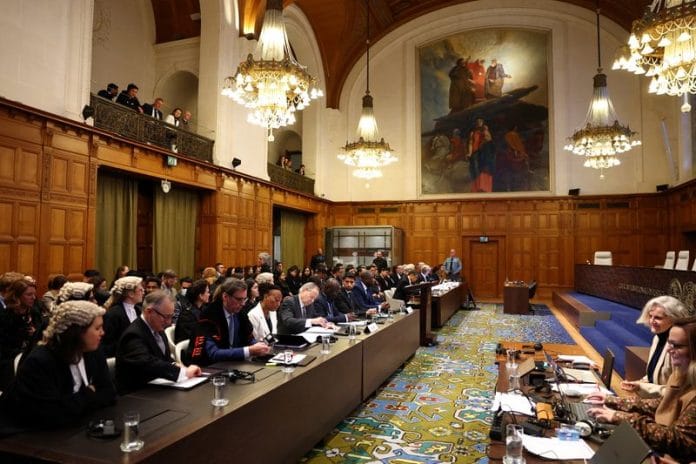



THE HAGUE, Jan 16 (Reuters) – Myanmar told the United Nations’ top court on Friday that Gambia had not proven its accusation that the Myanmar government had committed genocide against the minority Muslim Rohingya, part of a hearing on the landmark case.
Gambia, a predominantly Muslim West African country, brought the case before the International Court of Justice in 2019. It told the court on Monday that Myanmar’s authorities had targeted the Rohingya for destruction, allegations Myanmar rejected.
“Gambia has failed to meet its burden of proof. This case will be decided on proven fact not unsubstantiated allegations,” Ko Ko Hlaing, a representative of the Myanmar government, told the ICJ, which is also known as the World Court.
Myanmar’s armed forces launched an offensive in 2017 that forced at least 730,000 Rohingya from their homes and into neighbouring Bangladesh, where they recounted killings, mass rape and arson. A U.N. fact-finding mission concluded the 2017 military offensive had included “genocidal acts”.
Myanmar has denied genocide and Hlaing told judges the offensive was a legitimate counter-terrorism campaign in response to attacks by Muslim militants. He added the U.N. fact-finding mission was not objective or reliable.
Lawyers for Gambia had argued that it would be unreasonable for judges to conclude that Myanmar’s attack on thousands of Rohingya civilians, including women, children and the elderly, as well as burning their villages was done just to combat terrorism.
They said the pattern of conduct during the crackdown indicated the genocidal intent legally needed to determine genocide was committed.
The ICJ is the U.N.’s highest court and deals with disputes between states.
Gambia’s case, backed by the 57-nation Organisation of Islamic Cooperation, is the first genocide case the ICJ is hearing in full in more than a decade.
The outcome will have repercussions beyond Myanmar, likely affecting South Africa’s 2023 genocide case at the ICJ against Israel over the war in Gaza. Israel also denies genocide and lawyers for Israel dismissed South Africa’s case as an abuse of the genocide convention.
Myanmar has been in further turmoil since 2021, when the military toppled the elected civilian government and violently suppressed pro-democracy protests, sparking a nationwide armed rebellion.
The country is currently holding phased elections that have been criticised by the United Nations, some Western countries and human rights groups as not free or fair. The military says the vote has public backing and is being conducted without coercion.
(Reporting by Stephanie van den Berg; editing by Philippa Fletcher)
Disclaimer: This report is auto generated from the Reuters news service. ThePrint holds no responsibility for its content.