








By Jack Queen
NEW YORK, Jan 5 (Reuters) – Toppled Venezuelan leader Nicolas Maduro appeared in federal court on Monday to face U.S. drug trafficking charges after President Donald Trump’s stunning capture of him rattled world leaders and left officials in Caracas scrambling to respond.
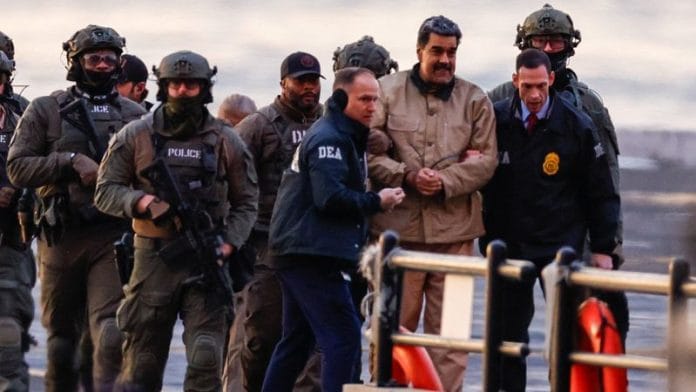
Maduro was expected to enter a plea during his court appearance before U.S. District Judge Alvin Hellerstein. The ousted leader – his hands zip-tied – and his wife Cilia Flores were transported under guard on Monday morning from a Brooklyn detention center to a helicopter bound for the Manhattan court.The arraignment got under way as U.N. chief Antonio Guterres raised concerns about instability in Venezuela and the legality of Trump’s strike, the most dramatic U.S. intervention in Latin America since the 1989 Panama invasion. Special Forces swooped into Caracas by helicopter on Saturday, shattered his security cordon and dragged him from the threshold of a safe room.
The judge began the hearing at 12:02 p.m. (1702 GMT) by summarizing the charges in the indictment. Maduro, in orange and beige prison garb, listened on headphones through an interpreter.
Hellerstein asked Maduro to stand and confirm his identity. He replied in Spanish.
Maduro is accused of overseeing a cocaine-trafficking network that partnered with violent groups including Mexico’s Sinaloa and Zetas cartels, Colombian FARC rebels and Venezuela’s Tren de Aragua gang.
Maduro, 63, has long denied the allegations, saying they were a mask for imperialist designs on Venezuela’s oil.
Outside the courthouse, dozens of Maduro supporters outnumbered a handful of anti-Maduro Venezuelan immigrants.
Amid global consternation at Trump’s seizure of a foreign head of state – albeit an unpopular one – the U.N. Security Council debated its legality and fallout as Russia, China and Venezuela’s leftist allies condemned the raid. While world leaders and American politicians wrestled with the extraordinary action, Venezuela issued an emergency orderdirecting police to hunt down anyone who aided the U.S. attack.
MADURO, WIFE FACE U.S. DRUG CHARGES
Maduro faces decades to life in prison on each count if convicted. He will be represented by Washington defense lawyer Barry Pollack, according to a court document. Pollack’s past clients include WikiLeaks founder Julian Assange, who pleaded guilty to U.S. charges in 2024 in a deal that allowed him to return to his native Australia.
Prosecutors say Maduro has been involved in drug trafficking from the time he began serving in Venezuela’s National Assembly in 2000 to his tenure as foreign minister and subsequent 2013 election as the late president Hugo Chavez’s successor.
Federal prosecutors in New York first indicted him in 2020 as part of a long-running narcotics trafficking case against current and former Venezuelan officials and Colombian guerrillas. An updated indictment made public on Saturday added some new details and co-defendants, including Cilia Flores.
The U.S. has considered Maduro an illegitimate dictator since he declared victory in a 2018 election marred by allegations of massive irregularities.
Experts in international law have questioned the legality of the raid, with some condemning Trump’s actions as a repudiation of a rules-based international order.
TRUMP ASSERTS OIL ASPIRATIONS
In Caracas, senior officials from Maduro’s 13-year-old government remain in charge of the South American oil producer of 30 million people, alternating between defiance and possible cooperation with the Trump administration.
U.S. oil companies’ shares jumped on Monday, fueled by the prospect of access to Venezuela’s vast oil reserves.
Trump has made no secret of wanting to share in Venezuela’s oil riches.
American oil companies will return to Venezuela and rebuild the sector’s infrastructure, Trump told reporters on Air Force One on Sunday.
“We’re taking back what they stole,” Trump said. “We’re in charge.”
Venezuela has the world’s largest reserves – about 303 billion barrels – but the sector has long been in decline from mismanagement, under-investment and U.S. sanctions, averaging 1.1 million bpd output last year, a third of its 1970s heyday.
After first denouncing Maduro’s capture as a colonial oil-grab and kidnapping, Venezuela’s acting president, Delcy Rodriguez, softened her stance on Sunday, saying it was a priority to have respectful relations with Washington.
“We invite the U.S. government to work together on an agenda of cooperation,” Rodriguez said. “President Donald Trump, our peoples and our region deserve peace and dialogue, not war.”
The country’s UN envoy, however, told the Security Council on Monday that the U.S. armed attack had no legal justification.
Trump has threatened another strike if Venezuela does not cooperate with opening its oil industry and stopping drugs. Trump also threatened Colombia and Mexico on Sunday and said Cuba’s communist government “looks like it’s ready to fall”.
Just how the U.S. would work with a post-Maduro government, full of sworn ideological enemies, is unclear. Trump appears to have sidelined for now the Venezuelan opposition, where many anti-Maduro activists had assumed this would be their moment.
Rodriguez, daughter of a leftist guerrilla who has been praised as a “tigress” by Maduro, is also known as a pragmatist with good connections in the private sector and a belief in economic orthodoxy.
GLOBAL CONSTERNATION
Washington’s allies, most of whom did not recognize Maduro as president due to vote-rigging allegations, have been more muted, stressing the need for dialogue and adherence to law.
Trump’s raid has created a political storm in the U.S., with opposition Democrats saying they were misled. Secretary of State Marco Rubio was due to brief top lawmakers later on Monday.
While a handful of conservative figures have criticized the Venezuela operation as a betrayal of Trump’s “America First” pledge to avoid foreign entanglements, most supporters have largely praised it as a swift, painless win.
Inside Venezuela, Maduro opponents have kept celebrations on hold as his allies remain in power and there is no sign of the military turning against them, even though many suspect some insiders helped in Saturday’s operation.
(Reporting by Reuters bureaux worldwide; writing by Doina Chiacu and Andrew Cawthorne; editing by Mark Heinrich and Howard Goller)
Disclaimer: This report is auto generated from the Reuters news service. ThePrint holds no responsibility for its content.