








By Emilie Madi and Khalil Ashawi
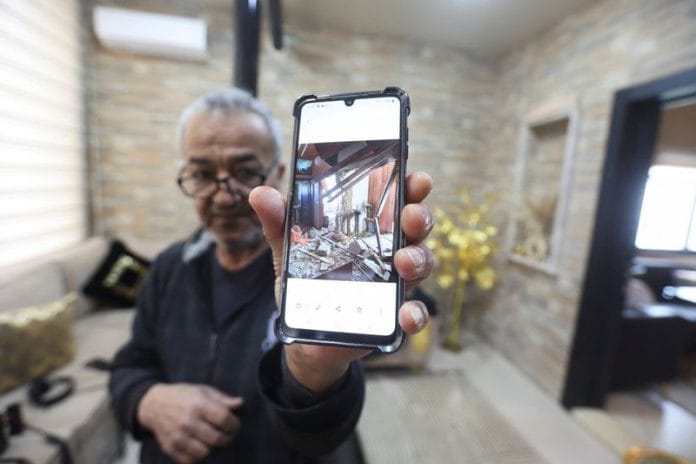
HAZMIEH, Lebanon, March 8 (Reuters) – Just days ago, Hussain Khrais was proudly showing off his newly restored home in south Lebanon, fixed up after being badly damaged in 2024 clashes between Israel and Hezbollah. But a new war has since erupted and his home is in the line of fire again.
Khrais fled his hometown of Khiyam, about five km (three miles) from the border with Israel, as Israel pounded Lebanon with heavy airstrikes last week in retaliation for Iran-backed group Hezbollah’s rocket and drone fire into Israel.
“Is the house I worked so hard to build, or the business I started, still there? Or is it all gone?” Khrais told Reuters from a relative’s home near the capital Beirut where he and his family are now staying.
“The feeling is very, very upsetting, because we still don’t know if we’ll go back or not.”
‘WHAT KIND OF LIFE IS THAT?’
It wasn’t Khrais’ first time – or even his second. The 66-year-old has been displaced at least four times in the last four decades by Israeli incursions and airstrikes, each time returning to a town in ruins and rebuilding patiently.
Last year, he spent months and around $25,000 repairing the damage from the last war between Hezbollah and Israel, which ended 15 months ago. Hezbollah started firing at Israel after the United States and Israel launched airstrikes against Iran on February 28.
“It really bothers me to think this is the life I’ve lived,” Khrais told Reuters. “Once again, displacement, return, rebuilding, restoration – then again displacement, return, rebuilding. What kind of life is that?”
With no support from the Lebanese state and little coming from Hezbollah’s social welfare programme, most Lebanese whose homes were damaged or destroyed in the 2024 war have used their own private funds to rebuild.
Reconstruction has placed a huge burden on affected Lebanese families, still struggling to access their savings in commercial banks after a financial collapse in 2019.
Two weeks ago, Khrais had told Reuters he was scared that a new war would start. “I’m at an age where I can’t start all over again. That’s it,” he said.
‘WORTH THE WORLD’S TREASURES’
The new war has dealt Lebanese another blow. About 300,000 people have been displaced over the last week by Israel’s strikes and by the Israeli military’s evacuation orders, which encompass around 8% of Lebanese territory.
Khrais is staying with around 20 other displaced relatives, some displaced from Khiyam and others from Beirut’s southern suburbs, which have been hit hard by Israeli strikes.
He is glued to the television, where news bulletins have reported on Israeli troops and tanks pushing deeper into his hometown.
“I’ve been in Beirut for four days now, and these four days feel like 400 years,” Khrais said.
He misses his house dearly.
“Maybe the thing I’m most attached to, is when I open the door to my children’s bedrooms and see the pictures of their children hanging on the walls,” he said.
“That sight is worth the world’s treasures – to see my grandchildren’s pictures in Khiyam.”
Khrais has no news on the state of his home. He said he remains hopeful but that if it has been destroyed, he’ll still do what he’s always done.
“The big shock would be if I came back and didn’t find it. But my feeling says no, God willing, it will remain. And like I said, even if we don’t find the house, we’ll go back and rebuild,” he said.
(Reporting by Emilie Madi and Khalil Ashawi in Hazmieh, Writing by Maya Gebeily, Editing by Timothy Heritage)
Disclaimer: This report is auto generated from the Reuters news service. ThePrint holds no responsibility for its content.