





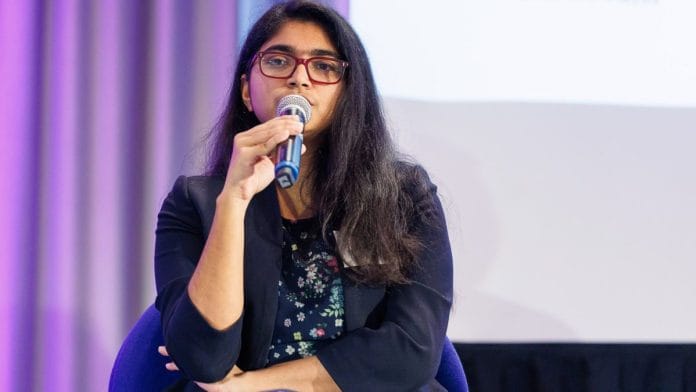



Dhaka: Tasnim Jara rejected the easy path and chose the demanding route instead. Formerly a senior joint secretary of the National Citizen Party, Jara resigned from the NCP in December last year.
Tasnim Jara’s decision to quit was after the party’s alliance with Jamaat before the 2026 Bangladesh national elections. For her, the tie-up signalled a narrowing, rather than an expansion of the political space within the NCP.
“When the NCP aligned with Jamaat, I struggled to see how a genuinely new political space could be created,” she said, speaking to ThePrint. “I chose a difficult path because I believe in the promise we made—to rebuild institutions and change structures.”
The Students Against Discrimination and Jatiya Nagorik Committee—which had largely been behind the July protests that toppled the Sheikh Hasina government in 2024—formed the NCP on 28 February 2025. The party initially promised to contest polls independently, maintaining it would not ally with Right-wing, religion-based parties, such as Jamaat.
As Jara cast her vote in Khilgaon Thursday, she was surrounded by people who had taken note of her position. They waited to hug her and take selfies with her.
Jara is among 17 women candidates in Dhaka. She is contesting as an Independent from Dhaka-9, one of the Capital’s most prominent urban seats.
Among the 12 candidates facing off, her primary competitor in the seat is the Bangladesh Nationalist Party’s Habib Habibur Rashid.
Women account for just nine percent of the capital’s candidate pool of 190.
Tasnim Jara said she resigned from NCP because she believes in the promise that drew her into politics—a promise born in the heat of the “July Uprising”—during which thousands had poured into the streets. In her words, “a window opened” for ordinary citizens, especially women, during the mass movement to step forward and claim a voice in rebuilding the nation’s institutions.
“We must make a space where women can meaningfully participate and feel included. The July uprising created that window, where many women came out on the streets to vote,” she told ThePrint outside her polling station in Dhaka.
Running, with the party symbol of a football, she has staked her campaign on that promise and a question that lingers beyond her candidacy—whether women can meaningfully participate in Bangladesh’s politics.
At least 14 central leaders have resigned or opposed the NCP-Jamaat alliance. Apart from Tasnim Zara, others who have opposed the move include Mir Arshadul Haque, Tajnuva Jabeen, Nusrat Tabassum, and Samantha Sharmin. NCP member Mahfuz Alam also publicly stated that he would not continue under the party’s current organisational structure, reflecting a broader political friction within the party.
Also Read: Bangladesh elections: Why Dhaka is key in high-stakes BNP-Jamaat showdown
‘Women must feel safe to organise, fight’
Nationwide, the disparity is even sharper—just 78 women among 1,981 contenders—less than four percent of the field. Yet, women account for nearly half of the registered voters.
In Dhaka alone, 4.12 million of the city’s 8.47 million voters are women.
“Representation is not symbolic,” Jara said. “It is about whether women feel safe enough to come out, to organise, to fight.”
She said that she believes the sense of safety has eroded over the years.
“The space for women’s participation has shrunk,” she said. “The July uprising created an opening. Many women stepped into politics for the first time. But since then, the structures have not held.”
On inclusion, her answer is blunt. “The proof is in front of you…It is not there at all.”
She is fighting from Dhaka-9—a densely populated constituency, encompassing Khilgaon, Sabujbagh, and Mugda, home to roughly 469,360 registered voters.
Independent candidates, such as her, have relied on crowdfunding and tight-knit volunteer teams, a model that’s nimble but fragile in a political environment dominated by traditional parties and patronage networks.
On polling day amid a largely festive turnout, Jara alleged her campaign had faced systematic obstruction.
She said her polling agents were barred from entering several centres or forcibly removed on what she called “fabricated” grounds.
“In some centres, they were told they could not enter because they were not registered voters of that specific area,” she said. “In others, officials cited separate male and female polling stations as justification. In several cases, agents were stopped for carrying mobile phones.”
According to Jara, no written explanations were provided. “There was no formal notification…These actions are contrary to the principles of free, fair, and acceptable elections.”
At the time of filing this report, election officials had yet to respond to her specific allegations publicly.
For Jara, the obstacles are part of a larger pattern. The July uprising that dethroned Hasina was built, she said, on the sacrifices of students, workers, and ordinary citizens who believed they were creating space for a more inclusive political order. But structural change, she argued, has been slower and more uneven than many hoped.
“We came out of the uprising after sacrificing so much,” she said. “We talked about rebuilding institutions. But unless women can participate meaningfully—not as tokens, not as afterthoughts—that promise remains unfulfilled.”
(Edited by Madhurita Goswami)
Also Read: BNP leader killed at Bangladesh polling station, party claims he was trying to stop fraud