








By Alexander Cornwell and Rami Ayyub
TEL AVIV, March 5 (Reuters) – Israel’s war in Iran is entering a second phase that will see its fighter jets attacking ballistic missile sites buried deep underground, two sources familiar with Israel’s military campaign said.
The joint air assault with the U.S. in Iran is nearing the end of its first week after opening salvos killed the country’s leaders and set off a regional war with Iranian attacks in Israel, the Gulf and Iraq, and Israeli attacks in Lebanon.
Israel’s military says it has hit hundreds of Iranian missile launchers above ground that could target Israeli cities. The second phase will include bunkers storing ballistic missiles and equipment, said the sources, who spoke on condition of anonymity because of the sensitivity of the subject.
One said Israel aimed to neutralise Iran’s ability to launch aerial attacks at Israel by the end of the war, which was also focused on taking out the Islamic Republic’s leadership.
A military spokesperson did not immediately respond to a request for comment on its attack plans. The military has previously asserted that it and the U.S. military took control of much of Iran’s airspace in the opening days of the attacks.
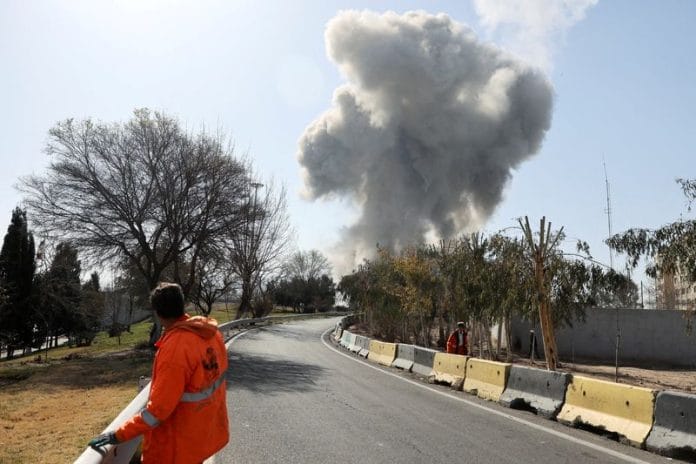
In a statement on Thursday, the military said that, overnight, the Air Force struck “an underground infrastructure site used by the Iranian regime to store ballistic missiles and storage sites for missiles intended for use against aircraft.”
The military has not previously announced attacks on underground missile facilities, according to a review of its public statements since the start of the joint U.S.-Israeli attacks on Saturday.
Estimates of Iran’s missile stockpile vary widely, from roughly 2,500 before the war, according to Israel’s military, to around 6,000 according to other analysts. The extent of what remains could prove critical to how the war develops. Tehran has continued to carry out missile attacks on Israel and across the region.
Douglas Barrie of the UK-based International Institute for Strategic Studies said on Wednesday the think tank assesses Iran still possesses some land-attack cruise missiles, precision-guided weapons that fly low to evade radar detection.
SYSTEM MUST BE ‘FURTHER AND FURTHER DEGRADED’
Israel’s Air Force fighter jets have carried out near-constant sorties since Saturday, accelerating further in pace after Lebanon’s Iran-backed Hezbollah militants fired rockets at Israel, drawing heavy Israeli airstrikes as far north as Beirut.
In some cases, the same Israeli warplanes have struck both Iran and Lebanon in a single operation: bombing targets in Tehran or western Iran on the way out, and striking Hezbollah sites on the way back, one of the sources familiar with the plans and an Israeli security source said.
Israeli and U.S. officials say ballistic missile and drone launches from Iran have declined since Saturday, a decrease that they attribute in part to U.S. and Israeli strikes on Iranian launch sites and related military infrastructure.
The Israeli military has said that the decrease could also reflect an effort by Tehran to preserve its missile stocks as it prepares for a drawn-out war of attrition.
Eran Lerman, a former Israeli deputy national security adviser, said the hope from the initial week of strikes was that Iran’s ruling system would “begin to disintegrate earlier, more quickly”.
“But this has yet to happen and as long as it doesn’t, the system needs to be further and further degraded,” Lerman said.
(Reporting by Alexander Cornwell and Rami Ayyub; Editing by Andrew Heavens)
Disclaimer: This report is auto generated from the Reuters news service. ThePrint holds no responsibility for its content.