








By Mark John
LONDON, March 8 (Reuters) – Tax the rich. Trash the tariffs. End monopolies.
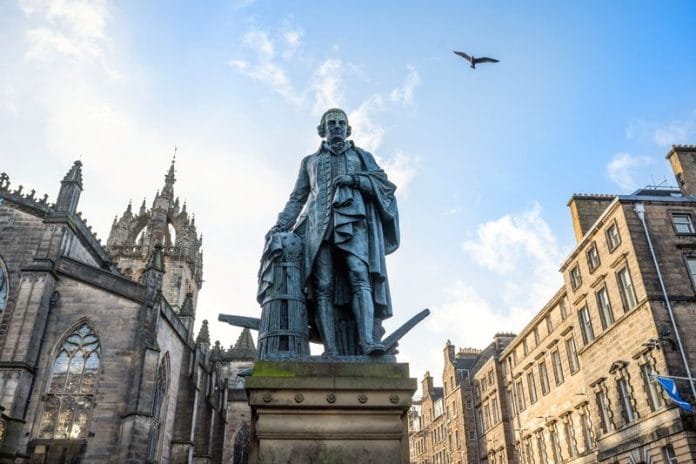
Such are the rallying calls of many of today’s most heated economic debates. They could also come straight from the pen of revered economist Adam Smith, hailed by some as the “father of capitalism” and others as an early progressive.
Smith knew nothing of Donald Trump or tech billionaires when he railed against trade protectionism and extreme affluence in “The Wealth of Nations”, the best-read economics book in history, which celebrates its 250th birthday on Monday.
“It is the maxim of every prudent master of a family never to attempt to make at home what it will cost him more to make than to buy,” the Scot wrote in the seminal work, for example.
“Would it be a reasonable law to prohibit the importation of all foreign wines, merely to encourage the making of claret and burgundy in Scotland?” he adds.
The foundational text of classical economics was published on March 9, 1776, the same year as the U.S. Declaration of Independence, 13 years before the French Revolution, and amid the early convulsions of the Industrial Age.
Yet it’s not hard to find parallels between the doctrines the book denounces – such as rival mercantilist empires seeking to minimise imports and maximise exports – and President Trump’s trade tactics and “America First” credo today.
And while Smith is most often cited for his free markets and free trade zeal, when it comes to distribution of wealth, he could almost be channelling Bernie Sanders or Alexandria Ocasio-Cortez, leftist U.S. lawmakers.
“It is not very unreasonable that the rich should contribute to the public expense, not only in proportion to their revenue, but something more than in that proportion,” Smith writes in the 1,000-page-plus tome, which draws on everything from grape-growing to pin factories.
“No society can surely be flourishing and happy, of which the far greater part of the members are poor and miserable,” he says in one of his best-known quotes.
DEBATES RAGE ON WHAT SMITH MEANT
Many scholars of the book – full name “An Inquiry into the Nature and Causes of the Wealth of Nations” – say it remains uncannily relevant to the economic issues of our time, though debates continue to rage about what Smith was actually saying.
Advocates of free-market economics have long claimed him as their spiritual father, while some more recent readings even peg him as a moderate progressive – something akin to a left-leaning, modern-day European social democrat.
“You can find a ‘Smith’ to support anything you want to say,” King’s College London research associate Leo Steeds said of the Scottish Enlightenment thinker.
Smith also accepted that there were certain circumstances when tariffs were called for, either because the terms of trade were unfair or for reasons of security – arguments increasingly heard in the United States, Europe and other trading blocs.
“Smith did understand those arguments,” said Eamonn Butler, director of the free market policy think tank the Adam Smith Institute in London. “But he thought these things (tariffs) really should be as temporary as possible. He thought the more trade you have, the better everybody is.”
SLEIGHT OF THE ‘INVISIBLE HAND’
One of the most famous metaphors from the “Wealth of Nations” is that of the “invisible hand”, most often interpreted as meaning how free markets channel the self-interest of different participants to the best outcome for all.
“It is not from the benevolence of the butcher, the brewer, or the baker, that we expect our dinner, but from their regard to their own interest,” Smith writes.
But other students of the work note the invisible hand metaphor was used just once in the book and must be taken alongside his wider arguments rather than being used to justify “laissez-faire” policies.
“This book … is actually a critique of the way in which special interests, monopolists, powerful people, lobbies capture the state,” said Pratap Bhanu Mehta, a leading Indian academic and public intellectual.
“He says: You fix that, then free markets come.”
U.S. economist Joseph Stiglitz, a professor at Columbia University and Nobel Prize laureate, agreed.
“It was much more of an enlightened self-interest looking at society more broadly,” he said. “Modern economics is based on infinitely selfish people. And clearly, Adam Smith didn’t believe that.”
Indeed, Smith – who taught moral philosophy at the University of Glasgow – is explicit about his views on selfishness at the expense of others.
“All for ourselves, and nothing for other people, seems, in every age of the world, to have been the vile maxim of the masters of mankind,” he writes.
‘A TOOL FOR PRODUCING IDEAS’
Events to mark the 250th anniversary of “The Wealth of Nations” are taking place throughout the year in Glasgow, Edinburgh, London and Smith’s birthplace of Kirkcaldy on the Scottish coast.
In a sign of his lasting imprint on the popular imagination, the ghost of Smith made an appearance last year as a character in a satirical musical staged during the Edinburgh festival about the 2008 collapse of Royal Bank of Scotland.
There are, however, limits to how much Smith can be re-branded a progressive or anything else in today’s terms.
While he criticised the rich and argued the accumulation of wealth by the few led to the poverty of many, Mehta argued that Smith, like many of his contemporary thinkers, would have been comfortable with levels of inequality not acceptable today.
Still others – including Karl Marx decades later – have criticised Smith’s production-enhancing ideas on the division of labour into small tasks as being deployed in factories to leave workers with morale-sapping, mind-numbing jobs.
Nonetheless, economic historian Richard van den Berg, professor at Goldsmiths, University of London, said the many questions and differing interpretations surrounding the book had clearly not diminished its appeal to subsequent generations.
“It is a tool,” he said. “A tool for producing ideas.”
(Writing by Mark John; Additional reporting by Nushaiba Iqbal and Sarupya Ganguly in Bengaluru, and Victoria Waldersee in Madrid; Editing by Pravin Char)
Disclaimer: This report is auto generated from the Reuters news service. ThePrint holds no responsibility for its content.