





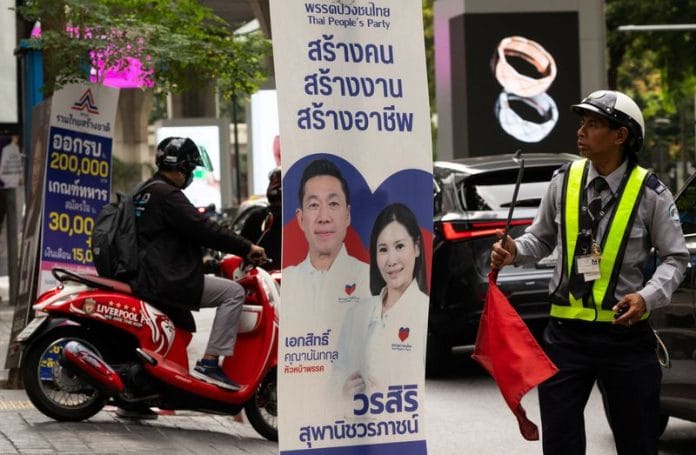



By Martin Petty
BANGKOK, Feb 5 (Reuters) – Thailand is holding a general election on February 8, a three-way contest and the latest round in a turbulent battle for power between the country’s progressive, populist and conservative camps.
WHO IS BEST PLACED TO WIN?
Opinion polls consistently show the progressive People’s Party is Thailand’s most popular party. With its ambitious reform agenda and mastery of social media, it has huge appeal among young and urban Thais and will be a force to reckon with.
Its predecessor Move Forward won the 2023 election, taking all but one of the 33 seats in the capital Bangkok and making inroads into conservative strongholds. But it lacked parliamentary support to form a government, despite a pact with the second-placed Pheu Thai party.
Surveys indicate People’s Party has lost none of its momentum. It was backed by 36% of respondents in a January 16-28 poll of 26,661 people by Suan Dusit University, with the former ruling party Pheu Thai on 22.1% and Prime Minister Anutin Charnvirakul’s Bhumjaithai third on 18.9%.
A January 23-27 survey of 2,500 people by the National Institute for Development Administration showed 34.2% support for People’s Party, with Bhumjaithai at 22.6% and Pheu Thai on 16.2%.
At the last election in 2023, People’s Party’s forerunner won 151 of the 500 seats at stake, Pheu Thai took 141 and Bhumjaithai won 71.
WILL THE WINNER FORM A GOVERNMENT?
An outright majority for any of the three main parties is unlikely so an alliance is almost certain to be required to form a government.
But this could be tricky given bad blood and ideological differences between the parties, with bitter histories of betrayal and big fallouts within the past six months. Pacts with some of the dozens of smaller parties running could be decisive in breaking any deadlock and the party that wins most seats in the election may not prevail.
People’s Party’s advantage will be its strength at the ballot box but forming a coalition could be difficult. Bhumjaithai’s politically savvy leader Anutin is an accomplished dealmaker willing to work with any party and his efforts would likely be backed by influential conservatives outside of politics.
The once-dominant Pheu Thai, controlled by the billionaire Shinawatra family, has a big war chest at its disposal, though it has been hit by defections to Bhumjaithai and declining popularity. Some analysts believe Pheu Thai is most likely to partner with Bhumjaithai to form a government, as it has previously.
WHAT CHALLENGES FACE PEOPLE’S PARTY?
People’s Party looks to have the upper hand, but its liberal, anti-establishment agenda and long-term quest for institutional reform could stand in its way, even if it has moderated its stance of late.
Its popularity and policies that have included tackling monopolies and reforms to the military and judiciary could upend Thailand’s decades-old status quo and threaten interests of business groups, powerful elites and royalist generals. It has very influential enemies.
Its first incarnation Future Forward was dissolved by a court in 2020 for a campaign finance violation, triggering street protests. It returned as Move Forward and won most votes in the 2023 election but was blocked from forming a government by army-appointed senators and dissolved by a court for campaigning to amend a law that protects the monarchy from criticism.
It regrouped again as People’s Party, the English name commonly used by the Khana Ratsadon, which launched a 1932 revolution that ended Thailand’s absolute monarchy.
People’s Party is braced for more legal action, with the National Anti-Corruption Commission, which has a broad remit, now investigating 44 former Move Forward lawmakers for ethics breaches for attempting to change the royal insult law in 2021, a plan it has now dropped.
Among them are 15 People’s Party members, including two of its three prime ministerial candidates, leader Natthaphong Ruengpanyawut and deputy leader Sirikanya Tansakun. If referred to the Supreme Court, they could face some kind of political ban.
CAN ANUTIN PREVAIL?
Anutin, 59, is a political pragmatist with a party big enough to negotiate key ministerial posts and a place in numerous coalition governments.
A staunch royalist who has positioned himself strategically between rival political clans, Anutin’s rise to the premiership last September demonstrated his ability to outfox opponents, moving quickly after a court sacked then Prime Minister Paetongtarn Shinawatra and lobbying parties to abandon her coalition and back him instead.
Anutin needs to drum up more support and expand on Bhumjaithai’s 71 seats in the last election and leverage his ties in the country’s establishment to help form an alliance capable of keeping People’s Party at bay.
HOW IS A PRIME MINISTER CHOSEN?
Parties contesting the election have submitted up to three prime ministerial candidates. Any party with at least 25 seats can nominate a candidate to be put to a parliamentary vote.
Support of more than half of the lower house’s 500 members is required to become prime minister. If a candidate fails, the house must convene again and the process is repeated for other candidates until a premier is chosen, with no time limit on this process.
(Reporting by Martin Petty; Additional reporting by Panarat Thepgumpanat; Editing by Raju Gopalakrishnan)
Disclaimer: This report is auto generated from the Reuters news service. ThePrint holds no responsibility for its content.