








By Philip Blenkinsop, Julia Payne and Giselda Vagnoni
BRUSSELS, Jan 6 (Reuters) – The European Commission appeared to have won the crucial support of Italy on Tuesday for a contentious free trade deal with South American bloc Mercosur, paving the way for the EU to sign the agreement as early as next week.
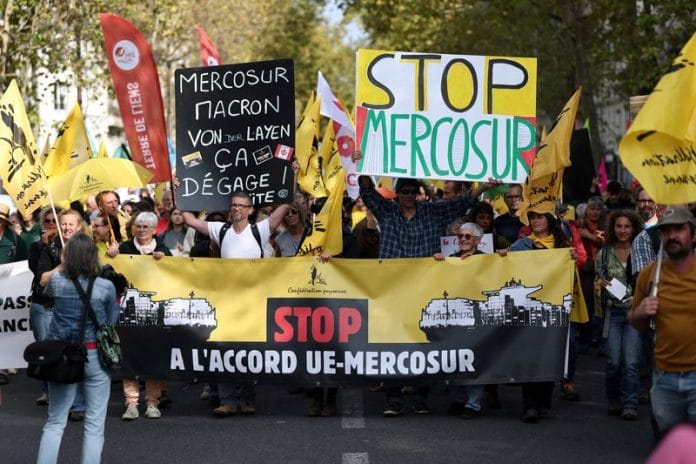
Italy and France last month dashed hopes for a December deal, saying they were not ready to support it until farmers’ fears of an influx of cheap commodities from Mercosur, including beef and sugar, were resolved.
However, Italian Prime Minister Giorgia Meloni welcomed a letter sent by the Commission on Tuesday proposing to accelerate 45 billion euros of support for farmers, describing it as a “positive and significant step forward”.
Italian Agriculture Minister Francesco Lollobrigida said the European Union was now proposing to increase spending on Italian agriculture in 2028-2034 rather than to cut it.
An EU source subsequently said Italy would now vote in favour of the Mercosur trade deal at a meeting on Friday.
The executive Commission, backed by countries such as Germany and Spain, is seeking to garner the broad majority of 15 EU members representing 65% of the EU population required to authorise the EU signature, possibly as early as January 12.
DEAL WOULD BE EU’S LARGEST IN TERMS OF TARIFF CUTS
They say the accord, which has been 25 years in the making and would be the EU’s largest in terms of tariff reductions, is vital to boosting exports hit by U.S. import taxes and to reduce reliance on China by securing access to critical minerals.
With Poland and Hungary opposed to the deal and France still critical, Italy’s stance is a key determinant of whether the deal can be signed.
The Commission has held discussions with member states over the past two weeks and the bloc is on track to sign the agreement soon, a spokesperson for the executive said.
The EU executive has invited all 27 EU agriculture ministers to a meeting in Brussels on Wednesday.
European commissioners for agriculture, trade and health are expected to give reassurances on future funding for farmers under the bloc’s Common Agricultural Policy, including a 6.3 billion euro ($7.4 billion) crisis fund in the next EU budget.
The Commission’s move to merge regional cohesion funds and CAP money in the next seven-year budget has alarmed farming nations.
The Commission will also review import controls, including permissible maximum levels of pesticide residues, two EU diplomats said.
“It is a critical moment to discuss demands from farmers,” one of the diplomats said. ($1 = 0.8538 euros)
(Reporting by Philip Blenkinsop, Julia Payne in Brussels, Giselda Vagnoni in Rome; editing by Mark Heinrich and Gareth Jones)
Disclaimer: This report is auto generated from the Reuters news service. ThePrint holds no responsibility for its content.