








By Jan Strupczewski and Lili Bayer
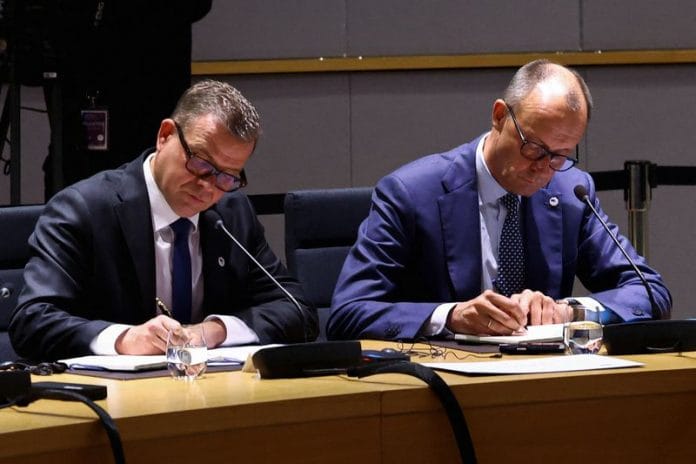
BRUSSELS, Jan 22 (Reuters) – EU leaders heaved a sigh of relief over Donald Trump’s U-turn on Greenland as they gathered for an emergency summit in Brussels, while saying that Europe’s relationship with Washington, though still crucial, had taken a hit.
The Thursday evening summit was convened before Trump stepped back on threats to impose tariffs or even take military action to acquire Greenland. His threats badly shook Europe’s confidence in its partner.
“Transatlantic relations have definitely taken a big blow over the last week,” the bloc’s foreign policy chief, Kaja Kallas, said as she arrived at the meeting.
TRUMP’S U-TURN IS GOOD NEWS, BUT EUROPE VIGILANT
“Things are quietening down and we should welcome that,” French President Emmanuel Macron said, describing the chaos of the past days that saw Trump issue major threats against Greenland and Europe before pulling back from those threats, saying a deal was in sight.
“We remain extremely vigilant and ready to use the instruments at our disposal should we find ourselves the target of threats again,” Macron told reporters, referring to “bazooka” trade sanctions the bloc had considered using.
Most leaders said the relationship with the United States remained key for the European Union and it was one they were ready to work hard to maintain – while expecting hard work, and respect, from Washington as well.
“Europe is not willing to junk 80 years of good transatlantic relations because of disagreements … we are willing to invest our time and energy in this,” Kallas said.
NO MORE THREATS
Danish Prime Minister Mette Frederiksen said she was more than ready to discuss security cooperation in Greenland with the United States – as long as it respects their sovereignty.
“We have to work together respectfully without threatening each other,” she said.
EU governments remain wary of another change of mind by a mercurial president increasingly seen as a bully whom Europe will have to stand up to. They are focused on coming up with a longer-term plan on how to deal with the U.S. under this administration and possibly its successors too.
“Trump crossed the Rubicon. He might do it again. There is no going back to what it was. And leaders will discuss it,” one EU diplomat said, adding that the bloc needed to move away from its heavy reliance on the U.S. in many areas.
“We need to try to keep him (Trump) close while working on becoming more independent from the U.S. It is a process, probably a long one.”
THE US HAS SUBSTANTIAL LEVERAGE
After decades of relying on Washington for defence within the NATO alliance, the bloc lacks the needed intelligence, transport, missile defence and production capabilities to defend itself against a possible Russian attack.
This gives the U.S. substantial leverage.
The U.S. is also Europe’s biggest trading partner, making the EU vulnerable to Trump’s policies of imposing tariffs to reduce Washington’s trade deficit in goods, and, as in the case of Greenland, to achieve other goals.
One of the key questions will be how close Europeans want to remain to the United States, and how much trust remains. All said Europeans need to be united and have a common stance, but historical ties vary from one country to another.
“I still treat United States as our closest friend,” Lithuanian President Gitanas Nauseda said.
Others were more cautious.
“It is important for … our partners in Washington to understand the difference between domination and leadership. Leadership is OK,” Poland’s Prime Minister Donald Tusk said. “Coercion is not a good method.”
WHAT’S IN THE GREENLAND ‘DEAL’?
The EU had been ready to deploy a package of retaliatory tariffs on 93 billion euros ($108.74 billion) of U.S. imports and anti-coercive measures if Trump had gone ahead with his own tariffs that were to kick in on February 1, officials said.
In protest over U.S. pressure to acquire Greenland, the European Parliament on Wednesday put on hold its work on ratifying the U.S.-EU trade deal agreed in mid-2025.
But European lawmakers are likely to resume their work on the ratification of the trade deal now that Trump has taken back his threats, European Parliament President Roberta Metsola said on Thursday.
Earlier in the day, senior parliamentarian Bernd Lange said parliament still needed clarity on U.S. plans.
“No one knows what this so-called solution is,” German Social Democrat Lange told Reuters.
“We would need a clear yes from Denmark and Greenland. It cannot just be an agreement between two individuals.”
(Additional reporting by Andrew Gray, Bart Meijer, Louise Rasmussen, Inti Landauro, Julia Payne Phil Blenkinsop, Ingrid Melander, Maria Martinez, Dominique Vidalon; Writing by Jan Strupczewski and Ingrid Melander; Editing by Gareth Jones, Andrew Cawthorne and Andrew Heavens)
Disclaimer: This report is auto generated from the Reuters news service. ThePrint holds no responsibility for its content.