








By Alexander Dziadosz, Marine Delrue and Maria Paula Laguna
CAIRO, Feb 2 (Reuters) – The deployment of a powerful model of Turkish combat drone to a remote airstrip on Egypt’s southwestern border signals a sharp escalation in Sudan’s civil war, suggesting one of its largest neighbours is being drawn deeper into the fray, more than a dozen officials and regional experts say.
Egypt, which shares the Nile River and a more than 1,200-kilometre frontier with Sudan, has provided staunch political backing to the country’s military in its nearly three-year conflict with the Rapid Support Forces (RSF) paramilitary group.
But while Egyptian security officials have privately acknowledged sending logistical and technical support to the Sudanese Armed Forces, until last year Cairo mostly refrained from direct intervention in fighting that has killed tens of thousands of people, displaced millions and spread famine across the vast country.
Cairo’s position toward the conflict started to change when the RSF made a series of advances in Sudan’s western Darfur region, first capturing a strategic northwestern triangle between Egypt and Libya in June and then overrunning the Sudanese military’s last foothold in Darfur, the city of al-Fashir, in October, according to eight regional analysts and three diplomats briefed by Egyptian officials.
Egypt’s presidency warned in December that the country’s national security was directly linked to Sudan’s, and Cairo would not allow its “red lines” to be crossed. Those lines include preserving Sudan’s territorial integrity and rejecting any “parallel entities” that threaten the country’s unity, it said.
Two Egyptian security officials told Reuters two airports in the south have been supplied with military equipment over the past eight months or so to secure the border and carry out military strikes to protect “national security.” The officials, who like other sources spoke on condition of anonymity, declined to provide details.
Satellite images from Vantor, a U.S. space technology firm, show a large drone on the apron of one of the airports, in East Oweinat, on September 29, December 28 and January 9.
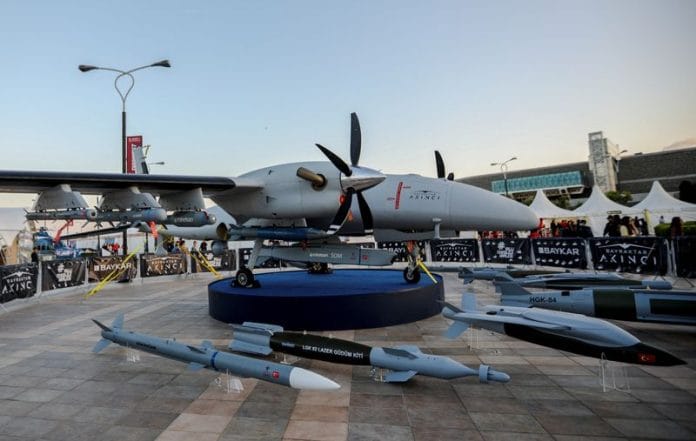
Two military experts who reviewed the images told Reuters the aircraft was identifiable as a Bayraktar Akinci based on its distinctive body and wing design. The New York Times has also published imagery of Akinci drones at the East Oweinat airstrip, which they reported were being used for strikes in Sudan.
The Akinci is one of the most advanced drones manufactured by Turkish defence firm Baykar, with the ability to travel at high altitudes, remain airborne for 24 hours and carry a wide range of munitions.
Egypt’s Foreign Ministry and State Information Service did not answer questions about operations at East Oweinat or in Sudan. Sudan’s military also did not respond to requests for comment.
A WIDE RANGE OF FOREIGN ACTORS
Egypt – along with Saudi Arabia, the United Arab Emirates and United States – is part of the so-called “Quad” of countries seen as most influential in the conflict, which has been trying, without success, to broker a ceasefire.
Cairo’s toughening stance adds another potentially explosive element to a conflict that has drawn in a wide range of foreign actors since April 2023, when the country’s military and the RSF fell out over how to integrate their forces during a planned transition to civilian rule.
U.N. experts have accused the UAE of providing weapons to the RSF, which Abu Dhabi denies. Sudan’s military has deployed Turkish and Iranian drones, and it has received political and other backing from Qatar and Saudi Arabia.
RSF head Mohamed Hamdan Dagalo has accused Egypt of being involved in airstrikes against the group since at least October 2024, which Cairo denied at the time. Shortly before al-Fashir’s fall, Dagalo said his forces were being attacked by aircraft taking off from “airports in neighboring countries”, warning they would be considered a “legitimate target” for his fighters.
The RSF did not respond to questions for this article.
The New Arab, a London-based pan-Arab news outlet, quoted an Egyptian military official as saying Egypt carried out an airstrike on an RSF convoy in the border triangle area on January 9. A diplomat in Cairo briefed by Egyptian officials said the strike was carried out from an airbase in southern Egypt. Reuters could not independently verify the accounts.
Samir Farag, a retired Egyptian military officer, said East Oweinat is one of the “main bases through which Egypt can secure its southern borders.”
The airstrip is located in a remote farming region, about 60 km (37 miles) from the Sudan border, and was primarily used to support a desert reclamation project before the war.
“Egypt doesn’t allow anyone to be present on its borders and threaten its national security,” Farag said. “It will intervene directly and manage the situation. This is the right of every country in the world.”
DRONE DEPLOYMENT AT THE BASE
While only one Akinci is clearly visible on any given day in the Vantor imagery, an image captured by U.S. satellite firm Planet Labs on December 28 almost certainly shows two outside one of the hangars, according to Jeremy Binnie, Middle East specialist at Jane’s, a defence intelligence company. Akincis can also be seen outside multiple hangars, suggesting more than one is being used to store drones when they are not flying, he added.
The presence of support equipment and loading material around the aircraft, and the fact that they appear in different locations, suggest they are being used, said Wim Zwijnenburg, a military technology expert at Dutch peace organisation PAX.
The images reviewed by Reuters also show renovations underway at the airport between early July and the end of January. The runway was being repaved and possibly widened slightly, and several smaller roads were added. There were also signs of digging and construction, with at least two small structures added.
The RSF says its territory has been attacked repeatedly with Akincis, claiming its fighters shot down at least seven since June. Reuters could not verify the claims.
Two videos posted on social media in mid-January showed what RSF fighters said was an Akinci shot down near Nyala, the group’s main stronghold in Darfur. The two military experts told Reuters the wreckage was consistent with a crashed Akinci, but the news agency could not determine when and where the videos were shot, or who was operating the drone.
In February 2024, Turkish Foreign Minister Hakan Fidan said Ankara would sell drones to Egypt as the two countries normalised ties following a decade-long rupture, but he did not specify what kind.
A Turkish Defence Ministry source said the countries reached an agreement on the sale of Akincis the same year. The source did not provide further details. A Western diplomat, who meets regularly with Turkish officials, said they had privately defended Egyptian airstrikes on the RSF as legitimate and had confirmed drones were recently delivered for use in the war effort but did not give further details.
Five of the six flights into East Oweinat that appear in flight tracking data from FlightRadar24 since September came from Turkey. Of these, three were Turkish Air Force-operated cargo planes from Tekirdag, the Turkish city where Akincis are tested, the data shows.
Reuters could not determine what was on the flights, which took place on December 25, December 26 and January 7.
The Turkish Defence Industries Presidency (SSB), which handles such agreements, the Akincis’ manufacturer, Baykar, and Egypt’s government did not respond to questions about the sale.
EGYPT’S SHIFTING STANCE
Justin Lynch, managing director of the Conflict Insights Group consultancy, which closely tracks the war in Sudan, said the drone deployment at East Oweinat was “an indication of Egypt’s recent policy to be more involved in Sudan”.
The airport is less than 400 kilometres from Sudan’s border triangle, a strategically sensitive region on Egypt’s doorstep through which the RSF can receive supplies from southeastern Libya destined for Darfur.
Supplies sent through that corridor proved instrumental to the fall of al-Fashir, during which the RSF was accused of widespread atrocities, including gunning down hundreds of civilians and holding residents hostage for ransoms.
The city’s fall was a turning point in Egypt’s previously “ambiguous” stance toward the conflict, said Jalel Harchaoui, a contributor to Britain’s Royal United Services Institute think tank.
“The Egyptian military harbors no affinity whatsoever for the Rapid Support Forces. Yet Egypt depends on the United Arab Emirates, a major backer of the RSF, for financial assistance,” he said. “When al-Fashir finally fell … Cairo’s equilibrium shifted toward taking tougher measures against the RSF.”
Egypt may also have been emboldened by Saudi Arabia’s moves to curb the UAE’s influence in Yemen, according to the analysts and diplomats who spoke with Reuters, a rivalry that has since spilled over into the Horn of Africa.
An Emirati official said the UAE was working with regional partners – including Egypt and Saudi Arabia – to secure a ceasefire in Sudan and that its “decisions have consistently favoured restraint over escalation”.
Saudi Arabia did not immediately respond to a request for comment.
(Alexander Dziadosz reported from Cairo, Marine Delrue from Barcelona and Maria Paula Laguna from Mexico City; Additional reporting by Nafisa Eltahir, Mohamed Ezz, Tuvan Gumrukcu, Giulia Paravicini, Andrew Mills, Timour Azhari and Milan Pavicic; Writing by Alexander Dziadosz; Editing by Alexandra Zavis)
Disclaimer: This report is auto generated from the Reuters news service. ThePrint holds no responsibility for its content.