





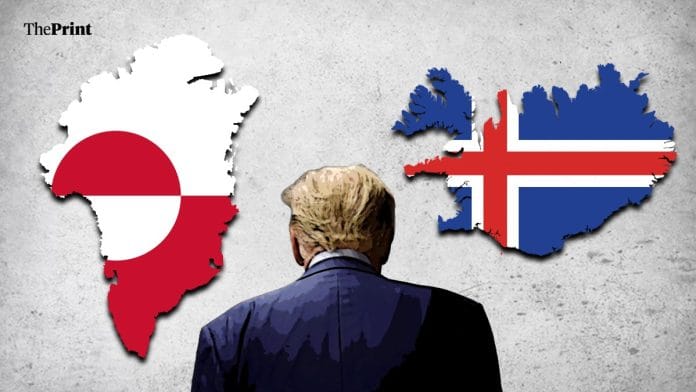



New Delhi: United States President Donald Trump mistakenly called Greenland “Iceland” during his Wednesday speech at the World Economic Forum in Davos, triggering a wave of giggles online and a flood of memes across social media platforms.
“FUN FACT: If you know the difference between Greenland and Iceland, you are smarter than the President of the United States,” said one of the X commenters.
A different post showed a map of Russia, with Iceland written on it, and the caption read, “Hey Trump, if you want to take over Iceland…”
Hey Trump, if you want to take over Iceland: This is what Iceland looks like on the map. pic.twitter.com/4YB9uH2i19
— Montrey (@Montrey82631182) January 21, 2026
Another post, on a more serious note, said: “Iceland sadly wouldn’t even be the first country invaded because a coloniser thought he was somewhere else,” among others, a reference to Columbus’s discovery of “Asia” or “India” in 1492 after he reached the Americas.
Other posts were memes that evoked a flurry of laughing emojis.
Iceland at the moment….as Trump repeatedly confuses them with Greenland pic.twitter.com/ej6FOslR2f
— Hugh Lovatt (@h_lovatt) January 21, 2026
It all started with Trump’s speech, in which he mistakenly blamed “Iceland” for the US stock market dip, saying “Iceland”—instead of Greenland—at least four times. His description of Greenland as “a piece of ice, cold and poorly located”, though, was closer to the facts.
“They’re [Europeans] not there for us—on Iceland—that I can tell you. I mean, our stock market took the first dip yesterday because of Iceland. So Iceland’s already cost us a lot of money,” President Trump said Wednesday.
And, while the world chuckles at the mix-up between two frosty North Atlantic neighbours, ThePrint takes a look at what sets Iceland apart from Greenland, distinctly, before any other geography cocktails.
Greenland and Iceland are neighbours—separated by the North Atlantic Ocean via the Denmark Strait, which is 290-300 km at its narrowest point. Despite sharing island status, a North Atlantic neighbourhood, and deceptively similar names, Iceland and Greenland boast distinct histories, languages, and vibrant cultures.
Greenland is an autonomous territory under the Kingdom of Denmark, with a population of 56,000–58,000. One-third live in the capital city of Nuuk. Ninety percent are Inuit Greenlanders, known as Kalaallit, who primarily speak Greenlandic, an Inuit language. The remaining 10 percent are mostly Danes and white Europeans—a minority.
The indigenous community of Greenland traces its lineage to the Thule culture, which migrated from North America, but due to Danish colonisation, the population’s genetic makeup has been significantly diluted. Not a total surprise that Danish missionary Hans Egede landed in Greenland in 1721, expecting to find descendants of early Norse settlers, but found the Inuits instead, and so began the years of colonisation.
Greenland’s history of colonisation is an aspect that the country shares with Iceland, which was under Norwegian/Danish rule until 1944.
In contrast with Greenland, Iceland is a sovereign country now. It has a population of 4,00,000, where nearly 80-90 percent have descended from original Norse/Viking and Celtic, i.e., Irish/Scottish, settlers.
Then there’s a fun animal fact that sets the two apart. Walruses are found in Greenland but not Iceland. Meanwhile, reindeer are found in Iceland, but not Greenland.
Moreover, both Greenland and Iceland may be islands, but the former is the world’s largest, spanning 2.166 million square kilometres. With an 80 percent ice cover and temperatures dropping to -30 degrees Celsius in winter, the vast land is largely uninhabited, and most people reside in the coastal areas. The territory supports limited vegetation and life.
Iceland, on the other hand, benefits from the Gulf Stream, a warm and swift Atlantic ocean current that originates in the Gulf of Mexico and flows to the North Atlantic Ocean. It faces milder winters—around 0 degrees Celsius—and cooler summers, with high rainfall making it wetter overall.
Iceland also sits at the Mid-Atlantic Ridge, which fuels intense volcanic activity—there are over 30 active systems now—with the country having effectively harnessed heat to generate electricity.
Overall, Iceland is warmer, with richer grasslands and more animals, aiding a higher population in a much smaller country, spanning 0.1 million square kilometres.
(Edited by Madhurita Goswami)
Also Read: ‘Will not take Greenland by force…we will remember if Europe says no,’ Trump says at Davos