





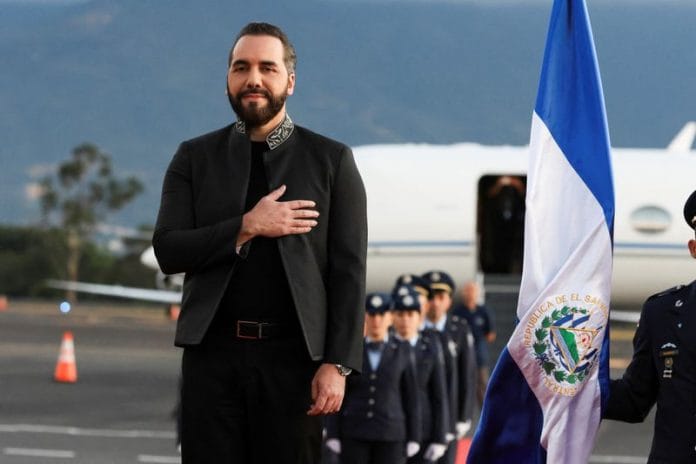



SAN JOSE, Jan 14 (Reuters) – El Salvador’s President Nayib Bukele inaugurated a new maximum-security prison in nearby Costa Rica on Wednesday, less than three weeks before Costa Ricans elect a new president in an election that has put crime front and center in campaigns.
Bukele’s government is helping build the prison, which Costa Rican President Rodrigo Chaves announced last year as part of a crackdown on violence fueled by drug trafficking.
The model for the new prison, El Salvador’s 40,000-inmate Terrorism Confinement Center (CECOT), is the centerpiece of Bukele’s war on gangs. The Salvadoran government is also providing technical assistance for the project.
“Everything we did in CECOT will be replicated in the Costa Rican version,” Bukele said on Wednesday, after describing how he took on a “dictatorship of organized crime” in his country.
While Bukele’s crackdown is credited with a sharp drop in El Salvador’s murder rate, human rights organizations report abuses within CECOT, describing inhumane conditions and deaths within the prison – allegations El Salvador’s government denies.
The new Costa Rican facility, named the Center for High Containment of Organized Crime (CACCO) and located about 11 miles (18 km) outside the capital San Jose, will have a capacity for 5,100 inmates and will increase Costa Rica’s prison capacity by 40%.
Costa Rica, long considered to be the safest nation in Central America, is grappling with a wave of homicides tied to drug trafficking groups fighting over territories and markets. Opinion polls rank insecurity as the public’s top concern ahead of general elections on February 1.
BURKELE WARNED NOT TO POLITICISE VISIT
Chaves leaves office on May 8, before the CACCO’s mid-year completion target. His party’s candidate, Laura Fernandez, leads polls to succeed him.
The ruling party is aiming to win in the first round, needing at least 40% of the votes, and hopes for a big enough legislative majority to be able to push through reforms similar to Bukele’s in El Salvador, especially in the judiciary.
“This CACCO will be empty if our laws don’t change and if the judiciary doesn’t change,” said Chaves, who has criticized Costa Rica’s justice system, saying it has worked against his government and been responsible for homicide rates that have hit record highs during his administration.
Chaves, who is facing corruption charges which he rejects, says the judiciary is politicised and corrupt. He is pushing for tougher penalties, restricting the possibility of alternative sentences, replacing judges and magistrates and making gang membership a crime.
Opposition groups criticized Bukele’s visit as potential interference in Costa Rica’s election. The Supreme Electoral Tribunal said on Monday that there were no laws preventing Bukele’s visit, though it warned him not to express support or opposition for political parties.
Chaves called this “a lack of respect” toward his guest and apologized to Bukele.
With a homicide rate of almost 17 per 100,000 inhabitants, less than a fifth of El Salvador’s figure a decade ago, Costa Rica needs to take measures soon to prevent the escalation of criminal gang control, Bukele said.
“If not, [crime] will continue to grow, and more Costa Ricans will die, and people won’t be able to go out on the streets at certain hours due to curfews,” he said, before admitting that the problems in both countries are different in nature, possibly alluding to the weight of the drug trafficking industry in the Costa Rican case.
(Reporting by Alvaro Murillo; Editing by Michael Perry)
Disclaimer: This report is auto generated from the Reuters news service. ThePrint holds no responsibility for its content.