





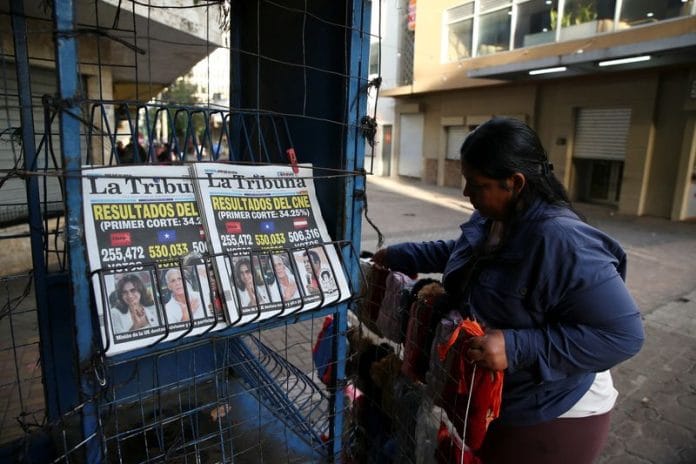



TEGUCIGALPA, Dec 1 (Reuters) – Nasry Asfura, the Conservative National Party candidate backed by U.S. President Donald Trump, led Honduras’s closely contested presidential election with 56% of votes counted, preliminary results showed on Monday, as the gap between the leading candidates narrowed.
A former mayor of Tegucigalpa, 67-year-old Asfura had 40% of the votes counted so far, just 4,100 votes ahead of the Liberal Party candidate Salvador Nasralla with 39.78% of the votes. Rixi Moncada, of the ruling LIBRE party, was third with 19.18%.
Preliminary data from Sunday’s election had shown a larger 2% gap between the first and second candidates, earlier on Monday.
Whichever candidate wins a simple majority will govern the country between 2026 and 2030.
Outgoing President Xiomara Castro reposted on X a message from her husband, former President Manuel Zelaya, calling for vigilance while “awaiting the final count, with 100% of the presidential ballots tallied.”
TRUMP WEIGHS IN TO SUPPORT ASFURA ON SOCIAL MEDIA
In the run-up, Trump weighed in on the tightly contested race to throw his support behind Asfura in a series of social media posts, saying he can work with him to counter drug trafficking and that “if he doesn’t win, the United States will not be throwing good money after bad.”
On Friday, Trump also said he will grant a pardon to former Honduras President Juan Orlando Hernandez, who is serving a 45-year prison sentence in the U.S. for drug trafficking and firearms charges. Hernandez, who led Honduras from 2014-2022, was also from the National Party.
Argentine President Javier Milei threw in his lot with Asfura as well, saying on social media that “he is the candidate who best represents opposition to the leftist tyrants who destroyed Honduras.”
Both Asfura and Nasralla have said they may resume diplomatic relations with Taiwan, which were severed in 2023. Such a move would mark the biggest diplomatic setback for China in the region for decades.
VOTE TAKES PLACE IN POLARIZED CLIMATE
Sunday’s vote, in which the 128 members of Congress, hundreds of mayors, and thousands of other public officials are also being chosen, took place in a highly polarized climate. Moncada has suggested she would not recognize the official results.
Most polls showed a virtual tie between the three candidates heading into election day. The Organization of American States expressed concerns about the electoral process.
U.S. Deputy Secretary of State Christopher Landau warned the U.S. would respond “swiftly and decisively to anyone who undermines the integrity of the democratic process in Honduras.”
On Sunday, some frustrated voters and electoral observers denounced officials for turning away citizens still waiting to vote.
DISTRUST OF ELECTORAL PROCESS
Honduras, where six out of every 10 citizens live in poverty, suffered a coup in 2009 when an alliance of right-wing military figures, politicians and businessmen overthrew Manuel Zelaya, the husband of the outgoing president, who was a Liberal Party member at the time.
In 2011, Zelaya founded the Libertad y Refundacion party, with which his wife swept to power in 2021, ending more than a century of rule by the National and Liberal parties.
Honduras’ Attorney General’s Office, aligned with the ruling party, has accused the opposition parties of planning to commit voter fraud, a claim they deny.
Prosecutors have opened an investigation into audio recordings in which a high-ranking National Party politician allegedly discussed plans with an unidentified military officer to influence the election. Those recordings, which the National Party says were created using AI, were central to Moncada’s campaign.
The Honduran military has also come under criticism for asking the National Election Council to give it copies of the tally sheets on election day, a violation of Honduran law.
These tensions contributed to a growing public distrust of the electoral authorities and the electoral process in general.
Castro, the first woman to govern Honduras, increased public investment and social spending. The economy has grown moderately, and poverty and inequality have decreased but remain high. The International Monetary Fund has praised her government’s prudent fiscal management.
The country’s homicide rate has also fallen to its lowest level in recent history, but violence persists.
Human rights groups have criticized Castro for maintaining a prolonged state of emergency in parts of Honduras and for continuing to rely on the military for policing, the approach of her predecessor Hernandez.
(Reporting by Laura Garcia in Tegucigalpa, Leila Miller in Buenos Aires and Diego Ore in Mexico City; additional reporting by Aida Pelaez-Fernandez; editing by Stephen Eisenhammer, Lincoln Feast and Sharon Singleton)
Disclaimer: This report is auto generated from the Reuters news service. ThePrint holds no responsibility for its content.