








Beijing: China’s top diplomat accused the U.S. of acting like a “world judge” by seizing Venezuela’s leader Nicolas Maduro to put him on trial in New York, with Beijing set to confront Washington at the United Nations over the move’s legality.
Beijing follows a policy of non-intervention and routinely criticises military activity conducted without the UN Security Council’s approval.
The U.S. military’s removal of the leader of one of China’s “all-weather” strategic partners from his capital in the dead of night will be a litmus test of Beijing’s assertion that it can play a role in resolving global hotspot issues without following Washington down the military route.
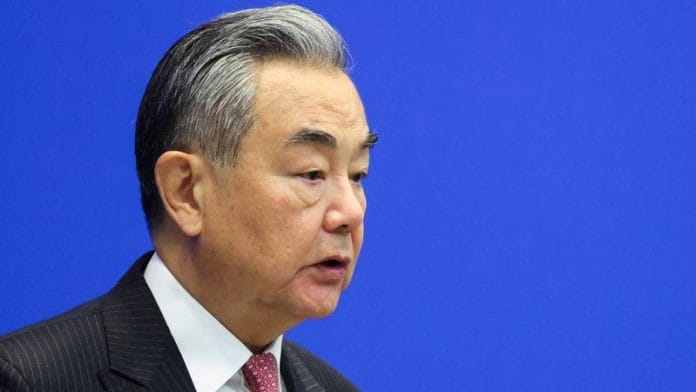
“We have never believed that any country can act as the world’s police, nor do we accept that any nation can claim to be the world’s judge,” Wang told his Pakistani counterpart during a meeting in Beijing on Sunday, referring to “sudden developments in Venezuela” without directly mentioning the United States.
“The sovereignty and security of all countries should be fully protected under international law,” China’s top diplomat added, in his first remarks since images of the 63-year-old Maduro blindfolded and handcuffed on Saturday stunned the world.
Maduro is scheduled to appear in a New York court on Monday to face drugs charges. Just blocks away, the UN Security Council will convene at Colombia’s request – backed by China and Russia – to debate U.S. President Donald Trump’s decision to seize him, a move UN Secretary-General Antonio Guterres has warned could set “a dangerous precedent.”
Analysts note China, the world’s second-largest economy and leading global trading partner, will be crucial in marshalling criticism of Washington’s actions.
“There isn’t much in the way of material support that China can offer Venezuela at this time, but rhetorically, Beijing will be very important when it leads the effort at the UN and with other developing countries to rally opinion against the U.S.,” said Eric Olander, co-founder of the China-Global South Project.
“What we’ve seen in the cases of Zimbabwe and Iran, both sanctioned by the West, is that China demonstrates its commitment to these relationships through trade and investment, even under difficult circumstances,” he added.
‘A BIG BLOW FOR CHINA’
With Trump also threatening military action against Colombia and Mexico and having remarked that Cuba’s communist regime “looks like it’s ready to fall” on its own, Latin American countries that signed up to Chinese President Xi Jinping’s flagship Global Security Initiative may now wonder how the pact will protect them if put to the test.
Xi on Monday urged all countries to abide by international law and the UN principles. He said major powers should set an example, while stopping short of naming the U.S. or Venezuela.
Beijing has had considerable success in persuading Latin American states to switch diplomatic recognition from Taiwan to China, with Costa Rica, Panama, the Dominican Republic, El Salvador, Nicaragua and Honduras all siding with the $19 trillion economy’s talk of strategic partnership over the last 20 years.
Venezuela switched recognition in 1974, a relationship that deepened under Hugo Chavez, the socialist former soldier who took power in 1998 and became Beijing’s closest ally in Latin America, distancing his country from Washington while lauding the Chinese Communist Party’s governance model and presiding over democratic backsliding at home.
The close relationship continued after Chavez died in 2013 and Maduro became leader, even enrolling his son at the top-ranking Peking University in 2016.
In return, Beijing poured money into Venezuela’s oil refineries and infrastructure, providing an economic lifeline as the U.S. and its allies tightened sanctions from 2017. China purchased around $1.6 billion worth of goods in 2024, according to Chinese customs data, the latest full-year figures available. Oil made up about half the total.
“It was a big blow to China, we wanted to look like a dependable friend to Venezuela,” said a Chinese government official briefed on a meeting between Maduro and China’s special representative for Latin American and Caribbean affairs, Qiu Xiaoqi, hours before the Venezuelan president was captured.
This report is auto-generated from Reuters news service. ThePrint holds no responsibility for its content.