





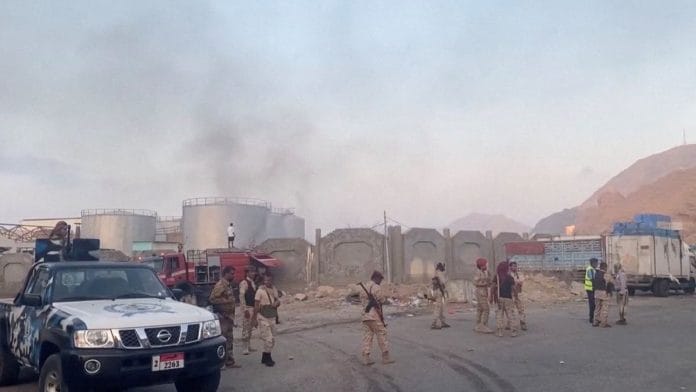



New Delhi: The United Arab Emirates Tuesday announced the withdrawal of its remaining forces in Yemen, after Saudi Arabia bombed the port of Al-Mukalla in a limited strike. The decision came after Riyadh accused Abu Dhabi—one of its closest partners—of moving military equipment to support the separatist Southern Transitional Council (STC) in Southern Yemen.
The latest flare-up between Riyadh and Abu Dhabi highlights the growing tensions between ostensibly the closest partners in the region, as both Saudi Arabia and the UAE continue to compete across West Asia and North Africa for influence.
The strikes by Riyadh occurred moments after Rashad al-Alimi, the internationally recognised president of Yemen made a speech demanding the UAE’s withdrawal from the country. Alimi is the leader of the Saudi Arabia-backed Presidential Leadership Council of Yemen.
The UAE is also part of the Riyadh-led coalition that has been locked in conflict with the Iranian-backed Houthi movement that is in control of large swathes of north Yemen, including the capital city of Sana’a, for a decade.
However, despite both Saudi Arabia and the UAE being a part of the same coalition, both countries have backed different organisations within south Yemen. Alimi has received strong support from Riyadh, while the STC, whose leader Aidarus al-Zoubaidi is one of the four vice chairmen of the Presidential Leadership Council backed by the UAE.
The Riyadh-led Arab coalition that intervened in the civil war in Yemen against Iranian-backed Houthis has now fractured, with the UAE’s withdrawal. For Saudi Arabia, instability in the governorates of Hadramout and Al-Mahara is a sensitive issue, given its fears that the violence could spill over into its borders.
The STC in early December had launched its own operation to take control of the two governorates that led to Khalid bin Salman, the Saudi defence minister issuing an “open letter” to the people of Yemen Saturday, urging the STC to withdraw from Hadramout and Al-Mahara.
“It is time for the Southern Transitional Council in this sensitive phase to prioritise the voice of reason, wisdom, the public interest, and unity of ranks by responding to the Saudi-Emirati mediation efforts to end the escalation, withdraw their forces from the camps in the two governorates, and hand them over peacefully to the National Shield forces and the local authority,” Salman said.
The latest air strike comes after the Houthis and Riyadh have maintained an uneasy ceasefire in Yemen since 2022. The Saudi Arabia-UAE faultline also extends in conflicts in Sudan, according to Financial Times.
What Riyadh & Abu Dhabi said Tuesday
Saudi Arabia alleged that UAE undertook steps considered to be “highly dangerous”, stressing that any action that is a threat to Riyadh’s national security is a “red-line”. “The Kingdom of Saudi Arabia expresses its disappointment by the actions taken by the brotherly United Arab Emirates, pressuring the Southern Transitional Council’s forces to conduct military operations on the southern borders of the Kingdom in the governorates of Hadramout and Al-Mahara,” Riyadh’s statement read.
#Statement | Pursuant to the statement issued by the Ministry of Foreign Affairs on 25/12/2025 corresponding to 5/7/1447 regarding the Kingdom’s concerted efforts, working with the brotherly United Arab Emirates, to end and contain the escalatory steps taken by the Southern… pic.twitter.com/lTyU0gLgpf
— Foreign Ministry 🇸🇦 (@KSAmofaEN) December 30, 2025
Before pulling out its troops, UAE initially rejected any attempt to implicate Abu Dhabi in pressuring the STC to undertake its current military operations to control the two governorates in southern Yemen. It had added that there were no weapons unloaded in the port of Al-Mukalla, and that the vehicles struck were meant to be used by its remaining forces in Yemen, which were present for counterterrorism operations.
Announcing the withdrawal, the UAE defence ministry said in a statement on X, “The Ministry of Defence notes that the UAE Armed Forces concluded their military presence in the Republic of Yemen in 2019 after completing the assigned missions within the agreed official frameworks. The remaining presence was limited to specialised personnel as part of counterterrorism efforts, in coordination with relevant international partners.”
It added, “In light of recent developments and their potential implications for the safety and effectiveness of counterterrorism missions, the Ministry of Defence announces the termination of the remaining counterterrorism personnel in Yemen of its own volition, in a manner that ensures the safety of its personnel and in coordination with the concerned partners.”
This statement is issued with reference to the statement made today, Tuesday, 30th December 2025, by the Ministry of Foreign Affairs of the United Arab Emirates regarding the ongoing developments in the Republic of Yemen, and the facts it outlined concerning the presence of the… pic.twitter.com/EN3kkMbuDa
— وزارة الدفاع |MOD UAE (@modgovae) December 30, 2025
The situation in Yemen
Yemen has been mired in a civil war since 2014, when the Houthis backed by Iran left the northern stronghold of Sadaa, and captured swathes of the most populous regions of Yemen. The Saudi-backed Arab coalition—that included the UAE—intervened in 2015 with airstrikes targeting the Houthis.
However, by 2019, the UAE removed a majority of its forces from Yemen as it recalibrated its strategy, but continued to maintain a presence within the Arab coalition. By 2022, the Houthis and the Saudi-led coalition came to an understanding for a ceasefire that has mostly been held over the last three years.
Yemen continues to remain a deeply divided country, with the capital still in the hands of the Houthi rebels. The STC, considered to be one of the most powerful groups in the country, pushes for the independence of southern Yemen from the rest of the country as it was before the unification in 1990.
The province of Hadramout, for example, is one of the wealthiest in Yemen today, and having it under control would further aid the STC’s cause. The STC was formed in 2017.
Saudi-UAE competition
While the main combatants in Yemen maintained the ceasefire, competition between Riyadh and Abu Dhabi continued to grow in other conflicts. In Sudan, for example, Abu Dhabi has been supporting the Rapid Support Forces (RSF), the rebelling organisation against the internationally recognised government that moved its operations to Port Sudan, according to reports.
Saudi Arabia has supported the government forces in Sudan, indicating the gulf with the UAE. In 2017, Riyadh and Abu Dhabi, along with Bahrain and Egypt, imposed a blockade on Qatar that lasted for over three years, due to Doha’s continued support for terrorist organisations and funding for Iran, reports have said.
Both Riyadh and Abu Dhabi are key partners for the US in the region. The UAE is also a signatory to the Abraham Accords, maintaining ties with Israel for the past half decade. Riyadh was also reportedly keen on the Accords until the war in Gaza began in 2023.
(Edited by Mannat Chugh)
Also Read: Foxhole ‘comrades’ to NATO membership for Russia: Timeline of Bush-Putin bromance & how it ended