





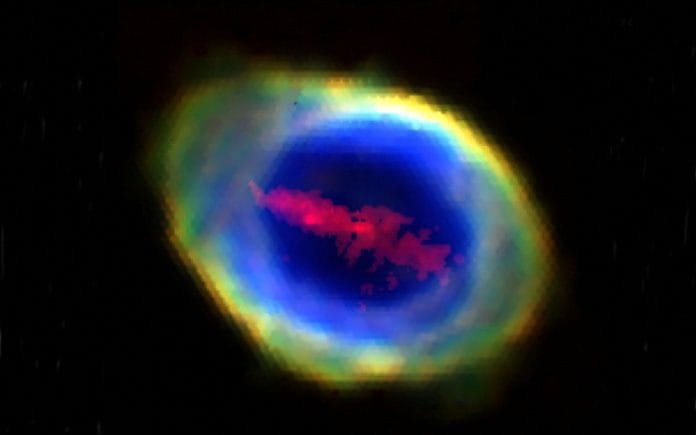



WASHINGTON, Jan 19 (Reuters) – The Ring Nebula, a stunning celestial structure residing in our neighborhood of the Milky Way galaxy, was discovered by French astronomer Charles Messier in 1779 and has been studied extensively ever since. But that does not mean we have it all figured out.
Researchers have spotted a large cloud of iron atoms in the shape of a bar stretching about 3.7 trillion miles (6 trillion km) long across the face of the nebula, which is a glowing shell of gas and dust expelled by a dying star, and are searching for an explanation.
They said it is possible the iron atoms, collectively comparable to the mass of Earth’s molten iron core, are the remnants of a rocky planet that was vaporized when the star threw off its outer layers, though they cautioned that such an explanation is mere conjecture at the moment. The inner rocky planets of our solar system, potentially even Earth, could face the same fate when the sun goes through these same death throes billions of years from now.
The researchers made the observation using a new instrument called WEAVE, short for WHT Enhanced Area Velocity Explorer, on the William Herschel Telescope, located on the Atlantic Ocean island of La Palma in Spain’s Canary Islands.
“It is exciting to see that even a very familiar object – much studied over many decades – can throw up a new surprise when observed in a new way,” said astronomer Roger Wesson of Cardiff University in Wales and University College London, lead author of the research published in the journal Monthly Notices of the Royal Astronomical Society.
“It’s a classic object for professional and amateur astronomers alike to observe,” Wesson said. “Although it’s too faint to see with the naked eye, it’s quite easy to spot with binoculars. In a small telescope, you can see the ring-like appearance.”
The Ring Nebula, also called Messier 57, is located about 2,600 light years from Earth in the constellation Lyra. A light-year is the distance light travels in a year, 5.9 trillion miles (9.5 trillion km). It is believed to have formed roughly 4,000 years ago, very recently in cosmic time.
It is familiar even to beginning students of astronomy.
“You’ll find it in many astronomy textbooks,” University College London astronomer and study co-author Janet Drew said.
That is why the iron bar is so intriguing.
“No other chemical element that we have detected seems to sit in this same bar. This is weird, frankly. Its importance lies in the simple fact that we have no ready explanation for it, yet,” Drew said. “The origin of the iron might trace back to the vaporization of a planet. But there could be another way to make the feature that doesn’t involve a planet.”
“A planet like the Earth would contain enough iron to form the bar, but how it would end up in a bar shape has no good explanation,” Wesson said.
The nebula formed when a star about twice the sun’s mass ran out of nuclear fuel in its core, swelled up into what is called a red giant and expelled its outer layers before becoming a compact stellar remnant known as a white dwarf, approximately the size of our planet.
“From the perspective of Earth, it has the appearance of a ring, although it’s believed that it’s actually more like a cylinder of material that we are seeing end-on. It’s made up mostly of hydrogen and helium, with small quantities of heavier elements,” Wesson said.
About 3,000 such nebulas are known in our galaxy. Studying them lets astronomers examine the life stage of stars when chemical elements forged by nuclear processes inside them are released into interstellar space to be recycled and contribute to the next generation of stars and planets.
“We look forward to getting more data to follow up on this discovery, to try to unravel this new problem and work out where the iron bar has come from,” Wesson said.
(Reporting by Will Dunham; Editing by Daniel Wallis)
Disclaimer: This report is auto generated from the Reuters news service. ThePrint holds no responsibility for its content.