








By Nandita Bose, Sarah Morland and David Brunnstrom
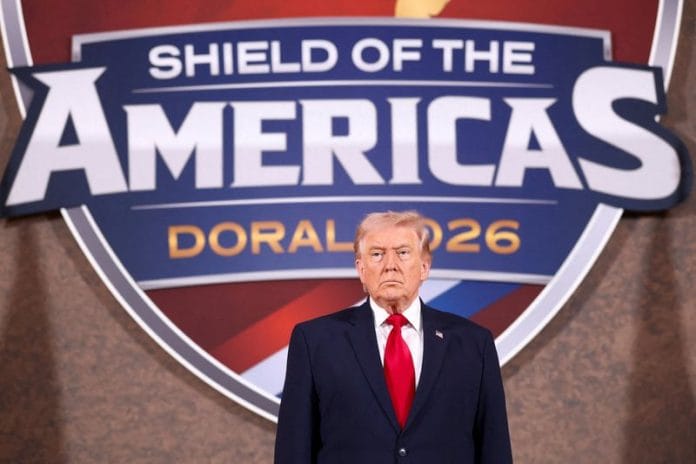
MIAMI, Florida, March 7 (Reuters) – U.S. President Donald Trump welcomed Latin American leaders to Florida on Saturday to launch a new coalition against drug cartels, even as he struck a dismissive tone toward the region, telling officials their countries had allowed gangs to seize territory and joking that he had no time to learn their languages.
Trump framed the effort as an aggressive campaign to confront drug cartels, citing them as a primary reason for ramping up U.S. involvement in Latin America, including a pressure campaign against Venezuela that culminated in the January capture of President Nicolas Maduro. At one point, Trump suggested the United States could use missiles against cartel leaders if partners requested it.
He also singled out Mexico as the center of cartel activity and predicted major political change in Cuba, saying the country was “very much at the end of the line” and repeating previous statements that Cuban officials are negotiating with him and Secretary of State Marco Rubio.
At least a dozen leaders from Central America, South America and the Caribbean joined the “Shield of the Americas” summit, where Trump signed a proclamation launching the coalition.
“Leaders in this region have allowed large swaths of territory in the Western Hemisphere to come under the direct control of transnational gangs, and they’ve run areas of your country,” Trump said. “We’re not gonna let that happen.”
In an opening speech that ran more than 30 minutes, Trump also touched on topics far beyond drug cartels, including Iran, Ukraine, Pakistan and India, political endorsements, former president Jimmy Carter, Dominican sugar, building battleships, Treasury Secretary Scott Bessent’s “soothing” personality, Mexican President Claudia Sheinbaum’s “beautiful voice,” and the importance of interpreters.
Trump joked about language differences between himself and the mostly Spanish-speaking group of leaders. “I’m not learning your damn language,” he said. “I don’t have time.”
Rubio, a son of Cuban immigrants, later delivered brief remarks in English and Spanish, while Secretary of Defense Pete Hegseth echoed Trump’s stance.
“I only speak American,” Hegseth joked.
Trump also joked about Kamla Persad-Bissessar, the prime minister of Trinidad and Tobago, saying that her name looked similar to that of former U.S. Vice President Kamala Harris.
Trump has pushed to build a coalition of regional partners around a more forceful approach to combating drug cartels and organized crime. Saturday’s event also gave him an opportunity to project strength closer to home as the war with Iran escalates and threatens to push up global oil and gas prices.
Earlier in the day, Trump said Iran would be “hit very hard” on Saturday and that he was considering widening the areas and groups of people targeted, without providing details
RIGHT-WING ALLIES ATTEND SUMMIT
Among those who attended the summit were Argentine President Javier Milei, Chile’s President-elect Jose Antonio Kast and Salvadoran President Nayib Bukele, whose gang crackdown, criticized by human rights groups, has become a model for parts of Latin America’s right.
Politicians from across the region have toured Bukele’s sprawling “mega-prison”, where the United States last year deported more than 200 Venezuelans without trial.
Also in attendance was Honduran President Nasry Asfura, who narrowly won a disputed election with Trump’s backing, and Ecuador’s President Daniel Noboa, who has echoed parts of Trump’s economic agenda and recently announced joint operations with the U.S. in a military crackdown on drug trafficking.
Many of the leaders share Trump’s hardline view of crime and migration, favoring crackdowns over deeper social fixes and private business over the state. Their rise reflects a broader rightward turn in parts of Latin America at a time when the region is being pulled between Washington and Beijing.
COUNTERING CHINA’S GROWING REGIONAL INFLUENCE
Trump did not mention China specifically but warned that the United States would not allow “hostile foreign influence” to gain a foothold in the Western Hemisphere, including in the Panama Canal, a key global freight route.
The comments, while not explicit, come as Washington increasingly views Latin America through the lens of strategic competition with Beijing.
China’s trade with the region reached about $518 billion in 2024 and Beijing has extended more than $120 billion in loans to governments across the Western Hemisphere, according to Ryan Berg of the Center for Strategic and International Studies.
China’s growing footprint — from satellite tracking facilities in Argentina to a Chinese-backed port in Peru and economic support for Venezuela — has long troubled U.S. officials.
In response, the Trump administration has pressed governments across the region to curb Beijing’s role in ports, energy projects and other strategic infrastructure.
(Reporting by Nandita Bose in Miami, Florida, David Brunnstrom in Washington and Sarah Morland in Mexico City; Additional reporting by Simon Lewis in Washington and Natalia Siniawski in Mexico City, Editing by Sergio Non, Himani Sarkar, Alex Richardson and Alistair Bell)
Disclaimer: This report is auto generated from the Reuters news service. ThePrint holds no responsibility for its content.