





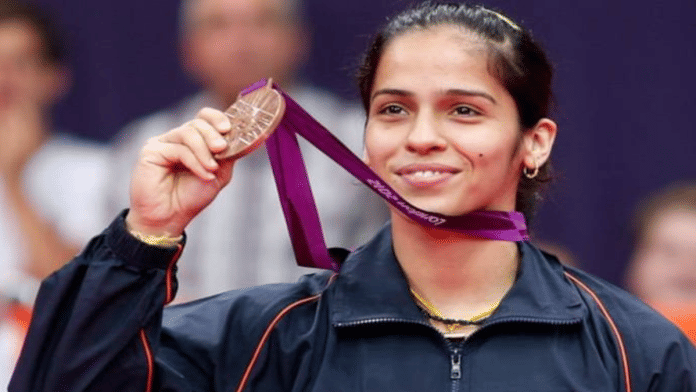



The first Indian badminton player to win an Olympic medal, first Indian female and youngest Asian to win a 4-star tournament, first Indian to win a BWF Super Series title—Saina Nehwal has been a true trailblazer on the badminton court. In 2015, just about a decade into her career, she rose to attain world number 1 ranking, becoming the only Indian badminton player, after Prakash Padukone in 1980, to achieve this feat.
Earlier this week, Nehwal announced her retirement, bringing to an end what can only be called a defining chapter of Indian sports.
In this 2015 edition of Walk the Talk, she talks to ThePrint Editor-in-Chief Shekhar Gupta about the initial moments of her career, of the rising popularity of badminton, of struggling with mental and physical pressures, as well as on her controversy with the Sports Ministry after her Padma Bhushan rejection.
Here is a complete transcript of the interview, edited for clarity.
SG: Hello and welcome to Walk the Talk. I’m Shekhar Gupta, in Bangalore at the Tata Padukone Badminton Academy. We were here about 10 years back to record a Walk the Talk with one of the greatest past legends of Indian badminton. And my guest today, a current legend and a legend for the future, Saina Nehwal.
SN: Thank you. Thank you.
SG: Wonderful to have you on Walk the Talk for the first time.
SN: I’m honoured to be on the show.
SG: You’ve been a star for many years now.
SN: Yes, sir. It’s all hard work and the sacrifice from my parents’ side, from my side, and the hard work of my coaches. So, almost like, 16 years now! I started at the age of 9, so I’m 24 now. It’s a long journey, but a sweet one because there are a lot of titles that I won. Also, there were some tough times, but all are okay because I have so many titles with me now.
SG: In fact, you won your first title at 18?
SN: 16, sir.
SG: 16
SN: That was in the Philippines. That was my first major international event. And in that event, I beat World Number 3, Zuhu. I won, and I was World Number 200 or something. I never expected to win such a big title at such a young age, but that gave me the confidence that I can go ahead and beat the best players in the world.
SG: It’s very tough at that young age to be a badminton player because, I see all these kids training here, it’s a very physical game!
SN: Of course, badminton is a very physically demanding game. It’s one of the toughest games in the world. But what happens in this sport, you don’t have any kind of restrictions. You have to keep working in each and every area of your… Whether it is on-court or off-court. It’s very much required that you do training for your upper body, for your lower body, or the strokes you have to improve, tactical or physical. So everything is required. It’s a very difficult game, but whoever is physically and mentally strong, they can push and they can…
SG: It requires both, touch and strength.
SN: Touch and strength, yeah. But you have to be physically and mentally very strong. If you are, then I think you can go ahead and do it. It’s not impossible.
SG: The game is very fast now.
SN: Yes, it’s become very fast and very long. Especially in the girls’, it’s become very long.
SG: Almost like lawn tennis. Just pushing it back from baseline in tennis.
SN: Yeah, but tennis is more like… It’s a little different from badminton because badminton has got a lot of fast reflexes as well. You don’t have so much time to think in between the shots. So it’s very quick, and especially in the girls, it’s become even longer. You have to continuously play for one and a half hours or one hour at least. So it’s become very, very tiring for the girls, especially.
SG: For a young champion, a very young champion, what is the toughest part? Is it to maintain your physical strength or mental strength? And what is more tiring? What is more demanding?
SN: Mentally, touchwood, I am mentally very strong.
SG: Tum to jaatni ho
(Both laugh)
SN: That is a plus point. My mom is a person who never gives up. She was also a badminton player. Yes, absolutely. I know. Both of them used to play really good. And she’s the one who made me mentally very strong. When I was nine, she used to tell me, Saina, you have to get an Olympic medal for me. At that time, I was just laughing it off because I was like…
SG: Nobody had got an Olympic medal until then.
SN: Nobody has got an Olympic medal. I was like, is she joking with me? You’re a kid. You never know what will happen in the future. But she had that aim for me. And she….
Even if I used to get tired, sometimes she used to push me- “you have to work hard, you have to train hard”.
And same with the coaches. My first coach, SM Arif, used to make us do a lot of physical training that really helped me to make my, you know, my basics very strong. Actually, because of that training, till today, I have that endurance level and strength. Because what you learn in your childhood remains with you till the end of your career. So that’s, I’m really thankful to him because I got such a good coach at the start of my career, that he really took care of my physical fitness.
And of course, Govardhan sir was helping me out on the court. And then came Gopi sir after that, three years later. He was, of course, All England champion. So he knew a lot more things about international badminton. So with his experience, within two years of time, I beat Aparna Popat, who was world number 28 then, and won the Philippines Open. So luckily, I got good coaches at the right time. And they made my game change according to the current, the current how the people are playing.
SG: And now you’ve also got good competition at the right time, that’s for it. Even domestically. That was a big problem earlier.
SN: That’s right. And then finally, Vimal sir is helping me out now personally. Of course, when you have so many kids at the same place, it’s difficult to concentrate on one person every time. So I thought, Vimal sir had some opinion on my game and he thought that I’m weak in some areas and I have to improve on those areas. So I thought maybe I should try out with him. And it’ll be a little change also.
SG: So this time you haven’t fought with Gopichand?
SN: No, no, this was nothing like that.
SG: Last time you fought with him?
SN: Yeah, it was something. And obviously, when you are 20, 19-20, you’re young, you don’t know what is going on. So obviously, some things went wrong here and there. But both the coaches, Gopi sir and Bhaskar Babu sir, really helped me out a lot. And I’m thankful to them that they were not…They were okay about it and finally everything was sorted out.
SG: Before we talked about it.
SN: Everything was okay.
SG: I think you made up in Denmark.
SN: Yes, I just told him that the things are not working out and my game, I see that I’m getting stuck somewhere, again, I have to improve. So he said, no problem, we’ll work it out. And it was a great thing.
SG: And you told him, you really want that medal at the Olympics?
SN: Yes. I told him, let us plan it out in a good way. Let us just forget everything now and just focus on the Olympics. And it showed good results. And finally, I had that Olympic medal with me.
SG: Everybody knows that you’re happy to play a long game. In fact, I was present in Delhi in the Commonwealth Games final, which really went to the wire, as they say, till the last point.
SN: Yes. Actually, I’m a player who can play long rallies as well. I am a very attacking player as well. So I’m good at both these things. So I don’t mind if I play matches for 2 hours or 3 hours. It’s just that, as I said, the physical fitness, which I did at the age of 9 and 10, was very, very tough and very good. So that made me physically very, very strong. And I continue it till today. I try to make myself physically very strong. And of course, then if you are physically strong, then on court, you can take care of it. It’s not that difficult to take care on-court, but off-court, you have to be very, very good.
SG: You’ve dealt with injuries
SN: Yes, I have.
SG: At a very young age also.
SN: Because when you play at the highest level, for almost like, as I said, I won my first schedule at the age of 16. So it’s been eight years now. So it is obviously difficult to maintain yourself at the highest level for so many years. But I am thankful to God that I’ve been in the top 5 for so many years now, and been World Number 2, beat so many top players. But it’s a part and parcel of the game. You have to go through with injuries.
SG: And now the league is so complex. It’s becoming like tennis now. These rankings keep changing all the time.
SN: They keep changing, but the difficult part is to maintain it. It’s a very difficult part. I’ve gone through a toe fracture which made me sit for almost six weeks. Then I went through some knee injuries. That was a difficult time because I had to play with the knee tape and I couldn’t do a few of the exercises which I was doing before. And I once had an ankle injury that almost took four, five weeks. So these things happen when you play at the highest level.
When you win titles, you can never be at your best always. So the same thing happened with the current world number 1, Li Xuerui. She’s suffering from some injury, and she’s not been playing in the last three months. So it’s because the first half of the season, she played excellently well. So sometimes you have to deal with these situations. And I think now she’s resting. Of course, she’ll be back again fresh and fit, but every player goes through it.
SG: She’s your favourite rival.
SN: She’s my favourite. All the Chinese are my favourite rivals because they are the ones who give tough fights to all the top players. And I respect them a lot because they have such a good training system. They’re very well planned.
SG: In China?
SN: Yeah, in China, they’re very well planned. They have the best of coaches in the world with them. And every player gets that amount of training required, only speciality to one player. It’s very, very nice to see that every player is always improving from China.
SG: From China.
SN: Always giving best results. But now India is no less. We are also doing well.
SG: We have an assembly line also now.
SN: We are also doing well.
SG: People don’t realise this, but in badminton, we have number fours for women as well as men.
SN: But the only thing we are lacking at, now, is the number of academies in India and the number of academies in China. We only have two academies in India, and we are just managing with that and still coming out as winners. But they have so many academies, so many kids who are playing badminton, and so much support from the sponsors. And obviously, the government is now supporting us a lot in a big way. But that thing has been happening with them for the last so many years. So that’s why they are able to produce those champions.
SG: That’s begun to change in India. It’s changing in India.
SN: Yes, yes.
SG: Now you’re getting commercial sponsorship also.
SN: Yes, yes.
SG: You have a league.
SN: Yes, we have a league. So that’s a big thing. All the sportpersons, not only the top players but the youngsters who are learning the game. They also have good opportunities to learn from the senior players and also financially they will be very well off.
SG: Nobody can grudge it to you. I do hope that you make more and more and more and more money with your honours, but the fact is that you, at your age today, can make a lot more money than even Prakash could, because stardom is now coming to badminton.
SN: Yes, it’s coming to badminton but I never started playing badminton because you know… I never knew what money is, at the age of nine. I just know that you want to win, I wanted to win always. More than badminton, it was only about winning. Because I never liked badminton so much. Only because my parents used to play. I used to watch them play and when we shifted to Hyderabad from Haryana one year.
SG: Most people don’t realise that you are actually Haryanvi. I have to keep underlining that.
SN: Because what happened was, when I was 8, I moved to Hyderabad and I was a very sporty person. I used to play all kinds of sports. But when I moved to Hyderabad, it was like only going to school and coming back home so I told my dad I have to do something different. So he put me in karate for a year and I am also a brown belt in karate. So that was at a very young age, I was only eight.
But the only thing was, I couldn’t continue it because it was too difficult for an 8 year old to take those difficult exercises and all those things. So I told my dad that I should play some game now that is more like, you know, a running game.
SG: And more movement.
SN: And more movement and all that. So he was like, because they were familiar to badminton, and as I said they used to play some badminton and he had some tournaments in Lal Bahadur stadium.
SG: Right, in Hyderabad.
SN: So my father told me, let’s go there and see if you get a chance. You just play in the summer camp. If you get selected for the regulars that will be very good. But the thing that happened was I joined the summer camp and I lost to one of the girls in the final round, in the last days of the camp and they could select only one player for the regulars.
So I was like, “Oh god, now I’ve lost. So I won’t be selected for the regulars”. But that girl had to go back to Maharashtra because she was studying there, so that’s how I got into it and started playing tournaments at the state level, at the school level. I started winning it and felt it’s nice, it’s good. But I didn’t know the journey was going to be so difficult, so hard. But I, I enjoyed every moment.
SG: When you play an intense game of badminton, it’s a very fast game and maybe table tennis is faster but badminton is quite fast. Points are running by, points change very fast. There is a new system. There is no respite or service change, etc, etc. What goes on in your mind. How do you keep your mind in control?
SN: I know, this is what is difficult nowadays but one thing which actually goes in everyone’s mind is- what will happen? Will I be able to do it or not? Before entering the court. But when you enter the court. You get the feeling that you are playing well, you sense it somehow and you just feel like continuing it and you feel like you are winning and you are a little bit in that zone of just playing and giving your best. But somedays, you feel a little tired and your body is not reacting.
Those are the days that you get a little frustrated and see yourself getting demotivated.
But most of the time, I just keep myself calm and relaxed and just give a touchwood and most of the time I come out as the winner.
Most of the time, I also lost some good close matches which I could have won because of tiredness, and mentally sometimes you don’t feel like pushing because you’ve already played some tough matches. Those are the days which really make me feel a little bad but otherwise, on court, I go with a very positive attitude and always with a killing attitude.
SG: That we can see. Particularly with the Chinese at the other end!
SN: Yes, yes.
SG: You have a specialty for the Chinese.
SN: Because they’ve been my competitors for like 5-6 years now. And even they feel, you know, that when Saina is playing against them, they also have that kind of feeling that we have to do well and win against her. So on both ends, it’s a very difficult and challenging thing. So whenever we play against each other, it’s always a very long, tough match with anyone, whether it’s Li Xuerui, whether it’s Wang Yihan or whether it’s Wang Shixian or any other Chinese player. They almost have 6-7 of them in the Super Series on any given day, so it’s very challenging to play against any one of them.
SG: And you hate to lose against the Chinese, particularly.
SN: I am sure everyone, because all of them are playing very well. Now internationally, if you see Thailand, Korea, Japan, India, Chinese Taipei. All are coming up very well. But when they play against the Chinese, they have that extra, you know, they always learn something different and they come out as winners most of the time and everyone just wants to win against them. It’s challenging with everyone and everyone wants to give them a tough time.
SG: Is there any moment, in your very young life, where you thought—‘Why do I have to work so hard’?
SN: I think most of the time, it happens because when you have to work so hard every day for 8 to 9 hours, when you go to tournaments and when you win you are happy. You want to come back and want to play hard. But when you lose, ‘why am I doing so much hard work, why do I have to push myself so much’, you somehow get that kind of feeling.
But you love the game so much now that you can’t.
SG: And what gets you angry? Does something get you angry?
SN: Many things get me angry, you know. Jaatni, as you said. Jaat people get angry very fast so yes, I do get angry very fast. Luckily people around me, my father, my mother. They just…
SG: What do you get angry about?
SN: Like I said, losing matches is one thing that makes me a little angry and a little irritated. But, apart from that. As a player, half our life is spent on the court so we don’t have so much time to think about other things. But, sometimes, you know people speak bad about me or they criticise me or something like that, I feel a little bad, you know.
SG: That’s only because they want you to win.
SN: I understand. But, you know, the thing is I am playing for my country. I always want to win. I am not the kind of person who will just lose when they get to the court, you know. Sometimes it happens in such a difficult sport and maybe the amount of hunger of winning which a player has. Nobody has got it.
So obviously those things make you angry sometimes, it’s not that you always think about it. But sometimes when you lose matches, and then suddenly people forget what all you’ve won. So those are the things you just remember and feel bad. Otherwise its nothing like that.
SG: Does the Padma Bhushan issue also make you angry? That you are being ignored?
SN: I was not angry about anything. They just made it like that. All is okay, you know.
Susheel’s name was there, I was very happy. He deserves the award. Of course, he deserves it. But there was something, you know, I know what went wrong. So I just spoke about it. I am not a person… I am not 40 years old to just, you know, think about it, I am a young person. I just said something which I felt was wrong for me.
So I just felt bad, I just talked about it. I was not angry about anything.
SG: So, disappointed?
SN: It made me angry for the next 2-3 days, about what all is happening and, now the topic has become so big. I never expected it. Because I don’t really want to get into controversies, I don’t like controversies.
SG: Your complaint may be more that the association did not recommend you?
SN: No, no. It’s not that. The association sent the letter. And the day before yesterday, I see that the letter was not received.
So how will a player feel? And then they say they got the letter only the day before yesterday? But I sent my application on 9th August, 2014 and I personally sent it to the association. So I don’t know what is right and what is wrong. I dont’t exactly know what happened.
SG: As a fan, I can tell you that it’s an unfair system. That Saina Nehwal hasn’t applied for any award. It should happen automatically.
SN: I don’t know any of these things, sir. My work is just to be on the court and play. I am not the kind of person who will run behind all these things and I think most of the players are the same.
They just keep playing throughout the day and suddenly they get this kind of news. Obviously they will feel bad.
SG: Also, having had the Padma Bhushan in my closet for six years. It’s the sixth year. Of course, at a much older age compared to yours, I can tell you that it’s not one-millionth of satisfaction that is equal to beating a Chinese girl at the top level of the game.
SN: I will continue working hard. The thing is I respect the awards a lot. Being a sportsperson, playing for your country. These awards are like motivation and help you get motivated. People are liking your performance & are honouring you for that.
When you receive it from the President of India, you feel even happier. So that’s why I didn’t suspect these awards. And this is part and parcel of life.
SG: I hope you get these and all other awards at National and International level. And I hope you keep winning and looking at you, all these little boys and girls also aspire to become big players.
SN: I am sure they will, I am sure they will. They are looking at me every day and playing very hard. I can see the improvement in them as of now. And I hope in the future they do very well.
SG: Thank you Saina. All the Best!
SN: Thank you!
Also read: Indian students keep getting stuck in war. Families send kids anywhere for Dr title