





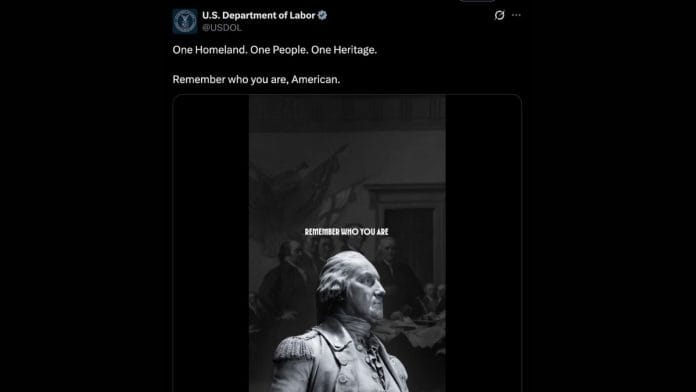



New Delhi: A US Department of Labour tweet about ‘oneness’ has raised hackles across the country and is being widely compared to a Nazi slogan. On 10 January, the department posted a black-and-white video on X. Across the screen ran the words, “One Homeland. One People. One Heritage. Remember who you are, American,” over an image of George Washington, with war scenes and battlefield imagery in the background.
Within hours, the tweet was everywhere. It moved beyond social media echo chambers, fueling debates across newsrooms, airwaves, and opinion pages about patriotism, policy, and historical echoes.
Yahoo News noted that users were already drawing historical comparisons—some admiring, others alarmed. X’s Grok AI flagged that the phrasing overlaps with “Ein Volk, ein Reich, ein Führer,”—one of the central slogans used by Adolf Hitler during his Nazi rule in Germany that translates to: One People, One Country, One Leader.
A BuzzFeed article on the labor department’s post drew hundreds of comments from readers who debated whether the montage celebrated unity or subtly narrowed the definition of what it means to be “American.”
Several users on X accused the department of echoing an adapted Nazi slogan, calling the post “beyond the lowest depths of depravity.” Another wrote, “80 years since World War II, the Nazis won.” Yet another said, “Babe wake up, the US department of labor is posting like the Third Reich department of labor.” Other users urged the department to delete the post altogether.
Retired NASA astronaut Terry Virts shared the X post on 12 January, warning, “I don’t see how this ends well.”
Also read: West’s 1930s obsession is warping its view of today’s threats. Trump & Putin aren’t ‘Hitlers’
A shift in strategy
Outlets like Truthout zoomed out and derived a pattern. The video, they argued, fit neatly into months of USDOL campaigns highlighting mostly white, male workers–especially as the administration tightened H-1B visas and pushed “native-first” hiring. To critics, the message felt less like patriotism and more like exclusion wrapped in sepia tones.
Conservatives pushed back just as hard. On Facebook and Reddit, defenders insisted the phrase speaks of the country’s founding ideals, not extremist slogans. On Reddit, some wrote that the first thing that came to their mind after reading the tweet was, “work sets you free,” a Nazi slogan displayed over concentration camps like Auschwitz.
In a 12 January segment, PBS NewsHour’s correspondents brought in experts who dissected the visuals of the tweet. Reporter Liz Landers outlined a broader pattern of messaging tied to immigration enforcement and national identity, highlighting ICE recruitment graphics using phrases linked to white supremacist and QAnon slogans.
In an interview with anchor Amna Nawaz, scholar Cynthia Miller-Idriss said the campaigns mark a pivotal shift in propaganda strategy, using patriotic imagery and coded language to reframe enforcement actions as public safety wins. She warned that such rhetoric mirrors narratives tied to past extremist violence and erodes public trust.
Meanwhile, a marketing professor interviewed by LeadStory offered a milder take: Nostalgia works because uncertainty is exhausting.
“It’s been used for a very long time to shape cultural narratives, and it is particularly effective when there are times of uncertainty like the ones we’re living through right now,” said the marketing professor Anna Bobich-Rosario. When the economy wobbles and politics churn, images of a simpler, unified past feel comforting–even if that past was never quite so simple.
A warning sign
Under Trump’s second term, the Department of Labor has taken on a louder role in immigration enforcement and workforce messaging. Apprenticeships over visas. “Americans First” wage protection. Campaigns touting job gains attributed entirely to native-born workers. Supporters expect job security, while the critics hear a closing door.
Economists interviewed by PBS raised practical concerns: Construction and tech already face labour shortage. The Department of Labor, for its part, dismissed racial interpretations and said the message is about fair wages, not identity.
But what makes this tweet the most powerful and volatile is its flexibility. To some, it’s a cry against globalisation and woke corporate culture. To others, it’s a warning sign, borrowing the language of unity while erasing pluralism in a nation built by immigrants.
That’s why it keeps resurfacing. USDOL reposted variations on Facebook and X. Podcasts debated it. Each replay brought out another layer of meaning. The video didn’t really tell Americans who they are. It asked them, and they answered very loudly, from every direction.
(Edited by Theres Sudeep)