





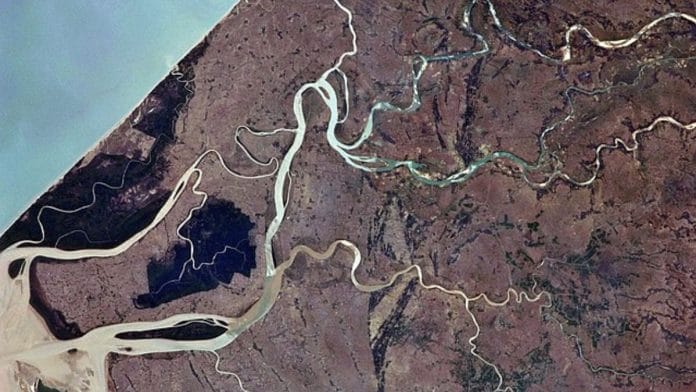



New Delhi: A new study by Nature has revealed that India’s major river deltas are sinking at an accelerated rate, largely driven by groundwater extraction and rising sea levels.
Titled ‘Global subsidence of river deltas’, the study analysed satellite data across 40 deltas worldwide. In India, the Ganga-Brahmaputra, Brahmani, Mahanadi, Godavari, Kaveri, and Kabani deltas were listed as experiencing significant land subsidence (sinking).
But one particularly alarming finding was that land subsidence is often a bigger contributor to local relative sea-level change than climate-related sea level rise. This means that delta areas are sinking at a faster rate than the oceans are rising.
Despite only occupying 1 per cent of the land area, deltas support between 4 and 6 per cent of the world’s population, estimated at 350-500 million people. They contain 10 of the world’s 34 megacities and support agriculture, fisheries, transportation networks, and entire ecosystems.
These low-lying areas are already threatened by a rise in sea level, saltwater intrusion, and ecological degradation—risks that have been elevated because of the increased subsidence.
Why are deltas sinking?
Between 2014 and 2023, the research team used interferometric synthetic aperture radar (InSAR) from the Sentinel-1 satellite. They measured surface elevation change across 40 river deltas at 75 metres resolution, enough to capture neighbourhood-level changes.
This allowed them to quantify vertical land motion (VLM)—elevation gain or loss—across entire delta systems, not just the urban cores with populations exceeding 3 million.
The study evaluated three human activity-led drivers of the land sinking: groundwater storage change, sediment supply alteration (because of dams built upstream), and urban expansion.
By using machine learning models, the team estimated the contribution of each factor to subsidence. Each factor also feeds into the other. For example, urban growth increases the demand for groundwater, which further compounds land sinking.
When groundwater is extracted faster than it can be replenished, the sediments located underground become compacted. Since they are compressed, it leads to a permanent sink in the land. This is usually a natural and slow process, but human activity—such as rapid urbanisation—accelerates it.
Also read: ‘Judges fear granting bail’—DY Chandrachud takes on Umar Khalid question at JLF
Flooding risk, land loss
The results of the study raise cause for concern. Of the 40 deltas studied, most areas are sinking rather than rising. In over half of the deltas, the average subsidence exceeds 3 millimetres per year. In 13 deltas, including the Nile, Mekong, Po, and the Yellow River, land is sinking faster than the current global sea-level rise, at approximately 4 millimetres per year.
Brahmani and Mahanadi are among the fastest-sinking deltas, with large portions of land sinking faster than 5 millimetres per year. Since the delta land sinking further exacerbates problems related to a rise in sea level, even small climate changes can translate into flooding risk and land loss.
“Addressing this requires shifting adaptation from just a global climate challenge to a regional socio-technical imperative and an integrated approach that prioritizes subsidence mitigation alongside RSLR [relative sea-level rise] adaptation,” wrote the authors of the study.
Some of the world’s biggest coastal cities—Dhaka, Kolkata, Bangkok, Shanghai, Jakarta—are all located in deltas showing significant subsidence. The threat to the infrastructure, economies, and populations of these cities is very real.
(Edited by Prasanna Bachchhav)