





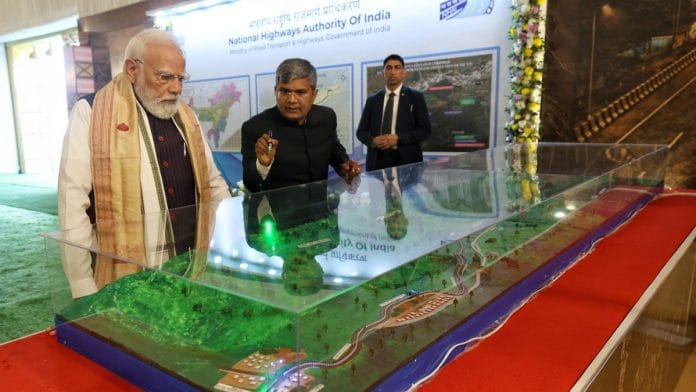



New Delhi: A four-lane highway with Assam’s first elevated wildlife corridor is set to come up right through the middle of Kaziranga National Park. Prime Minister Modi, who performed the Bhoomi Pujan for the project on 18 January, said it would improve connectivity in Upper Assam while also “keeping the forest safe”.
The Rs 6,950-crore project will expand the existing two-lane National Highway-715 into a four-lane road, with certain stretches built as elevated flyovers in wildlife corridors based on traditional movement routes of animals such as rhinos, elephants, and tigers.
The elevated corridor has been designed to account for monsoon flooding, when animals move towards higher ground and are forced to cross the highway, said a government release. Under the plan, traffic will pass above, allowing wildlife movement to continue below.
While the official Detailed Project Report (DPR) is not in the public domain, releases issued by the Press Information Bureau (PIB) and the Assam government describe the project as an 86-km stretch between Kaliabor and Numaligarh. This includes the widening of 30 km of the existing National Highway, a 21 km bypass section, and 35 km of elevated wildlife corridor passing through Kaziranga National Park.
“The project aims to improve regional connectivity while ensuring protection of the park’s rich biodiversity,” added the PIB statement.
In a reply to a question in the Rajya Sabha on 11 November 2025, the Union Ministry of Environment, Forest and Climate Change (MoEFCC) said the stipulated timeline for constructing the elevated corridors is 24 months.
Here’s what the project is expected to achieve, and why some environmentalists are raising concerns.
Also Read: India is home to fastest-sinking river deltas, study shows. What it means for Brahmani, Mahanadi
How does the project improve connectivity & conservation?
The Cabinet Committee on Economic Affairs, chaired by Prime Minister Modi, approved the wildlife corridor project in October 2025, outlining the towns and cities expected to benefit from it. The highway will improve connectivity between cities, including Guwahati, Nagaon, Golaghat, Numaligarh, and Jorhat, while also easing access to tourist destinations such as Kaziranga National Park and Kakochang Waterfall.
Project documents, parliamentary discussions, and court records note that wildlife corridors in the Kaliabor-Numaligarh stretch are especially important during the monsoon season. This is when the Brahmaputra tends to flood and animals move south of Kaziranga toward the Karbi Anglong hills to escape rising waters.
The existing two-lane highway also leads to more frequent road accidents during this period, as animals are forced to cross traffic-heavy stretches.
While hearing a writ petition on illegal stone mining in Kaziranga National Park on 20 November 2024, the Supreme Court described the proposed elevated corridor as a “wildlife-friendly measure” that would allow animals free access to the Karbi Anglong hills. The court order, a copy of which is with ThePrint, also noted that the Ministry of Road Transport and Highways has designated the project as Category I, indicating its urgency.
Last November, the MoEFCC told the Rajya Sabha that the Wildlife Institute of India, the National Tiger Conservation Authority, and the research wing of the Assam Forest Department are all involved in conducting ecological assessments of the project. However, none of these assessments are publicly available.
Also Read: What is Bagurumba? Bodo dance with a place of honour at Advantage Assam 2.0
Concerns about ecological impact
The project will entail cutting into almost 20 hectares of forest in the core region of Kaziranga National Park, home to India’s one-horned rhinoceros and a UNESCO World Heritage Site. The highway will also take up 364 hectares of land from Kaziranga’s Eco-sensitive Zone, and will essentially divide the park into two halves— with the Kaziranga core area on one side and the Karbi Anglong hills on the other.
A video shared by the Assam Chief Minister’s Office on Facebook displayed the project outlay, showing how the highway would run parallel to the Brahmaputra river, and the stretches where it would turn into an elevated corridor to allow wildlife to pass underneath.
This has led some environmentalists to raise concerns about stress on wildlife populations during the construction of the highway, and its impact on the natural movement of animals. In November 2025, Assam newspaper The Sentinel reported that local environmentalist Prasanta Kumar Saikia wrote a letter to UNESCO, urging it to intervene in the project. He sought a monitoring mission to assess the environmental impact of the highway, the report said.
However, the project had already received clearance from the National Board for Wildlife (NBWL) by the time the letter was sent. It approved the project in February 2024, with certain conditions to mitigate the impact of highway construction on wildlife.
“The elevated expressway will involve several entry and exit options. It is important to get the design of the animal passage plan absolutely correct at the outset,” said the minutes of the NBWL standing committee meeting on 22 February 2024. “(This project) is going to be one of the most critical linear infrastructure developments for any major wildlife area or landscape in the country.”
(Edited by Asavari Singh)