





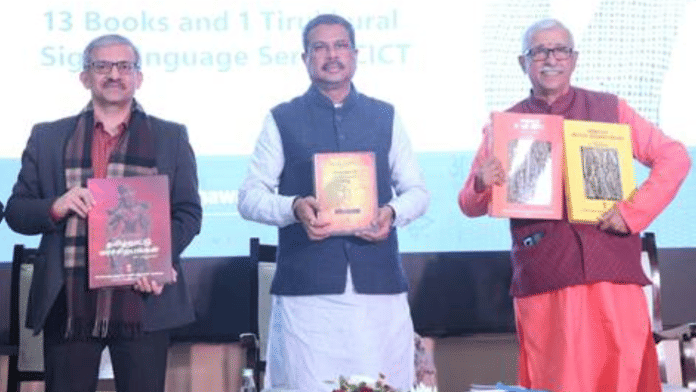



New Delhi: A year after the announcement of classical language status to five Indian languages, the Modi government on 6 January released a set of 55 literary works developed by classical language centres.
Releasing the books at New Delhi’s Kaushal Bhawan, Union Education Minister Dharmendra Pradhan said that Indian languages have stood the test of time despite the attempts to destroy them.
“The Government has worked extensively to strengthen and promote all Indian languages including more languages in the scheduled list, to translating classical texts into Indian languages, and encouraging education in Indian languages,” said Pradhan.
The collection features works from Kannada, Telugu, Malayalam, Odia, Tamil, and the sign language series of Tirukkural by the Tamil poet Thiruvalluvar.
These publications are part of a wider push by the Modi government to place India’s linguistic heritage at the centre of education and research and to foster cultural pride in classical knowledge traditions.
Out of the total, 41 books were developed by the Centres of Excellence for Classical Languages under the Central Institute of Indian Languages (CIIL); the remaining 13 books, along with the Tirukkural series, were published by the Central Institute of Classical Tamil (CICT).
“Languages are a unifying force, and note that Prime Minister Narendra Modi has always emphasised that all Indian languages are national languages,” said Pradhan.
In 2024, the Modi government officially conferred classical language status on five additional languages, such as Marathi, Pali, Prakrit, Assamese and Bengali. In India, there are eleven official classical Indian languages, recognising their high antiquity, rich literary heritage and cultural contributions.
There’s been a long-standing demand for more languages such as Maithili, Assamese, and Bengali to receive the Classical Language tag.
Also Read: This Pakistani professor is reviving Sanskrit in a Lahore university. ‘This is shared heritage’
Sangam-period books to Telugu epics
The literary works feature a wide range of texts from the Sangam-period to the Telugu epics such as Silappathikaram. One of the earliest Tamil texts, the poem is of 5,730 lines in almost entirely akaval meter.
Six Malayalam translations of Sangam-period literature, such as Purananooru, Pathitrupathu, Pathuppattu, Nanmanikkatigai, Nanarpattu and Muthollayiram were also published.
In a post on X, Pradhan said that the Classical Odia Language Study Centre has released 10 ancient and research-based books, including the Charyapada to Madalapanji.
“These books will create a new introduction to the rich vocabulary of the Odia language,” said Pradhan, adding that these publications will remain a valuable asset for researchers and language enthusiasts of future generations.
Out of the 55 works, 22 books are related to ancient Kannada literature, manuscripts, inscriptions, folklore, linguistics, dictionaries, archaeology and history, performing arts, and the like, prepared by the Classical Kannada Advanced Study Centre functioning under the Central Institute of Indian Languages.
Also Read: Which is the oldest Dravidian language—Kannada or Tamil? Listen to scientists, not celebrities
Institutions behind the translations
Pradhan said that the National Education Policy 2020 helped advance the vision of education in Indian languages. He said, in contrast to the Macaulay mindset of the colonial era, Indian civilisation has always regarded languages as bridges for dialogue and cultural harmony.
The literary works Pradhan released were documented by institutions focused on promoting Indian languages, such as the Bharatiya Bhasha Samiti on Indian Languages, the Central Institute of Indian Languages (CIIL) and the Central Institute of Classical Tamil (CICT).
The CIIL, based in Mysuru, is part of the Language Bureau of the Ministry of Education and was founded in 1969. It has seven centres across the country.
Bharatiya Bhasha Samiti on Indian Languages is a high-level Indian government committee formed by the Ministry of Education in 2021 to promote Indian languages as envisioned in the NEP 2020.
The CICT was officially established and began functioning in 2008 in Chennai, funded by the Ministry of Education. In 2022, Prime Minister Narendra Modi inaugurated CICT’s new campus in Perumbakkam, Chennai.
(Edited by Insha Jalil Waziri)