





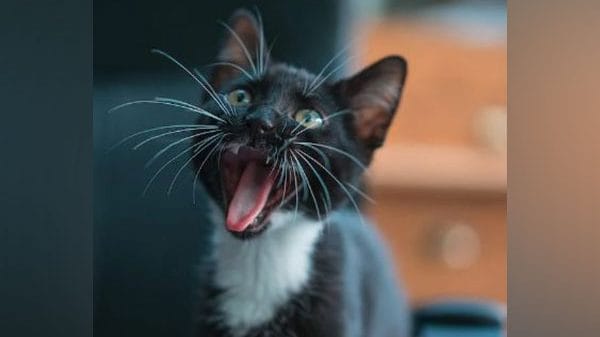



New Delhi: Men don’t always listen the first time, and even cats have learned to change their meowing accordingly, says a new study. Published in the journal Ethology, it states that cats meow more frequently when greeting male caregivers. The researchers hypothesise that men “require more explicit vocalisations to notice and respond to the needs of their cats.”
Scientists, led by Yasemin Salgirli Demirbas from Ankara University, carried out the study in Turkey with 31 volunteers, who identified themselves as their cats’ primary caregivers. They wore a camera and recorded the first five minutes of their interaction with their cat after returning home, while behaving as naturally as possible. The researchers then analysed the first 100 seconds of footage from the volunteers. In multi-cat households, the focus was on the first cat to approach the caregiver.
After taking into account all demographic variables — from the sex, age, and pedigree status of the cat to the number of cats at home — only one factor was found to be linked to vocalisation frequency of the cats: the biological sex of the caregiver. On average, cats produced 4.3 meows in the 100-second greeting with men, and 1.8 with women. Trilling, chirping, growling or even purring were counted as vocalisations.
Men ignoring cats?
A total of 40 people volunteered for the study, of which nine were excluded for not meeting the criteria. Among the remaining caregivers, 58 per cent were female, and the rest male. About 77 per cent of the cats in the study were described as mixed or random-bred, while 23 per cent were reported as purebred. Forty-two per cent of the cats were female. About two thirds of the participants lived in single-cat households, whereas the remainder reported having multiple cats at the time of the study.
The study observes that female caregivers are generally more verbally interactive, more skilled at interpreting their cats’s vocalisations, and more likely to mimic it too. Male caregivers tend to engage less frequently in verbal behaviors compared to female caregivers. This is why cats might use vocal signals more actively to get responses from male caregivers.
Feline experts also weighed in on the study’s findings.
“So the authors suggest that we men are clueless, that we’re ignoring cats and they need to get our attention more. Could be true,” Jonathan Losos, an evolutionary biologist at Washington University in St. Louis and author of The Cat’s Meow, told The New York Times.
Also read: 91% of Indians report feeling safer because of street dogs, says new survey
Limitations
While the study has thrown up an interesting premise about feline behaviour, there are also some limitations. The small sample size limits making generalised claims about cats’ greeting behaviors. The number of cats included is comparable to that of a previous experimental study on cat-human interactions conducted in 1988. But more participation of both cats and caregivers would be needed to get a comprehensive understanding of interspecific greeting behavior.
The second limitation is the experiment’s inability to control the exact duration of the caregivers’ absence from home or the cats’ hunger levels at the time of their return. However, most participants filmed their videos upon returning home from work, which meant the cats were alone for the better part of the day.
The third limitation was the geographic location of the study. Turkey’s feline-friendly environment and the socio-political and religious affiliations of its residents may have influenced the findings of the study. To understand the full scope of factors influencing the greeting behavior of cats, cross-cultural studies with increased sample sizes are essential.
The authors want to replicate the study in other parts of the world, but for now, it has been established that even cats want men to be more attentive, and listen.
(Edited by Aamaan Alam Khan)