





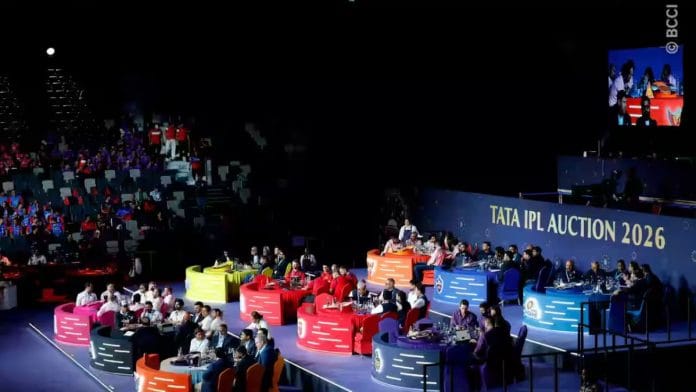



New Delhi: The first few moments of the IPL 2026 auction could not have been predicted. It produced one stunning record and a long list of unsold players.
Teams arrived with different budgets: Kolkata Knight Riders came in with Rs 64.30 crore, Chennai Super Kings with Rs 43.40 crore, while Mumbai Indians had only Rs 2.75 crore. This meant KKR and CSK had their pick of players, while MI was mainly a spectator.
A second pressure point was squad balance, a crucial factor in short-form cricket. Most teams were looking for at least one or two game changers, who could win the game for them: A death-overs bowler, a powerplay hitter, or a lower-order finisher.
IPL’s recent seasons have also changed what franchises value. A single-skill overseas player must be an all-rounder, wicketkeeper-batter, or high-pace death bowler who can create the most impact.
As the IPL auction kicked off in Abu Dhabi, its defining moment came early on, with Cameron Green going to KKR for Rs 25.20 crore, setting a new record for an overseas player. The bidding climbed quickly because Green offers top-order batting, finishing ability, and overs if needed.
The purchase sent a clear message from KKR—they were the big spenders, and they had no intention of saving their big purse. KKR also doubled down on their pace-and-power idea by buying Matheesha Pathirana for Rs 18 crore. The figure was also a measure of how desperate teams are for bowlers who can handle the last four overs under pressure.
CSK made headlines too, with uncapped Indian talent. They paid Rs 14.20 crore for Prashant Veer and Kartik Sharma each; their intent clear—investing in Indian players who can grow into first-choice starters.
CSK’s uncapped splurge showed teams now believe domestic T20 is deep enough to produce match-winners who are yet to receive the ‘cap’, leading to reduced dependence on overseas players.
Defending champions RCB, meanwhile, landed Venkatesh Iyer for a rather underwhelming price of Rs 7 crore.
Delhi Capitals’ co-owner Parth Jindal said the franchise came in with “a clear plan”, and their buys followed that goal. DC picked up David Miller for Rs 2 crore which fans labelled a “steal”, appreciating the idea of getting experience without blowing up the purse.
Mumbai Indians bought Quinton de Kock back for Rs 1 crore, a bargain for an experienced wicketkeeper-batter for IPL.
There were shocking moments too: Well-known names going once, twice, and then unsold. This list included Jonny Bairstow and Gus Atkinson, among others.
Liam Livingstone too, had a strange day, first going unsold before later being bought by Sunrisers Hyderabad for Rs 13 crore.
Across the room, the broad needs were easy to spot. Teams wanted powerplay hitters who can score 150-plus without needing 10 balls to settle. They wanted finishers who can hit pace at the death, given many IPL games now get decided in the last 18 balls.
Bowling needs were just as clear. Several franchises hunted for one bowler who can own the 18th and 20th overs—the reason Pathirana’s price flew so high. Others chased middle-overs control and wicket-taking.
(Edited by Viny Mishra)
Also read: Baramulla Express comes to IPL—Auqib Nabi, the ‘thunderbolt’ from J&K who sparked a bidding frenzy