





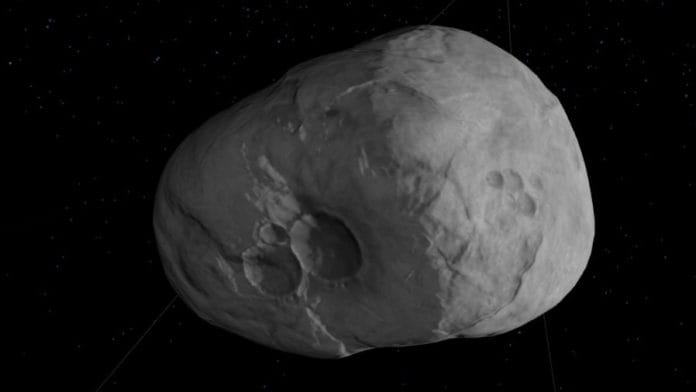



New Delhi: If your Valentine’s Day felt boring this year, it may be a very different experience 23 years down the road, including a date with an asteroid between 2046 to 2051.
A new asteroid named 2023 DW has a “very small chance” of impacting Earth two decades from now, on 14 February 2046, NASA said Wednesday. It also has the potential to impact on Valentine’s Days thereafter – from 2047 to 2051.
The asteroid was first discovered on 26 February last month at the San Pedro de Atacama observatory in Chile, according to the European Space Agency (ESA) and is now ranked on top of their Risk List, a catalogue of space objects that could potentially impact Earth.
It is the only object on NASA’s risk list that ranks 1 out of 10 on the Torino Impact Hazard Scale, a metric for categorising the estimated risk of an object colliding with Earth. All other 1,448 objects rank at 0 on the Torino scale.
NASA is currently tracking the asteroid which takes about 271 days to revolve around the sun, is approximately 49.29 meters in diameter and currently at a distance of 0.13 astronomical units (AU) or 19447723.2 km from Earth. Astronomical unit (AU) is a unit of length roughly measuring the distance between Earth and the Sun.
“We’ve been tracking a new asteroid named 2023 DW that has a very small chance of impacting Earth in 2046. Often when new objects are first discovered, it takes several weeks of data to reduce the uncertainties and adequately predict their orbits years into the future,” the agency’s Asteroid Watch tweeted.
We've been tracking a new asteroid named 2023 DW that has a very small chance of impacting Earth in 2046. Often when new objects are first discovered, it takes several weeks of data to reduce the uncertainties and adequately predict their orbits years into the future. (1/2) pic.twitter.com/SaLC0AUSdP
— NASA Asteroid Watch (@AsteroidWatch) March 7, 2023
The asteroid is currently travelling at a velocity of 24.63 km per second, relative to the sun, coming closest to the Sun at 0.49 AU while the farthest it can go is at 1.15 AU.
In terms of 2023 DW colliding with Earth, scientists believe the event is unlikely, with the ESA’s data projections currently estimating that the asteroid has a 1 in 625 chance while NASA predicting a 1 in 560 chance of impacting Earth.
On the other hand, astronomer Piero Sicoli said he believes there’s about a ‘1 in 400 chance’ that the asteroid will actually have an impact.
“Surely this possibility will soon be ruled out,” he tweeted last week. “However, as an exercise, I calculated where the asteroid might fall if this possibility occurred.”
#2023DW. With just 3 days of arc, I found about 1 in 400 chance of impact on Feb. 14, 2046 (JPL 1/770). Surely this possibility will soon be ruled out, however, as an exercise, I calculated where the asteroid might fall if this possibility occurred. pic.twitter.com/ldlSYJMvMz
— PS (@Piero_Sicoli) March 2, 2023
A map of his calculations, which is expected to change over time, shows that if 2023 DW were to impact Earth, it could fall anywhere between the Indian Ocean to the US East Coast.
Also read: NASA’s Curiosity sends ‘clearest ever’ images of sun rays shining through Martian clouds