





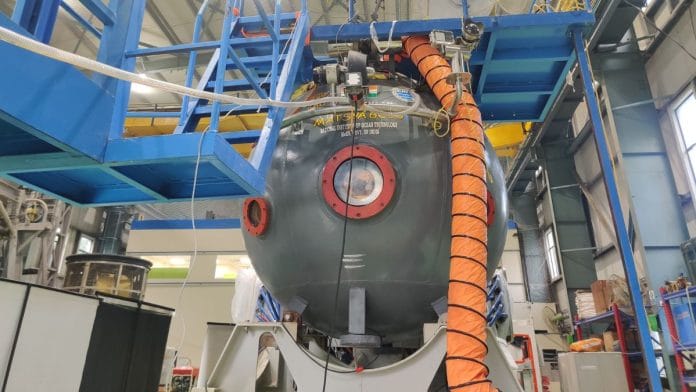



New Delhi: A minor crack in the foam casing of the indigenously-built manned submersible has delayed the 500-metre test run of India’s first deep ocean mission, Samudrayaan.
A senior official from the Union Ministry of Earth Sciences, which is overseeing the Samudrayaan mission, told ThePrint Monday that a “minor crack” was observed while the human sphere was undergoing its final round of scrutiny. While the defect was negligible and would not interfere with the test run, the submersible failed to obtain clearance because of it.
“The final quality certification for the capsule is granted by Norway. We have fixed the problem and are now awaiting the clearance,” the official said.
The official added that the test is now likely to be scheduled around October.
“We cannot do the test in the monsoons, so we will have to wait until October. But we are sure to have it this year,” he said.
India’s Samudrayaan project, being piloted by Chennai’s National Institute of Ocean Technology (NIOT), is part of the larger Deep Ocean Mission, which aims to undertake deep-sea exploration through a manned submersible.
The final mission, which will send a crew 6,000 metres deep in the Indian Ocean, will be carried out in a specially designed human capsule—the MATSYA-6000. It is a self-propelled manned submersible capable of transporting three individuals to depths of up to 6,000 metres.
“The submersible is built to work for 12 hours of operational period and sustain up to 96 hours in emergency scenarios. It features advanced systems like a high-density Li-Po battery, underwater acoustic telephone, drop-weight emergency escape mechanisms, and bio-vests for crew safety and health monitoring,” NIOT said in its project statement.
Also read: The two PSLV failures were not related. Failure assessment committees have been set up
Prior delays
India’s ambitious manned ocean project has already faced significant delays. The 500-metre test dive was initially planned for 2024, but was delayed due to procurement issues with different parts.
In November 2025, NIOT scientists said the institute was facing delays in procuring syntactic foam cladding from France.
(Edited by Prasanna Bachchhav)