






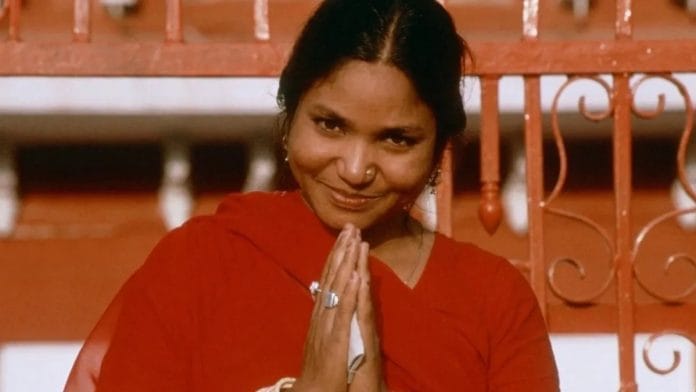



Are we overlooking a crucial dimension of Phoolan Devi’s life? We tend to reduce her to the victim-versus-bandit debate and ignore the global spaces she occupied. The Indian public and media have always imagined Phoolan Devi through the eyes of either victimisation or criminalisation.
In I, Phoolan Devi: The Autobiography of India’s Bandit Queen, she writes: “So many people had spoken for me without me ever having been able to speak for myself. So many people had taken my photo and distorted it for their purposes. So many people disdained the little village girl, who was tortured and humiliated, but still not crushed. Journalists had tried to get my story, movie directors had tried to capture me on film. They all thought they could speak about me as though I didn’t exist, as though I still didn’t have any right to respect.”
This tells us that the violence against her was not just physical; it was also in defining her without listening to her. In doing so, we overlooked the woman she was, who had her own aspirations and agency.
When Indian discourse confined her, Devi took her story to international platforms. Her autobiography travelled across borders and appeared in different languages. She understood how she was being framed and used those spaces to speak for herself, shaping the narrative instead of being a mere subject. In parts of Southeast Asia and Europe, she drew admirers who felt a sense of kinship with her struggle.
Also read: Bandit Queen, MP, feminist: Phoolan Devi could never be put in a box
An unlikely friendship
During her years in prison, Phoolan Devi received an unexpected letter from a British author, Roy Moxham, who was then working as a book and paper conservator at the Passmore Edwards Museum. Moxham had come across her story in The Independent, which reported on the by-election she contested from jail and carried a brief account of her life. Deeply moved by what he read, he decided to write to her, unsure whether the letter would even reach her, let alone draw a reply. Yet it did. Over the next two years, they exchanged several letters that brought a rare sense of connection and solace to Devi during her years of isolation.
Phoolan Devi’s autobiography found a wide readership in Japan. When she converted to Buddhism in 1995, Ito Michiko of the Japanese royal family attended the ceremony at Deekshabhoomi in Nagpur. The same site where Dr BR Ambedkar converted to Buddhism, along with lakhs of his followers, in 1956.
Devi visited Japan in January 1999 to address the Japanese Parliament. During her visit, she toured Tokyo and Kyoto. The Japanese translation of her autobiography was widely received there, and she found considerable sympathy among her readers. She grew especially fond of the two cities, visiting local markets and trying Japanese cuisine with great delight.
Chiharu Takenaka, Professor of Politics in Asia, in her paper, Gendered Violence and Beyond: Situating Phoolan Devi in Indian Democracy, writes, “Phoolan did not die as bandit; she died, quite amazingly, as member of Parliament. Her life illustrates to us the possibility of Indian democracy to overcome violent crimes as crude forms of class struggles. India is now seen by Japan as an important partner in Asia and Pacific Region of the 21st century. I would be very happy if my little book could make a humble contribution for India and Japan to understand each other as old but new neighbors.”
Also read: I did nothing wrong. Upper castes see Dalits as insects, I showed them I’m human: Phoolan Devi
Unfulfilled dreams
During the same period, Devi visited three European countries—France, Germany, and Sweden—to promote the French edition of her autobiography, Moi, Phoolan Devi.
In his book Outlaw: India’s Bandit Queen and Me, Roy Moxham notes that while in Paris, she developed a close friendship with a female doctor whom she regularly consulted for her gynaecological issues. He also recalls her fondness for French bread.
Later the same year, she addressed a public meeting in Dubai and said: “I thought many times about committing suicide, about dying. But then I thought that thousands of girls die every day. Tell me, people know me as a dacoit, ‘Dacoit Phoolan Devi.’ Tell me, do I have four arms and legs? They say, ‘She is from Chambal Valley, she is from Chambal Valley’—is the Chambal Valley my mother and father? I was born to parents. My only crime is that I was born in a hut, born into a poor family, born in an oppressed society. So, don’t I have the right to live?”
Phoolan Devi had long expressed a desire to visit London, where she had several friends and well-wishers who often invited her. However, her responsibilities as a parliamentarian kept delaying the trip. She had even promised Roy Moxham, whom she regarded as a brother from a distant land, that she would stay at his home when she finally visited.
The London visit remained unfulfilled. Her assassination in 2001 brought an abrupt end to both her political career and the journeys she had only begun to make across the world.
Roy Moxham later recalled that in the early years of their friendship, he often feared that Devi might be killed. He remembered their first meeting, when her house was surrounded by armed police. An officer had taken him to the rooftop to show the position chosen for machine guns. Over the years, her security was gradually reduced. On a visit to Chitrakoot, only one bodyguard accompanied her. In some ways, she encouraged this; she wanted to lead as normal a life as possible. Yet she remained aware that her enemies might seek revenge. She had often told him that she might be killed. In her later years, Moxham observed, she no longer seemed to fear death in the way she once had in prison. Perhaps she felt she had achieved some of what she had set out to do. If it was destined, it would happen.
Devi writes in her autobiography: “Now, for the first time, a woman from my community has been able to tell the truth about her life, and testify in public to the injustice we all had to suffer. It was my hope that my testimonial would give help to others: other women, my sisters who have been humiliated, and my brothers who are being exploited. I wanted to prove that we all have our honour, whatever our origins, our caste, the colour of our skin or our sex. I wanted respect. I wanted them to say, ‘Phoolan Devi is a human being because then they would say it about others.”
“Sing of my deeds
Tell of my combats
How I fought the treacherous demons
Forgive my failings
And bestow on me peace”
Ritesh Jyoti is pursuing a Master’s degree in Development from Azim Premji University, Bengaluru. He studies and writes on the Phule-Ambedkarite movement and Kanshiram’s politics. He tweets @Riteshjyotii. Views are personal.
(Edited by Theres Sudeep)