






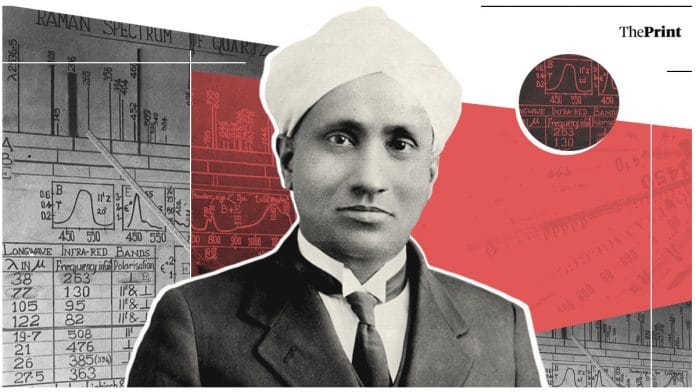



National Science Day is celebrated every year on 28 February to commemorate the discovery of the Raman Effect. This moment was not only a scientific breakthrough, but also a statement about India’s intellectual self-confidence.
On this day in 1928, C V Raman announced to the world the observation of “a new type of secondary radiation”, a phenomenon that would later be known as the Raman Effect. The discovery demonstrated that when light passes through a transparent medium, a small fraction of it is scattered at different wavelengths — direct evidence of energy exchange between photons and molecular vibrations. For many scholars of that period, the Raman Effect provided striking experimental confirmation of emerging quantum theory. It reinforced the concept that light-matter interaction occurs in discrete quanta, lending support to ideas that were, at the time, still under intense theoretical debate.
Equally remarkable is the institutional context of the discovery. Raman carried out this work at the Indian Association for the Cultivation of Science (IACS), Kolkata, an institution founded not as a colonial extension of European science, but as an indigenous space for scientific inquiry. That Raman conducted Nobel Prize-winning research there, without having begun his career within a conventional academic scientific track, remains a powerful testament to intellectual self-belief and institutional vision.
Coincidentally, this year also marks the 150th anniversary of IACS. The institute was established in 1876 by Mahendralal Sircar with a bold and forward-looking aim: to create a workplace where Indians could pursue original scientific research and cultivate scientific education rooted in a strong Indian perspective. Sircar envisioned science not merely as an imported body of knowledge, but as an enterprise to be practised, debated, and advanced within India itself.
Thus, National Science Day commemorates not only a landmark scientific discovery, but also a deeper assertion that rigorous, world-class science can flourish through self-motivation, intellectual courage, and institutional support.
Also Read: US is facing brain drain. India must decide if it’s ready to welcome back scholars
An age of scientific anxiety
That the past few decades have been exceptional in advancing scientific knowledge is hardly contested. The current phase of discovery across disciplines, computer science, life sciences, materials research, chemistry, and beyond, is marked by remarkable breakthroughs that promise transformative improvements in human well-being.
From artificial intelligence to gene editing, from novel materials to precision therapeutics, the frontiers of knowledge are expanding at an unprecedented pace. Yet alongside this excitement, there are also growing anxieties about the potential consequences of these advances. Questions surrounding unintended applications, ethical boundaries, environmental sustainability, and societal disruption have moved from academic circles to the centre of public discourse.
Similar debates have accompanied earlier high-impact scientific discoveries as well, so the present moment is not entirely without precedent. However, what distinguishes our times from earlier epochs is the convergence of extraordinary capability and profound uncertainty.
For perhaps the first time in human history, our greatest achievements and our gravest fears arise from the same source — scientific progress itself. This duality imposes an unprecedented responsibility upon the scientific community. Our capacity to intervene in natural systems, edit genomes, engineer intelligent machines, and manipulate planetary-scale processes has advanced more rapidly than our collective ability to anticipate and govern long-term consequences. Human ingenuity has never been greater, but at the same time the ethical, social, and ecological responsibilities accompanying that ingenuity have never been heavier.
I would like to argue that, in India, our civilisational traditions can serve as guiding principles through this current phase of uncertainty.
Also Read: Plants to physics, JC Bose showed the world India had its own way of doing science
Indian traditions as compass
At a time when uncertainty is amplified by unprecedented technological power, drawing upon the ethical insights of our civilisation is not a retreat into the past, but a necessary condition for navigating the future responsibly. Periods of rapid scientific and technological transformation often unsettle established moral, social, and ecological balances. It is precisely in such moments that long-standing civilisational wisdom acquires renewed relevance.
Our civilisational traditions do not offer technical solutions to contemporary scientific challenges; rather, they provide ethical orientations. They cultivate habits of restraint, responsibility, interdependence, and humility, which are values that become indispensable when human capability expands dramatically.
Indian cultural traditions have long conceived the human being not as an isolated, sovereign entity, but as an integral part of a larger cosmic order. The individual is situated within an interconnected web linking the self (ātman), society, nature, and the universe (brahmāṇḍa), forming a continuum rather than a hierarchy of domination.
In the philosophical reflections of the Upanishads, the identity of the individual self with the universal principle (Brahman) is expressed in formulations such as tat tvam asi (“That thou art”), suggesting that the human and the cosmic are fundamentally continuous. Similarly, many strands of classical Indian thought, including Sāṃkhya, Vedānta, and certain Buddhist and Jain traditions, emphasise interdependence, balance, and restraint. Nature is not conceived as inert matter to be conquered, but as a dynamic force with which humans must remain in harmony. Traditions that view the human being as embedded within a larger cosmic, ecological, and moral order therefore serve as a safeguard against unchecked domination.
This civilisational perspective carries contemporary relevance. At a moment when technological power is pushing humanity toward increasing anthropocentric control, Indian traditions offer a sobering counterpoint. They remind us that human agency derives its legitimacy not from dominance, but from alignment with ecological balance and moral responsibility.
In an era when we possess the capacity to engineer life, reshape environments, and influence planetary systems, such traditions caution against capability without wisdom. They affirm that human action acquires meaning only when situated within the broader rhythms of nature and guided by ethical restraint.
Thus, rather than constraining progress, this perspective enriches it, inviting humanity to exercise its expanding power with humility, responsibility, and a conscious awareness of its place within the larger cosmos. A renewed commitment to these principles on National Science Day would reaffirm our collective resolve to ensure that knowledge serves humanity in good faith. In doing so, we would honour both the spirit of discovery and the deeper responsibility that accompanies it, securing a future in which progress remains guided by conscience as well as capability.
Shekhar C Mande currently works at the Savitribai Phule Pune University and National Centre for Cell Science, Pune. He is the president of the Indian National Science Academy (INSA), New Delhi and also the national president of Vijnana Bharati. Views are personal.
(Edited by Asavari Singh)