









Writing can take you to some unimaginable places, and sometimes not only in the chambers of the mind. I’m 36,000 feet up in the night sky, somewhere between Kandahar and Hyderabad, returning home from four magical days in northern India.
Having been immersed in literature, words and ideas over recent days, it seems only appropriate to take the opportunity to write.
At the end of last year, an email arrived out of the blue, asking if I’d come to the Jaipur Literature Festival along with Fintan O’Toole to talk about our book, For and Against a United Ireland.
The festival is a legendary literary jamboree which attracts authors, publishers, and readers from around the world, as well as a huge local audience. Described as the greatest literary show on earth, it sees hundreds of thousands of people throng into seven indoor and outdoor venues on one site to ponder and debate grand ideas.
Having never been to the land of elephants and curries, even my Indian friends said to expect an assault on all the senses. An Indian diplomat was among many people to warn about getting sick from the food (on the contrary, it was magnificent) or water. Yet almost everyone also said it was a captivating land.
Jaipur is an ancient desert city whose grand Arabic-influenced pink architecture alongside roadsides planted in trees and flowers is reminiscent of Marrakech. The teeming roads resound to the incessant beeping of horns, the driving is hair-raising, and much of life seems to the uninitiated to involve barely-organised chaos.
Day after day at the festival energetic crowds moved from morning to night between stages where novelists, poets, classicists, historians, scientists, journalists and others discussed their work.
People who’d certainly never read a word I’ve written stopped to ask me for advice on writing or for a photo. These were the crowds and the fervour you’d expect at a rock concert.
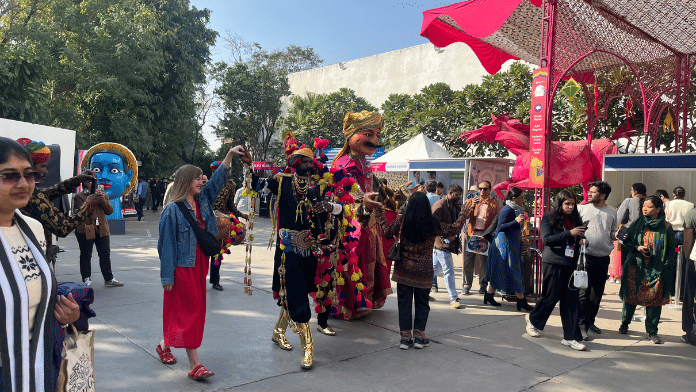
The JLF, as it is known, is a rock festival for books. It’s a carnival of colour, of music, and of food, as well as of words.
There are celebrity authors – Stephen Fry, Ian Hislop, William Dalrymple and Lyse Doucet – but also writers unknown to most of those there, your correspondent among them.
At a time when research shows an alarming drop in attention spans, a drop in cognitive ability, and when we are reading fewer books, what I saw in Jaipur was intensely heartening.
Most inspiring was the line of schoolchildren waiting to enter. Younger children were running around with balloons. Despite having little knowledge of what’s being said, at this impressionable age they are absorbing at some intuitive level that learning, reasoning and reading are not just important but exciting.
Not everyone, was there for high-minded reasons. There were hordes of young people filming themselves or posing for photos for social media. But to be dismayed by that is to miss something important, and surprising.
They want to be there, and to be seen there because they think it’s cool. Isn’t that amazing? Whether having come for the talks or for TikTok, they’re in a place where it’s hard not to be caught up in the excitement about what books can do.
In a world of vacuousness, of insatiable greed, of multiplying dystopian possibilities, and where the idea of progress as a straight line has been disproven, this event involves something counter-cultural.
India is an imperfect country. It involves extreme wealth and extreme poverty, and the direction its current government is taking alarms many observers. Even though the festival is priced exceptionally cheaply (£1.62 for all five days) to maximise access, most of those who came were from the well off and well educated classes.
But regardless of status or class, reading books is important for everyone. The freewheeling erraticism of Donald Trump, a man who clearly doesn’t read books, demonstrates the perils of ignorance – constantly lurching in one direction before the consequences are explained to him and he lurches off on another course.
From 22-31 May, the JLF is coming to Ireland – the first time that a version of the festival has been held across a border. It will visit Belfast, Armagh, Dundalk and Dublin in what the Irish Ambassador to India, Kevin Kelly, described as a travelling caravan of literature.
At a press conference for a large Indian media contingent where the JLF Island announcement was made, British High Commissioner to India (as ambassadors within the Commonwealth are known) Lindy Cameron was present. Cameron, who is Northern Irish, was present for most of the festival, with the British and Irish embassies working together to promote the cross-border initiative.
There’s diplomacy behind this, as well as a belief in the value of the festival itself. India is a rapidly rising world power being courted by both the UK and Ireland. Racist attacks on Indian migrants in Dublin last year were widely reported in India and it was notable that the Irish Embassy in Delhi circulated a video by Kevin O’Brien – the former Irish cricketer who played in India – in which he condemned the attacks.
Yet the story of migration to this island over recent decades is overwhelmingly one of migrants who have worked hard, behaved honourably, and been welcomed into communities on both sides of the border.
At that press conference, Northern Irish novelist Michelle Gallen spoke movingly about how when her husband was recently fighting for his life, those who cared for him were overwhelmingly from India and surrounding countries. She expressed thanks for the lifesaving work of these people – a sentiment far more representative of views on this island than the thugs who demean or attack migrants.
In another session where the post-Empire partition of India was discussed, there was no need to set out to an Indian audience the scale of the slaughter involved. That partition, which was largely modelled on Ireland, was disastrous.
Yet historian Kishwar Desai recounted tales of humanity amid the wanton bloodshed. She told how a Hindu woman hid a Muslim man in her home, telling neighbours he was her brother; when able to go to Pakistan, he decided to stay in India. Another person hid children under a bed to save their lives.
It reminded me of how so many victims of the Troubles appealed for no retaliation and refused to endorse the violence which terrorists claimed they were inflicting to avenge their loss. When we remember barbarism, we should also remember those who stood against it.
The following day, Fara Dabhoiwala discussed his book on the history of free speech, arguing that our understanding of it stems from the Protestant Reformation when the idea that people have the right to read the Bible and decide its meaning for themselves logically led to wider questioning about the world around them.
He said that people became addicted to newspapers and to the free circulation of ideas and knowledge but that then led to excesses which saw defamation law respond to malicious lies.
A senior Indian journalist told me that print sales are still rising there as rising literacy opens more people to the excitement of being able to understand the world through the written word. That must have been how our ancestors felt 150 or 200 years ago.
Every country is imperfect. Even the US, France, Germany, and Britain – four of the richest and most sophisticated societies the world has ever seen – have each felt like they’re slipping backwards over recent years.
Northern Ireland has always been deeply flawed. Yet we also know it is a wonderful place in which to live – a land of natural beauty, warm people, wonderful culture and rich history. We shouldn’t accept the maddening failures at Stormont, and should strive for better, but sometimes stepping away from Northern Ireland helps clarify how much there is about this place which we would miss if we could never return.
There was a time when people from this island – both Catholic and Protestant – went to places like India as colonisers who looked down on the local population. Some of what they did was barbaric; other actions were positive. History is complex.
But we have much to learn from other cultures and contexts. Even the English language, which is now spoken across India, is something which has developed in a unique way. Indian English involves a gloriously idiosyncratic and creative use of language.
That exquisitely evocative and creative talent was part of the reason that diplomats, celebrities and ordinary people from as far away as Norway, Australia and the Netherlands poured into the capital of Rajasthan. If our version of it is even half as invigorating as the real thing, it will be magnificent.
This article was first published as the subscriber-only email newsletter of Belfast Telegraph by Northern Ireland Editor, Sam McBride.
Sam McBride is an Irish journalist, he is the Northern Ireland editor Belfast Telegraph and Sunday Independent.
Views are personal.