






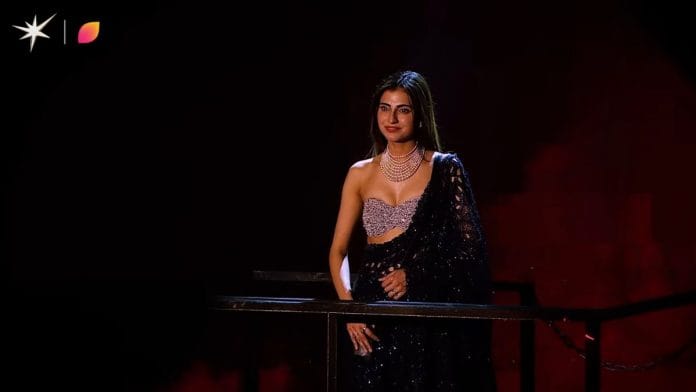



Farrhana Bhatt didn’t win Bigg Boss 19. At least not officially. But in Kashmir, she’s being celebrated as the “audience winner”, a young woman who held her ground, spoke her mind, and refused to shrink herself on national television. Videos of Kashmiris cheering for her, women defending her choices, and young people celebrating her rise flooded social media hours after the finale. When it comes to her home, she received her flowers.
Yet, running parallel to this wave of support was a familiar storm of moral policing. Many declared that she does not represent “Kashmiri culture”, that she embarrassed the Valley, and that she should not be the face of a place already burdened with stereotypes.
On social media, Kashmiri men accused Bhatt of “misrepresenting” their culture, of dressing in ways they deemed inappropriate, of displaying behaviour that supposedly embarrassed an entire community. The argument was familiar: “This is not how Kashmiri women behave. We don’t want to be seen like this.”
This tension—the applause and the outrage—captures a deeper reality: Bhatt’s journey was never just about a reality show. It reopened Kashmir’s long, complicated wound around representation. It forced the region to ask itself yet again: Who gets to stand for Kashmir? What does it mean to be a Kashmiri in the public eye?
For generations, Kashmir has lived under the harsh gaze of conflict and the narratives built around it. Kashmiris are accustomed to being represented by others: the state, the media, political interests, and endless commentary by people who don’t live in the Valley. They have been cast as either of two recurring figures: the rebel or the victim. They’re rarely afforded the luxury to be an ordinary person living an ordinary life.
Not first Kashmiri to carry the weight
It’s no surprise then that representation feels existential. The fear of being misrepresented is real and historically justified.
Here lies the contradiction: while the fear is understandable, the instinct to punish individuals, especially women, for wanting more is not.
Bhatt is not the first to face this disproportionate weight. Zaira Wasim, once celebrated as Kashmir’s breakout star in Bollywood, was accused of betraying Kashmiri sentiment and aligning with Indian state interests. It forced her to post an apology stating that she didn’t intend to hurt anyone and never asked to be a role model. Many Kashmiris, including political figures, defended her, highlighting the pressure she faced and the diversity of opinions within the region.
Singer Faheem Abdullah was trolled for making music. He was deemed too Western, too public, and called a “sellout”. Even in moments of cultural success, Kashmiri artists are forced into a referendum on morality.
The backlash doesn’t emerge from hatred alone; it comes from a place that has seen decades of collective punishment and constant scrutiny. When a society grows up with the idea that “one wrong move can cost everyone”, its response to individual choices becomes hyper-vigilant. But in the process, a dangerous precedent is created, and personal freedom becomes a threat to communal dignity.
This is where Bhatt’s journey matters. In a region repeatedly told how to exist, the mere fact of existing differently becomes an act of resistance.
Also read: Gaurav Khanna’s wife doesn’t want children. It’s a choice, not an obligation
Bhatt on Bigg Boss 19
Bhatt challenged a script that Kashmiri women are expected to follow.
Her critics argue that she misrepresents Kashmir. But this presumes that Kashmir is a monolith, a single moral code, a single cultural imagination, a single acceptable way of being.
Kashmir is plural, layered, contradictory. It contains the religiously conservative and the liberal, the artist and the academic, the grieving and the hopeful.
Bhatt’s presence on Bigg Boss 19 cannot redefine Kashmir. But it can remind the Valley and the rest of India that Kashmiris deserve to be seen in their full human range, not squeezed into acceptable categories.
The debate around Bhatt is not really about her. It’s about Kashmir learning, slowly and painfully, that representation does not need to be perfect to be valid. And that individuals simply trying to live isn’t a betrayal of Kashmiri culture. In fact, it can lead to collective healing.
Views are personal.
(Edited by Prasanna Bachchhav)