






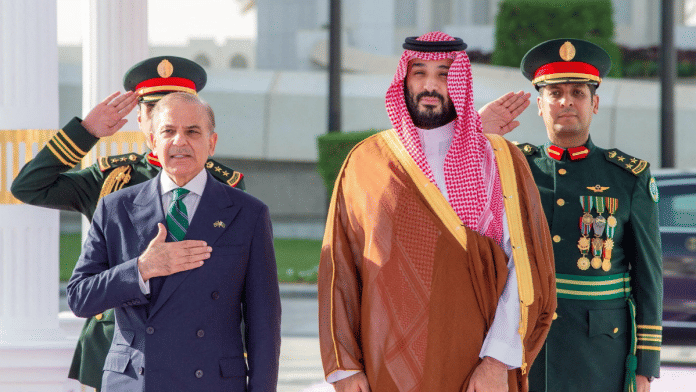



Pakistan Prime Minister Shehbaz Sharif and the Chief of Defence Forces Field Marshal Asim Munir seem to spend more time in the air, travelling around the world, than at home. Most of their recent trips are to the Middle East, as several guests have also been visiting Islamabad.
The general understanding is that the back-and-forth trips have been made to sort out the multi-layered conflict that the region is embroiled in. The other interpretation is to resolve equally complicated relations that Islamabad has developed with the various countries of the Gulf, particularly Saudi Arabia, the United Arab Emirates and Qatar.
Viewed in a historical context, the Persian Gulf littoral has always been critical to Pakistan for cultural, political, geopolitical and economic reasons. This part of the Middle East, which includes the Gulf states and Saudi Arabia, has always had a greater significance for Islamabad than the rest of the region, especially after the British retreated. Pakistan was viewed as a country that would look after British and later American interests in this part of the world.
Culturally, a common religious bond provided further unity that was absent in other states like Egypt, Syria or Iraq. Also, given the division of the Middle East by the British that entailed the creation of Israel, Jordan, Lebanon, and a new monarch in Iraq, with contestation from Syria and the emergence of a Gamal Nasser-led Egypt, that part of the region became too turbulent and unattractive for Pakistan.
Not that the Arab peninsula and Gulf didn’t have their own territorial and factional issues, but this is where Pakistan’s first Foreign Minister, Zafarullah Khan, pitched a role for his country, leading them to join the Central Treaty Organization (CENTO) in 1955. Furthermore, Saudi Arabia and Gulf states became important for Pakistan as oil acquired political currency in the 1970s, with Bhutto pitching for its use to generate greater global influence.
This is also the decade when Middle East countries opened their doors to Pakistan to contribute to their development by sending manpower. This made the Gulf and Saudi Arabia a major source of financial help for Pakistan, which constantly needed more—from feeding its economy to meeting security needs. The region was also important because India didn’t pose a challenge in this area. The key role of protecting monarchies, especially Saudi Arabia’s, meant that Islamabad had to be vital for Riyadh and the Gulf.
Change in political landscape
In many respects, Pakistan has continued to play the role of a secondary security provider for decades. However, the dynamics seem to have shifted due to the gradual changes in the political landscape. Though Pakistan’s major offering to the region continues to be security and mainly unskilled or semi-skilled manpower, it now also has to deal with the fact that many of the states are politically more ambitious than before and are in the process of imagining their own geopolitical role in global politics.
In 1979, the reign of Shah Mohammad Reza Pahlavi in Iran was replaced by the Islamic government. It was a major milestone, meaning that Iran—once a major partner for the West—no longer had the role to negotiate and provide balance in the region. This was followed by other events, including the long Iran-Iraq war and later collapse of Iraq, which created a vacuum that the various states then competed to fill.
An essential development is the emergence of the “Dubai model” of economic growth, which was subsequently adopted by Qatar and Saudi Arabia. This shift was driven by an increasing urgency to move beyond oil dependency and establish sustainable, diversified economies. Laying out this historical trajectory is essential as this part of the Middle East now has heightened internal tension to claim space in global politics. It has further sharpened due to independent visions for where each leadership want to take their respective state. The events in Gaza have further escalated internal tension.
Also read: Modi mainstreamed Israel like no Indian PM before. Delhi must stay alert to regional realities
Manoeuvring Pakistan
From Pakistan’s perspective, the internal tensions in the Persian Gulf littoral make the situation complex and far more difficult to negotiate than through simply marketing security as the only product. Two issues are important to note. First, in dealing with the Gulf, security is no longer a one-way route. These states also have a role to play as far as Pakistan’s security is concerned. This is particularly regarding Pakistan’s relations with Afghanistan, where Saudi Arabia, the UAE and Qatar all have a role to play.
Sharif and Munir’s recent visit to Qatar, for example, was critical not only on the lines of defence, cultural and labour mobility, but also to urge for Qatari indulgence regarding the Taliban. Sources said that Doha, which played a role in negotiating a peace deal between the American and Afghan Taliban, has since emerged as one of the important influences on the Taliban. It does not entirely support Pakistan’s position on its friction with its western neighbour.
However, this is definitely one of the doors, including Saudi Arabia, that Islamabad has to keep knocking at. Pakistan Foreign Minister Ishaq Dar has again reached out to Riyadh, seeking intervention to de-escalate the tensions between Islamabad and Kabul.
Clearly, these states have acquired influence in both Afghanistan and Pakistan due to their long engagement after 1979. Many of the Taliban families continue to live in Qatar and have deep ideological links with Saudi Arabia that would allow these states to play a role in conflict management between Afghanistan and Pakistan. Earlier, the Taliban released at least three Pakistani soldiers after intervention from Riyadh.
However, Islamabad’s interaction with the Gulf states, requesting to stop the Taliban from aiding the Tehreek-e-Taliban Pakistan (TTP), which carries out attacks in Pakistan, has not borne the desired results. For Middle East countries, the interaction is less about stopping Kabul and more about manoeuvring Pakistan.
Also read: Don’t frame Modi-Israel as ‘this hurts Indian Muslims.’ We don’t mix faith & foreign policy
Internal friction
Second, selling security in the Gulf and Arabian Peninsula is now a far more complex project. Every state has been aiming to maximise their influence and manipulate conditions to boost its advantage. The fact that Islamabad signed a mutual security agreement with Saudi Arabia—a deal that seemingly includes Qatar and the UAE as well—does not put Pakistan in an advantageous position, given the internal friction in the region.
As a senior retired diplomat, I spoke and commented about the Saudi-Pakistan agreement and its larger impact: “If you want to date several women, then you don’t get married to one.” The argument being that in the backdrop of the growing tension between Saudi Arabia and the UAE or Qatar, Pakistan’s signing a specific security agreement with Riyadh is not likely to bring any advantage to Islamabad, but will push it further into the middle of the internal regional complexity.
This also means that the relations are bound to become very sharply transactional, with each side supporting Pakistan in its friction with Afghanistan or any other state, depending on what benefits it can draw for itself. More recently, Islamabad has also experienced the UAE’s growing reluctance to expand financial support unreservedly. Apparently, Pakistan is still negotiating a rollover of the $2 billion from the UAE for a longer period, which has been extended to two months or less.
Finally, the relations with the Gulf states are also clouded by the fact that Pakistan aimed to play a larger role in the region on behalf of the US than it can bargain for. An important lesson from history that was entirely forgotten by the Munir-Shahbaz regime is that Arabs like to buy security as a service but do not necessarily see their South Asian partner’s claim of being bigger than the Arab states.
This is a reminder of Egypt snubbing Pakistan’s Field Marshal Ayub Khan regime during the 1960s, when it claimed to be the largest Muslim country in the world. The Arab states would like to use Pakistan, but in a subservient role. Pakistan’s continued financial and now security dependence on the Gulf and Saudi Arabia calls for a less aggressive role than what Munir aims to play.
Ayesha Siddiqa is a senior fellow at the Department of War Studies at King’s College, London. She tweets @iamthedrifter. Views are personal.