






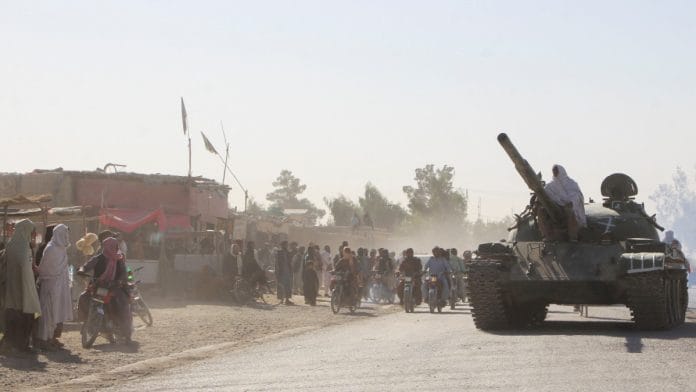



It’s no longer all quiet on Pakistan’s western front. Not just that, Islamabad and Kabul have declared war on each other, but have been actively attacking each other across the border with no end to the conflict in sight. One could expect a lull in hostilities, but the anger will persist as neither side has a game plan regarding where they can draw the line, especially at a time when it is becoming a matter of national honour and survival.
After the first round of retaliatory attacks inside Afghanistan, the Establishment voices in Pakistan are feeling more ambitious and advocating more attacks to wrap up the Taliban rule, especially when the world is watching the Middle East. According to journalist Fahd Hussain, Pakistan must escalate, as he believes that the US is on Islamabad’s side.
Both sides also strongly suspect each other of conducting hostilities on the behest of other regional and international players. This means that an escalation could happen again unless some of the Middle Eastern countries, like Saudi Arabia and Qatar, put their foot down and convince Pakistan and Afghanistan to get down to the brass tacks of serious negotiations.
In international circles, the conflict between the South Asian neighbours is still being noticed as a case of violent border skirmishes. However, the recent attacks and counterattacks clearly pose a milestone in Taliban-Pakistan Army relations. As author Avinash Paliwal points out, these are the worst clashes since the Bajaur campaign of 1960-61.
The situation denotes a total reversal in Taliban-Pakistan Army relations—a stark contrast to the ‘everything will be ok’ statement made by the former Inter-Services Intelligence (ISI) chief Lt General Faiz Hameed in September 2021.
Presence of TTP
There was much excitement then in Pakistan’s Army circles over the Taliban takeover, replacing the Ashraf Ghani government. Now, there is much talk of the necessity of an Islamabad-driven regime change in Kabul.
Obviously, the fundamental question is how that would happen without Pakistan putting its boots on the ground, which is a herculean task and may prove to be a case of more than what Pakistan can chew. Islamabad was never successful in totally disciplining the Taliban and convincing it to act in its interest. One is reminded of how even the Mullah Omar regime, which was so much more dependent on Pakistan from 1996-2001, had refused to accept the Durand Line as the official international border between the two nations.
Indubitably, the Asim Munir regime is very upset with the Taliban for not curbing the presence of Tehreek-e-Taliban Pakistan (TTP), which carried out attacks in Islamabad after 1922. He is reputed not to like the current group ruling Afghanistan. It would be interesting to find out when he began to hate the Taliban, since he was heading the ISI when the army still supported the idea of bringing the Taliban back to Kabul. In fact, it is not a secret that Pakistan’s former army chief, General Ashfaq Pervez Kiyani, presented a non-paper to former US President Barack Obama that espoused the idea of US reconciliation with the Haqqani network.
While not adhering to Pakistan’s constant request to deny its territory to the TTP, the Taliban’s position during the three sets of talks—in Doha, Istanbul and Riyadh—has been that Islamabad needs to secure its borders and improve its security rather than point fingers at its western neighbour. Interestingly, Qatar and Turkey, which hosted the first two talks, were not enamoured by the attitude of Pakistan’s delegation.
Sources claim that the biggest issue was regarding the attitude of the Pakistani delegation, which was not conciliatory but commanding. The military regime headed by then-Army Chief General Qamar Javed Bajwa had negotiated with the Taliban and the TTP, allowing the latter to move thousands of its men inside Pakistan under the condition that they would de-weaponise. It’s not known how effective the process was, but it allowed the TTP to move its people into tribal areas, which now makes it easier for them to have the information that they use to carry out attacks.
But the period of negotiations was also the time when TTP attacks had minimised to a large degree, indicating that some arrangement was working that collapsed after 2022.
The aforementioned year is marked by a change in the army’s command in Pakistan, after which there was a change in several policies pursued by the previous high command. Now the division has become sharper with Islamabad wanting an inclusive government to replace the Taliban, who do not represent a consolidated regime but a network comprising various groups, all of whom find it difficult to oust the TTP. Some of the journalists said about a conference that Islamabad organised, inviting other Afghan ethnic groups, with the hope of being able to put together a group that could push back the Taliban.
The news of the conference was hidden to not annoy Kabul, but it did leak, which did not make the Taliban happy. Also, since 2022, the new narrative, which has been gradually built by the Pakistan Army and its public relations team, is to claim that the Pashtun are actually a minority in Afghanistan, when a totally different argument was made earlier.
Also read: How Pakistan lost the plot in the Middle East—from security provider to security seeker
Challenge for Pakistan
What certainly drives Pakistan’s concern is not just the TTP but that Afghanistan has got out of control to the degree where it could become a second front yet again. It’s definitely worried about Kabul’s connection with India and believes that New Delhi is using Afghanistan to destabilise Pakistan. What is not talked about is the suspected involvement of some Gulf states, like the UAE and Qatar, that are not happy with Pakistan’s larger Middle Eastern politics.
One may not doubt the suspicion that the Taliban have other partners as well. However, what boosts their confidence is that Pakistan’s policy of throwing out Afghan refugees, including those settled in Pakistan for decades, has brought sympathy for Kabul and resentment among the general Afghan population for Islamabad. In chucking out the Afghans, Pakistan made a classic mistake of bringing the ordinary Afghan and the Taliban regime together. This itself is a huge challenge for Pakistan to infiltrate the region.
Moreover, it will generate a kind of resentment that would make the task of any government that is brought in to replace the current one more tenuous. Moreover, a forced change is likely to generate or deepen ethnic tension inside Pakistan. It is already a sight watching the Pashtun and Punjabi commentators have a go at each other regarding the idea of a Pakistani attack on Afghanistan.
Such ethnic conflict is compounded by another layer of tension between the current regime and former Prime Minister Imran Khan’s Pakistan Tehreek-e-Insaaf (PTI), which does not want to have a war with the Taliban or Afghanistan. Part of the persistent problem in Pakistan has been that the PTI government in Khyber Pakhtunkhwa, the federal government and security forces are not on the same page, which often makes it difficult for the provincial police to deal with TTP attacks. An armed force must remind itself of the problems that could arise if its war objectives lack moral relevance in society.
The issue here is not about Pakistan’s right to defend itself but about managing these conditions and tedious relations more tactfully. The generals would benefit from not thinking of its conflict with Afghanistan in light of its earlier war with India.
Despite the anger and ideological anxiety, both countries eventually used rationality to draw a line as to where to stop the conflict. The war with Afghanistan, on the other hand, could prove more exhausting and dangerous. It’s high time that Pakistan used its friends to get the Taliban on the table and sort the issues out more decisively.
Ayesha Siddiqa is a senior fellow at the Department of War Studies at King’s College, London. She tweets @iamthedrifter. Views are personal.
A really solid article.. You will see this play out over the years. The Pakistani establishment is the military, they see all problems as military ones. They’re going to fight the Taliban and end up uniting the people of Afghanistan, with Taliban even stronger. The Pakistani military always tries to bait India to do that to make their own people rally in the same way..
As the chief editor of The Print said and I am paraphrasing – if the British, the Russians and the Americans couldn’t do it then how is Pakistan going to do it ?