






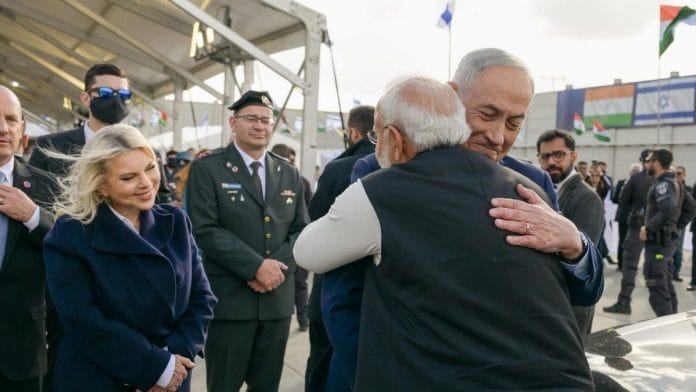



Prime Minister Narendra Modi’s visit to Israel this week marks what is arguably one of the most consequential strategic shifts in Indian Middle East policy over the past decade. If there is one lasting legacy of the Modi era in the region, it will be the mainstreaming of Israel in India’s security discourse in a manner no previous government has attempted. India’s traditional balanced anchoring in Palestine and its civilisational moorings with Iran have not entirely disappeared, but they have been decisively overshadowed by an unapologetic embrace of Israel as a special strategic partner.
The India-Israel joint statement speaks of a partnership ready to “go together into the future,” expanding beyond its already robust defence cooperation into cybersecurity, trade, investment, innovation, and connectivity. Beneath the diplomatic language sits a more profound political and psychological shift.
Israel has captured India’s strategic imagination not merely because of shared interests, but because of its hyper-securitised statism: a nation perpetually at war, battling Islamic radicalism in a hostile region, excelling in both overt and covert security capabilities, and showcasing technological and military superiority despite contextual vulnerabilities. For many within India’s strategic community, this image resonates deeply, even aspirationally.
At present, the India-Israel partnership remains anchored in defence. However, four broader factors will shape the trajectory of this relationship from the near to the long term. Failure to anticipate these possible unintended consequences now may complicate its future direction.
Also Read: India has to do the Israel-Iran-Arab world balancing act. Stay away from Shia-Sunni rivalry
First, Bibi’s domestic political calculus
Israel is heading toward parliamentary elections in 2026. While technically due in early November, Prime Minister Benjamin Netanyahu may hold them much earlier. Until last year, the rationale was for Bibi to capitalise on diplomatic gains — particularly if normalisation with Saudi Arabia or Indonesia had materialised. Such normalisation appeared plausible, partly due to the momentum of the Abraham Accords. But Israel’s relentless military campaign in Gaza and its pro-Emirati positioning amid the growing rift between Abu Dhabi and Riyadh have complicated those prospects.
Saudi Arabia now likely perceives greater risks than opportunities in openly normalising ties with Israel, especially as public sentiment across the Arab world has hardened against Israel’s endless wars. Indonesia, under President Prabowo Subianto’s more pragmatic leadership, may be more flexible, yet Jakarta remains wary of Israel’s reluctance to take concrete steps toward recognising a Palestinian state — basically underscoring why normalisation with these two largest Muslim states is no longer on the cards before Bibi enters election.
Meanwhile, several European capitals have adopted an increasingly stringent view of Israel’s conduct in Gaza, citing the humanitarian tragedy. Bibi understands the regional risks of being isolated globally or regionally, and is nevertheless driven to continue the wars he began after Hamas’ brutal attack in October 2023. He has struck targets in Syria, Lebanon, Iraq, and Iran, projecting brute strength after the devastating assault shattered his security credentials.
In this context, Modi’s high-profile embrace carries political value for Netanyahu. When the leader of the world’s largest democracy and fourth-largest economy stands alongside him, it undercuts the narrative that Israel is alone on the world stage. It helps Netanyahu project global legitimacy at a time when he needs it most.
From India’s perspective, a corollary therein stems from Israel’s convergence with the UAE, which itself is relatively isolated within Gulf politics today due to its deepening rivalry with Saudi Arabia. And yet Abu Dhabi remains strategically influential through its expansive network across the Middle East, North Africa, and the Sahel, while also being a key partner to India. Abu Dhabi’s network-centric geopolitics — engaging rivals and allies alike without rigid red lines — has enhanced its strategic depth even amid intensified frictions with Riyadh.
On the surface, New Delhi, Tel Aviv, and Abu Dhabi appear to be on the same side of the geopolitical equation, but closer scrutiny reveals inconsistencies in that argument — something I will return to now.
Second, limits of Israel’s securitised, macho strategy
Since Netanyahu’s return to power in 2009, the right-wing Likud party, rooted in Vladimir Jabotinsky’s revisionist Zionism and the idea of Greater Israel, has dominated Israeli politics. Its worldview prioritises security, expansion, and wars until Israel reaches the borders it envisions — think the West Bank, the Golan Heights, and the Sinai Peninsula.
Despite appealing to India’s security capability aspirations, India’s geopolitical environment differs significantly. India is not a small state in a compact, militarised theatre; it is a continental power with sprawling economic, demographic, and diplomatic equities across regions.
An overly securitised framing of the partnership risks narrowing its potential. India’s stakes in the wider Middle Eastern region include millions in its diaspora, energy security, remittance flows, connectivity corridors, and trade and investment. Deeper engagement with Israel’s hard-edged posture cannot be reconciled with India’s scale, complexity, and interests, and would be strategically short-sighted.
Before I come to what India’s Middle East strategy should entail, I will stress that New Delhi must acknowledge the changing nature of regional geopolitics that very much carry potentially unintended consequences.
Third, the changing nature of Middle Eastern geopolitics
The region’s power distribution has shifted dramatically. Iran has been systematically weakened since the Hamas attacks and the subsequent military campaigns by Israel against its proxies and the regime itself. Assad’s fall in Syria has manifested zones of Turkish and Israeli influence in the north and south of the country.
A new Sunni axis is emerging, with Turkey’s rising profile intersecting with Saudi Arabia, Qatar, and even Bahrain. The Palestinian question — once consciously sidelined during the first Trump-era normalisation — has returned to the forefront.
Less discussed, however, is the evolving equation between Israel and the UAE, vis-à-vis the deepening rift between Abu Dhabi and Riyadh. The Emirati-Saudi collision course is no minor matter and is unlikely to dissipate anytime soon. For decades, the Gulf Cooperation Council’s internal balance provided predictability. Today, dirty wars between proxies and a contest for regional influence has manifested unprecedented tensions—starting from Yemen and now simmering in Sudan and Somaliland.
Abu Dhabi’s approach to Iran, a tense geopolitical flashpoint today, could be illustrative. Unlike Riyadh, which invested heavily in Chinese-backed normalisation with Tehran, and unlike Israel, which seeks a weakened Iran, the UAE hedges. It has invested in multiple channels — offering logistical space for Israeli operations against Iran while also allowing elements of the Islamic Revolutionary Guard Corps to park assets and move funds through Emirati financial networks. This model of engagement seeks to position the UAE to capture commercial space likely to open if the regime falls. Emiratis see value in engaging the highly skilled Iranian workforce — something that Israelis would be very wary to accept.
As Middle East scholar Andreas Krieg has described, the UAE champions this “weaponized interdependence”: playing all sides, preparing for multiple scenarios, and positioning itself to capture commercial opportunities in a post-sanctions or post-regime Iran.
For Israel, however, a strengthened post-regime Iran, regardless of its form, would be suboptimal. Israeli strategy prefers a weakened Iran constrained from projecting future ideological hostility.
For other Arab states, an unstable and hollowed-out Iran risks spillover across borders, sectarian unrest, and disruption. Containing problems within Iran’s vast geography is preferable to regional contagion.
India’s position is distinct. New Delhi has longstanding trade, connectivity, and infrastructure interests tied to Iran. It would prefer gradual, managed transition over a potential regime collapse and regional upheaval. India also has deep stakes in Saudi Arabia, the UAE, Qatar, and beyond.
It benefits most when Gulf capitals operate within complex interdependence rather than zero-sum rivalry. This remains true even after security deepening between Pakistan and Saudi Arabia.
The question to ask is whether India is prepared for the implications of regional upheavals in the Middle East and to take sides. Probably not. Indian interests — energy imports, diaspora, infrastructure investments, and financial flows — are spread across all major Gulf capitals. While tilting toward obvious and visible synergies, India has the least interest in being drawn into the pitfalls of weaponised interdependence among Gulf rivals. India would prefer engaging each at varying strategic depths.
Also Read: Don’t frame Modi-Israel as ‘this hurts Indian Muslims.’ We don’t mix faith & foreign policy
Fourth, potential for genuine transformation
If there is one construct that evades a deeper understanding of Gulf geopolitics, it is binaries.
Over the longer term, even beyond the Netanyahu era, a deeper and more mature partnership with India could open avenues for Israel to expand and rebalance its strategic profile. Such engagement may encourage the development of underutilised domains, including its potential as an energy hub, a partner in infrastructure development, and a facilitator of regional connectivity — the rationale that gave birth to IMEC.
India, for its part, should seek to leverage its policy of multi-alignment in the region to cultivate the structural conditions necessary for such a transformation, rather than tilting too much toward sides with their own internal tensions.
Swasti Rao is a Consulting Editor (International and Strategic Affairs) at ThePrint. She tweets @swasrao. Views are personal.
(Edited by Asavari Singh)
One statistic matters a lot. India has Five hundred times as many guest workers in Muslim countries in West Asia as it does in Israel. Sent after 7th October. Israel cannot rival those countries as a source of oil and natural gas for India. Or as an export market for India, barely a couple of billion dollars. Viewed objectively, Israel is a very small part of Indian equities in the Middle East. 2. India is diversifying arms purchases away from Russia. France and Israel, USA are emerging as alternatives. Nothing so special about Israel that it needs to be placed on a pedestal. Sweet talk aside, buyers are spoils for choice in the arms bazaar. 3. No longer the land of Mahatma Gandhi, true. But post Gaza, a sense of discretion in engaging too visibly with Israel would be prudent. That would have a bearing on BRICS and SCO as well.
A more nuanced analysis than this publication typically offers. The regional risk mapping around Gulf rivalries and Iran’s uncertain future is genuinely useful. But a few fundamentals seem to have been overlooked.
Bharat was not dragged into the US-Pak-Afghan quagmire after 9/11. It was not dragged into Russia-Ukraine. It has consistently maintained a peace-seeking posture while major powers played their games around it. This institutional wisdom didn’t develop accidentally — it was earned over 75 years of sophisticated navigation. So the implicit assumption that Bharat might suddenly lose this compass while deepening ties with Israel deserves some scrutiny.
The author also sidesteps a question of reciprocity that matters enormously. During Kargil, Israel delivered — weapons, intelligence, no hesitation. The Gulf states the author worries about Bharat alienating? Considerably less helpful when it actually counted. Strategic partnerships are built on such moments, not just on shared commercial interests.
On Palestine, Bharat has given far more than it has received — decades of aid, diplomatic solidarity, and vocal support. Their reciprocity on Kashmir for Bharat has been either Zero or underwhelming at best. This asymmetry deserves acknowledgment when weighing how much India owes to that relationship versus its relationship with Israel.
The multi-alignment concern is also somewhat misplaced. Bharat was practicing multi-alignment long before it became fashionable — buying Soviet weapons while engaging Washington, cultivating Iran while building Gulf partnerships. Non-Alignment was always the label; multi-alignment was always the operational reality.
The author’s caution is not wrong. But a nation that has navigated 75 years of great power rivalries without being consumed by them has more than earned the benefit of the doubt