





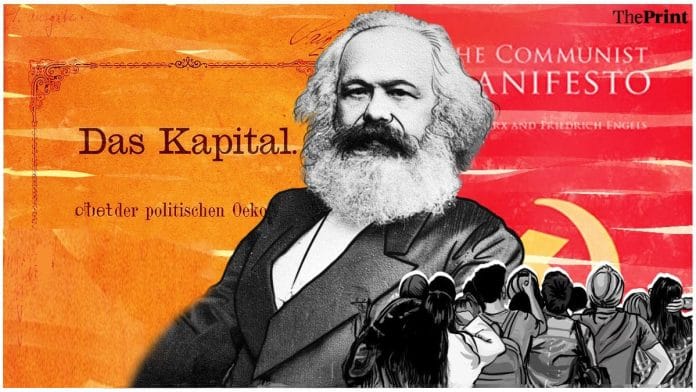



It has been the misfortune of humanity that it was the violent, class-war doctrines of Karl Marx that got crystallised as the authentic form of socialism and the sole scientific system and saviour of labour throughout the world. The adherence of Lenin and the Russian revolutionaries and that of the German social democrats under Lassalle contributed to enhance Marxist communism in this dominant position. The Russian Revolution of 1917 and its triumphant career to its present position of World Power challenged the whole free world has added hypnotic power to this collectivist, conspiratorial, violent form of communism.
Communism has today become the climate of thought in most countries. Even where a small part of the intelligentsia is free from the prevailing views, they are influenced all the same to a more or less extent, so that the cause of freedom is put on its defence. It is not State aggrandisement that has to explain and justify itself but on the other hand the claims of human liberty and individuality!
The capitalist Robert Owen fell in with the French socialists and initiated workers’ communes or settlements in England, Scotland and even the United States in the early decades of the last century. An American thinker called Josiah Warren joined Owen’s socialistic settlement and was inspired to start his own village settlements on a more individualist basis. He developed a time and labour theory of value in his own way. In Karl Marx’s hands, the theory was distorted to become the surplus theory of value in order to support the thesis that all capital is robbery of the value created by labour. In Warren’s hands, it became the foundation of a new equalitarian individualism which asserted the right of each individual to the proceeds of his labour as measured by the time taken in producing the product of industry. Measurement of labour contributions became a subtle and vexatious calculation and source of trouble among members of settlements.
His example inspired a line of thinkers to reflect on the social aspects of individual liberty. Stephen Pearl Andrews developed the outlines of a science of society. Others developed the aspects of cooperation and mutual aid in banking and other forms of economic production and exchange. Others specialised in problems of currency and inflation. Others investigated the effects of State interference in banking, currency and economy generally. These thinkers of the libertarian school in America developed reflection both into the role of property, its meaning, function and limitations and into the role of the State in social affairs and individual life.
The general line of thought in regard to both aspects was to discover the degree of waste and frustration and complication involved in anti-social uses of property such as are indulged in by monopolies and cartels by the State outrunning its legitimate field of police and justice and by welfare policies of robbing Ram to pay Kishen. These excesses of the individual and the State lead to ever rising costs of production, to excessive pressure of economic groups on the State to get something for nothing, to rising inflation and confusion of values all round and to the collapse of confidence in currency and economic production generally and to the emergence of unnecessary economic crises with over- or under-production and unemployment.
The remedy is to return to individualist economy regulated by provisions against monopolies to safeguard the equal liberty of all. This principle of the equal liberty of all for engaging in free enterprise within the law (to exclude fraud and the annexation of unearned profits) is sufficient, say the libertarians, to justify the imposition of checks on those who take undue advantage of the freedom granted.
If these principles are intelligently followed, it is urged, the State and society will be freed from this excessive burdens from which they are suffering at present under the influence of collectivist ideas. They will be free from much of the present load of public debt. The State will be compelled by individualist citizens to live within its means and not to create artificial money by issue of loans and not to burden the present generation by ever-rising loads of interest on public debt. Though the principal is supposed to be paid by future generations, as a matter of fact it is the present generation that has to pay heavy interest. These interest payments to one class of citizens namely bond-holders will distort the economy by conferring on them more purchasing power than on the rest of the community. This distorts the economy in favour of unearned incomes annexing too much of the capital resources of the community towards the satisfaction of a few, leaving the demands of the vast majority starved and unfulfilled or under-fulfilled.
The central stream of thought in advanced democratic countries like the U.S.A. is that of liberal democracy formulated in the early and middle periods of the nineteenth century. Today technological industry, the growth of population and the advance of communication media-radio, newspapers, wireless, aeroplane for passenger and goods traffic etc. have all conspired to confer more and more powers on the State to regulate the myriads of new inter-relations among citizens. Organisation has tended to become ever more complex and interwoven. Hence the feeling of inevitability in regard to the growing tendency towards collectivism and the expansion of State power.
Collectivism has become the illusion of the epoch today in which the rights and duties of the individual citizen as a self-determining and self-realising person are lost to view. Individuals and small groups feel lost in the vast agglomerations of large nation-States. Even small States feel a prey to massive influences and pressures impinging into their life from outside.
The wheel has come full circle. The individualist philosophy of John Stuart Mill and his followers which guided liberal democracy is today eclipsed by the dominant collectivism of Karl Marx, particularly in respect of economy. Adam Smith and Mill are both put into the shade. They have become “Gods that failed.”
But today doubts and misgivings are being felt in many quarters that we have embraced a remedy worse than the disease. After all, the only known reality is human life is the individual centre of experience, of thought, feeling, action and fellowship-individual men and women.
Sociologists are formulating theories of the right relationship between primary and secondary groups. The former like the home, neighbourhood and religious or educational fellowship are primary in moulding human life. They deal with individuals as full-rounded persons and not as fragments-hands or members or customers or wage earners or employers or officers or rank and file anonymous common men. Secondary associations like occupations, amusements or casual groups as in hotels and railway carriages are necessary but if they crowd out much of the scene and activity of life, man is atomised and impoverished. Neuroses come to prevail. Suicides, mental aberrations, juvenile delinquents, divorce proceedings, prostitution, gambling, alcoholism, corruption in economic and political life-will all make themselves felt in disturbing degrees.
Libertarians call for a greater simplification of institutions, a reform in the use of property and a return to the limited role of the State in social life so that the submerged individual may be released for a new career of purposeful, healthy activity in which science and the other achievements of the modern spirit may be used more wholesomely to help men and women to fulfil themselves in pursuits within their reach and power of assimilation.
The libertarians call for a new relationship to land, so that unearned income may not accumulate in hands that do not contribute to production. Since land is limited unlike other forms of industrial or commercial property, it needs to be kept in the hands of people who actually use it for production, eliminating functionless or parasitic holders.
The libertarians are also interested in education. They are exploring the avenues whereby the individual may be led through self-directed thought and investigation to discover the right relations between individual and society. The new aim is to strengthen dispositions of cooperation and individual self-reliance during the process of learning. It is also necessary to destroy the roots of class antagonism by imparting the joys and skills of using tools so that the ancient class distinction of workers and lords may disappear in the minds of men and women. Work and culture should be integrated.
Freedom in economic and political life has to be supported by a new psychology of cooperative and creative living, fostered in creative education inspired by a vision of human unity and human progress in free and joyous fellowship.
This essay is part of a series from the Indian Liberals archive, a project of the Centre for Civil Society. This essay is excerpted from the journal “The Indian Libertarian”, published on 1 October 1958. The original version can be accessed here.