






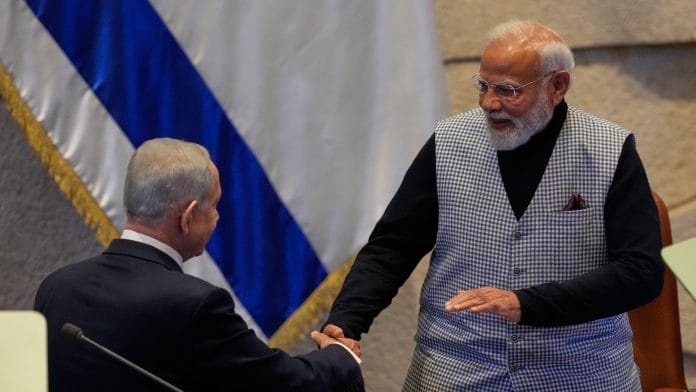



Prime Minister Narendra Modi’s second official visit to Israel is happening at a crucial juncture when the Middle East and West Asian geopolitics is witnessing massive changes.
Modi’s first visit to Israel in July 2017, the first by any Indian PM since Independence, laid a strong foundation for an enduring friendship between the two countries. Israeli PM Benjamin Netanyahu and Modi affirmed their intention to build a broad-based relationship. Nine years later, this latest visit promises to strengthen the ties to a special strategic partnership and upgrade economic and defence cooperation, elevating the bilateral relationship.
As key defence partners, both countries are expected to deepen ties beyond previously agreed terms. Cooperation is likely to expand into joint defence development, including advanced systems in air and missile defence and AI-enabled capabilities, technology and intelligence sharing. These efforts will also perk up indigenous defence production under the Make in India programme. Intelligence sharing and technology upgradation are major components, not only of defence but also of counter-terrorism operations.
Barely three days before PM Modi left for Israel, India announced the National Counter-Terrorism Policy and Strategy codenamed PRAHAAR. It outlines domestic actions, coupled with international and regional cooperation, which will be key elements in addressing the transnational terrorism challenge.
A day before the visit, the 10th meeting of the India-Israel Joint Working Group (JWG) on Counter Terrorism was held in Delhi. Both sides unequivocally and strongly condemned terrorism in all its forms and manifestations, including cross-border terrorism and reaffirmed the principle of zero tolerance toward terrorism.
It is not a coincidence that Modi assured Netanyahu that India stands committed to support and form a cooperative framework with Israel in all its counter-terrorism initiatives. Afterall, both India and Israel have been victims of terrorism for a long time, which has deeply affected domestic economic growth and international trade prospects.
The Israel model
Both countries have ambitious national, regional and international trade projects and economic connectivity schemes. The India–Middle East–Europe Economic Corridor (IMEC) aims to bolster economic development by fostering connectivity and economic integration between Asia, the Persian Gulf, and Europe. It is an initiative that seeks to reshape global trade, connectivity, and cooperation across three continents. Israel, by virtue of its strategic geography and economic heft, will be an integral part of this project.
With a view to supporting IMEC and regional trade, supply and value chain efforts, Israel has proposed the Hexagon Alliance. It should be seen as part of the larger IMEC corridor, which together will strengthen trade and provide strong security architecture.
Israel, one of the largest economies in the Middle East, is estimated to be the 25th-largest economy, compared to India, the fourth-largest economy in the world. But Israel’s socio-economic and industry-infrastructure capabilities are far ahead of those of India.
It has a readily deployable, powerful and modern, and technologically advanced military, with the second largest number of startups after the US. India needs to do serious research and introspection to understand the nuances of Israel’s developmental model. It is a country with approximately 55 to 60 per cent of land area as desert, primarily consisting of the arid and semi-arid Negev in the south, including the Arava valley and the Judaean Wilderness, stretching from below Be’er Sheva to Eilat and covering most of the national landmass.
Today, Israel is a global leader in agricultural innovation and technology, known for extreme efficiency, boasting the highest cow milk productivity per cow and record-setting crop yields. One of the reasons for this, besides hard work, research and innovations, is that Israel considered agriculture as part of their security architecture.
The Ministry of Agriculture and Rural Development (MARD) was renamed as the Ministry of Agriculture and Food Security (MOAG). In 2017, India and Israel agreed to establish a “Strategic Partnership in Water and Agriculture”. Focus is on water conservation, waste-water treatment, and its reuse for agriculture, desalination, water utility reforms, and the cleaning of the Ganges and other rivers using advanced water technologies. Ideally, India should have been the world leader in agriculture, water conservation and other related technologies. A joint statement on the visit might reveal all the details of the partnership.
Also read: Op Sindoor shifted something in Pakistani nuclear command structure. It puts the region in danger
Balancing Israel, Iran, Arab world
Needless to say, what the joint statement will not reveal is the domestic situation in Israel, which will hold its election in October 2026. Especially at a time when the country is deeply divided internally and under mounting pressure from the international community, making the results potentially decisive for the country’s political future, its approach to Gaza and the West Bank, and how it navigates its standing on the world stage.
Creating a regional forum to tackle Shia Iran, Sunni neighbourhoods, terror outfits like Hamas, Hezbollah and Houthis, the Arab world and an unpredictable Trump, is of utmost necessity for Netanyahu to win the forthcoming election. And this is where Netanyahu probably requires India more than India requires Israel at this time.
India has a very good relationship with Israel as well as with Iran. In recent times, India has also significantly increased its economic and strategic engagements with the Arab countries. India is also a strong supporter of the Palestinian cause and has been advocating a negotiated settlement for the issue.
Modi has to do a very great balancing act. New Delhi will have to maintain defence and economic partnership with Israel, continue the existing infrastructure projects like the Chabahar in Iran, deepen good relations with Arab countries and ensure the safety of Indians working in the Middle East region.
India should avoid becoming a party to the Shia-Sunni rivalry, which is peculiar to this region. Hence, the visit of PM Modi at this juncture is highly significant, but there are challenges that India will successfully resolve.
Seshadri Chari is the former editor of ‘Organiser’. He tweets @seshadrichari. Views are personal.
(Edited by Ratan Priya)