






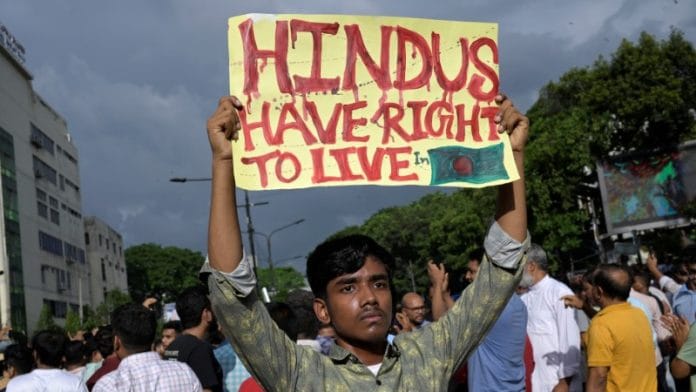



Bangladesh entered one of the gravest passages of its post-Liberation history on 5 August 2024. The unlawful removal of Prime Minister Sheikh Hasina and the installation of Muhammad Yunus’s unelected, externally engineered administration on 8 August 2024 ruptured constitutional order and corroded the ethical bond between state and citizen. That rupture has been felt most acutely by the Hindu community, whose suffering since then has been persistent, patterned, and widely disregarded.
For more than sixteen months, Hindu families across the country have lived under an unspoken siege. Homes have been vandalised, temples desecrated, livelihoods disrupted, and lives terrorised through intimidation and targeted violence. These are not isolated acts of disorder; they reveal a consistent logic of persecution enabled by official inertia. When authority remains silent, silence becomes complicity, and neglect hardens into practice.
The Yunus-installed marionette regime, lacking an electoral mandate and constitutional legitimacy, has displayed a disturbing indifference to repeated pleas for protection. Responses have ranged from procedural deflection to outright denial. In a republic founded upon equality, secularism, and human dignity, such disregard constitutes not merely administrative failure but a betrayal of the Republic’s animating ideals.
This vacuum of accountability has emboldened extremist fundamentalist networks, including the horrific Jamaat-e-Islami, Islami Chhatra Shibir, and their rebranded affiliates. Operating under shifting labels, these actors have advanced a politics of exclusion through intimidation and fear. Their objective is evident: To erode pluralism and recast Bangladesh as a homogenised theocracy, in which minorities survive by sufferance rather than by right.
Also read: Bangladeshi Hindus have nowhere to go in the election. Choice is between fear and fear
A national emergency
The tragedy is sharpened by historical irony. Hindus are not peripheral to Bangladesh; they are co-authors of its making. Alongside Muslims, Buddhists, Christians, and indigenous communities, they fought in the Liberation War of 1971. With decisive support from neighbouring India, the nation emerged as a secular, humane, and inclusive state. To subject a founding community to dispossession today is to repudiate the sacrifices that consecrated independence.
Contemporary Bangladesh is descending into a sombre darkness where fear circulates, and justice falters. Institutions charged with safeguarding pluralism seem paralysed or politicised. Law enforcement averts its gaze; administrators hesitate; the ruling dispensation prioritises external patronage over civic protection. Such conditions corrode trust and normalise impunity.
Yet despair cannot be destiny. Bangladesh’s history affirms a recurring capacity to overcome fear through civic courage. The persecution of Hindus is not a sectional concern; it is a national emergency. When one community is targeted, the Republic itself is wounded, and silence today invites wider despotism tomorrow.
Recovery requires the reclamation of conscience. Civil society, scholars, journalists, and citizens must speak with moral clarity and persistence. Fear must be unlearned. The spirit of 1971—secular, inclusive, and resistant to oppression—must be renewed as practice, not preserved as nostalgia. Bangladesh did not rise from genocide and ruin to become a theatre for extremism or a laboratory for foreign manipulation; it was born to secure dignity for all.
The suffering of Hindu citizens stains the nation’s collective honour. Erasure of that stain demands resistance to apathy, rejection of extremism, and restoration of constitutional legitimacy and ethical governance. Only then can Bangladesh emerge from the shadow into fidelity with its history and promise.
As these words are written, grief overwhelms me. Friends bound by shared struggle now depart their homeland quietly, bearing broken hopes. The pain deepens because, in 1971, we stood together in battle against the Pakistani army and its local collaborators, including Jamaat-e-Islami and Al-Badr. A fellow freedom fighter, Babul Sarkar, gave his life so that Bangladesh might be free; his sacrifice, and that of countless others, sanctified this soil.
Today, the ideological heirs of those forces, operating through multiple offshoots, have dragged the nation toward medieval shadows where fear eclipses conscience and cruelty masquerades as faith. As a frontline freedom fighter, I live under persistent threat; ordinary journeys have become trials of vigilance. This is a bitter recompense for those who once risked everything for the Republic.
International norms and treaties to which Bangladesh is a party impose clear duties of protection, investigation, and remedy. Failure to uphold these obligations risks reputational damage, economic consequences, and the erosion of the rule of law. Regional stability likewise suffers when minority persecution accelerates displacement and grievance.
A principled course, therefore, aligns morality with interest: Safeguarding minorities strengthens sovereignty, social cohesion, and democratic credibility, while reaffirming Bangladesh’s constitutional commitments before its citizens and the world. Such action honours liberation ideals and deters impunity through accountable institutions nationwide.
The hour is late, but redemption remains possible. Bangladesh’s future awaits the courage required to claim it.
Anwar A Khan is a Bangladeshi freedom fighter of 1971 and an independent political analyst based in Dhaka. He writes on politics and international affairs. Views are personal.
(Edited by Theres Sudeep)